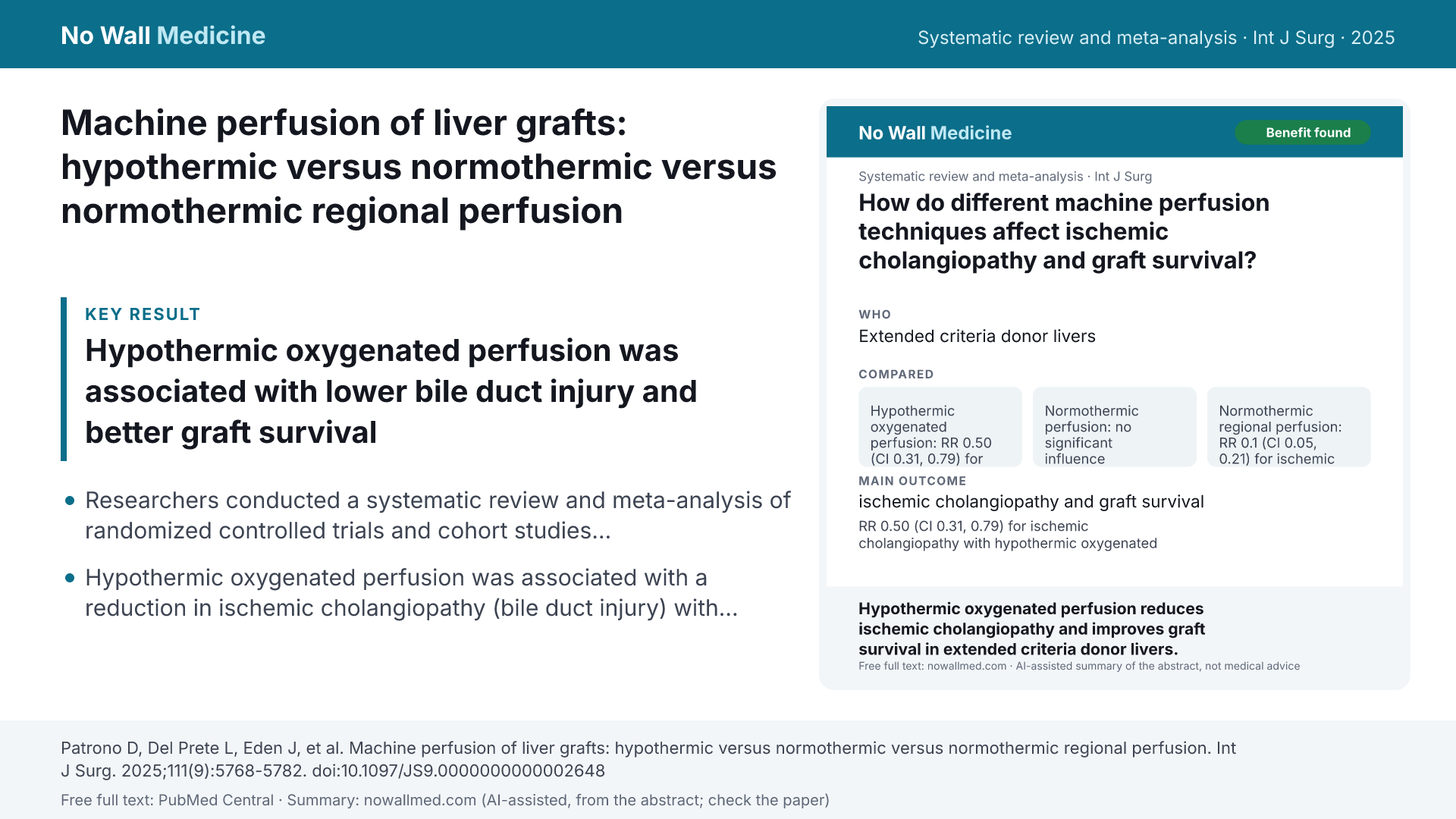
Hypothermic oxygenated perfusion was associated with lower bile duct injury and better graft survival
Machine perfusion of liver grafts: hypothermic versus normothermic versus normothermic regional perfusion
Systematic review and meta-analysisBenefit found
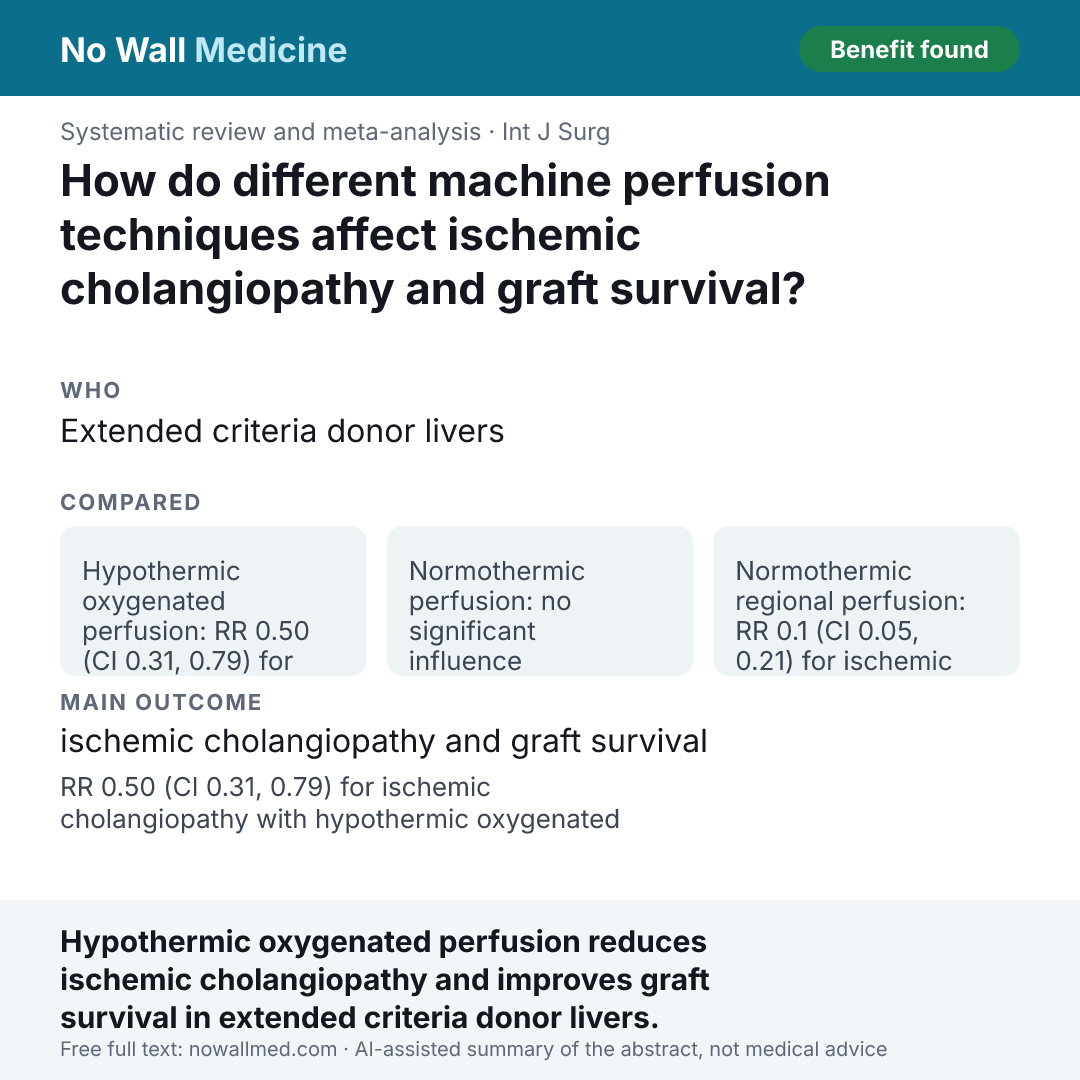
How do different machine perfusion techniques affect ischemic cholangiopathy and graft survival?
Who
Extended criteria donor livers
Compared
Hypothermic oxygenated perfusion: RR 0.50 (CI 0.31, 0.79) for ischemic cholangiopathy
Normothermic perfusion: no significant influence
Normothermic regional perfusion: RR 0.1 (CI 0.05, 0.21) for ischemic cholangiopathy
Main outcome
ischemic cholangiopathy and graft survival
Result: RR 0.50 (CI 0.31, 0.79) for ischemic cholangiopathy with hypothermic oxygenated perfusion
Bottom line: Hypothermic oxygenated perfusion reduces ischemic cholangiopathy and improves graft survival in extended criteria donor livers.
Limitation: Available literature is largely heterogeneous regarding risk profile, donor characteristics, and study designs.
Int J Surg · 2025-06-28 · Save PNG
Clinical question: How do different machine perfusion techniques affect ischemic cholangiopathy and graft survival?
Why it matters: Clinical indications remain uncertain for different machine perfusion strategies used to optimize outcomes for livers from extended criteria donors.
Key points
- Researchers conducted a systematic review and meta-analysis of randomized controlled trials and cohort studies comparing different machine perfusion techniques for livers from extended criteria donors.
- Hypothermic oxygenated perfusion was associated with a reduction in ischemic cholangiopathy (bile duct injury) with a relative risk of 0.50 and improved graft survival with a relative risk of 1.08.
- Normothermic perfusion did not significantly influence ischemic cholangiopathy or graft survival, while normothermic regional perfusion was associated with a relative risk of 0.1 for bile duct injury.
Limitation the authors note: The available literature is largely heterogeneous regarding donor risk profiles, study designs, and endpoints, which limits clear recommendations for clinical indications.
Headline and key points written with AI from the paper’s abstract, with every number checked against it. Read the paper before relying on them.
Was this summary helpful?
Subject terms
Headline, design, result, key points, caveat and citation as plain text.
Cite this article
Patrono D, Del Prete L, Eden J, et al. Machine perfusion of liver grafts: hypothermic versus normothermic versus normothermic regional perfusion. Int J Surg. 2025;111(9):5768-5782. doi:10.1097/JS9.0000000000002648
Spotted a mistake? Suggest a correction