Magnetic resonance imaging in prostate cancer screening is associated with fewer biopsies and less insignificant cancer detection
Magnetic Resonance Imaging in Prostate Cancer Screening: A Systematic Review and Meta-Analysis
Meta-analysis of 12 studiesBenefit found
Does MRI improve prostate cancer screening?
Who
80114
men at risk for prostate cancer
Compared
MRI-based screening
PSA-only screening
Main outcome
clinically significant prostate cancer detection
Result: odds ratio 1.02 (95% CI 0.75 to 1.37)
Bottom line: MRI reduces unnecessary biopsies and overdiagnosis
JAMA Oncol · 2024-04-05Download image
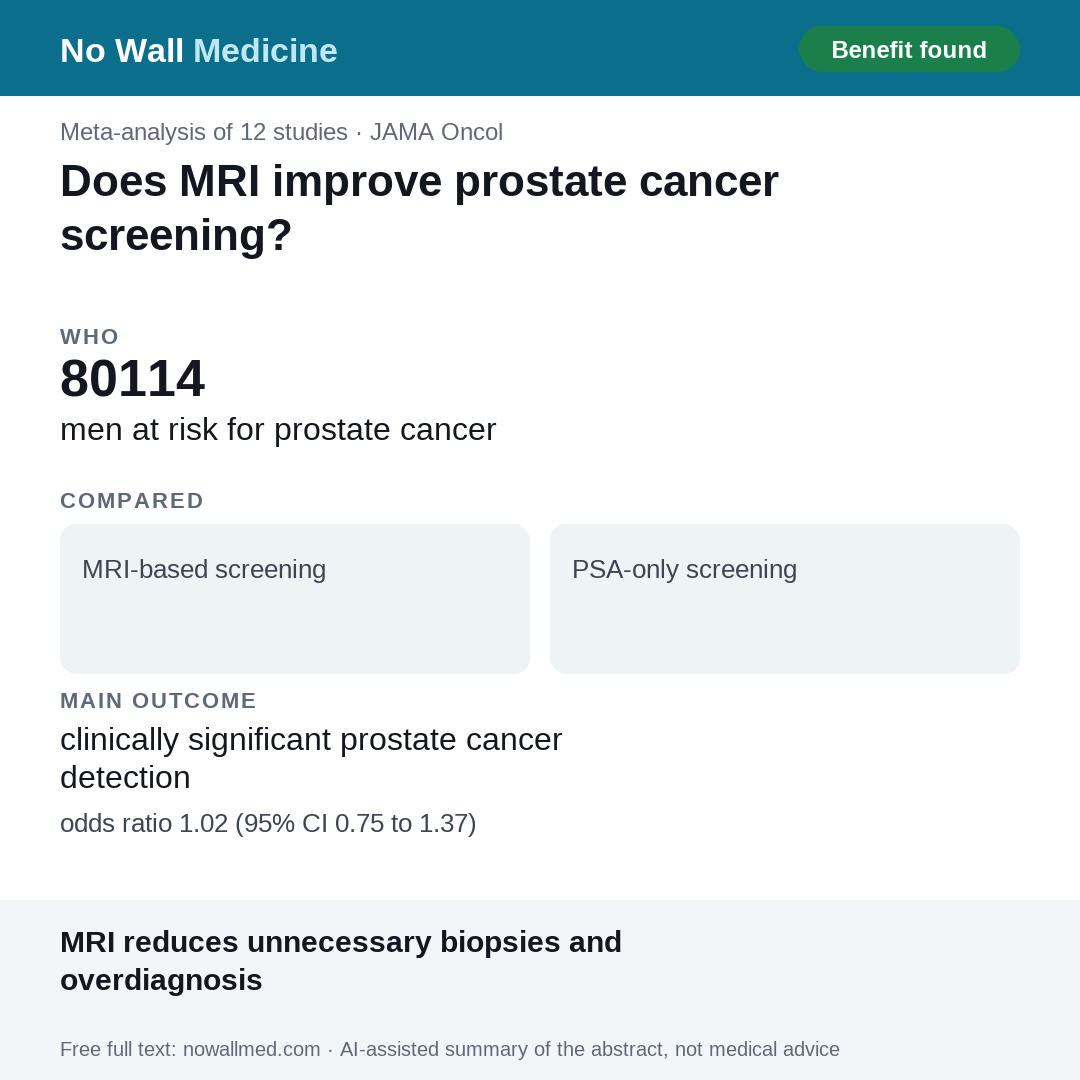
Clinical question: Does MRI improve prostate cancer screening?
Why it matters: It is unclear how integrating magnetic resonance imaging into screening pathways compares to standard prostate-specific antigen testing regarding the detection of clinically significant cancer and the rate of unnecessary biopsies.
Key points
- Researchers analyzed 12 studies involving 80,114 men to compare magnetic resonance imaging (MRI) pathways with standard prostate-specific antigen (PSA) screening.
- Using an MRI pathway with a PI-RADS score of 3 or greater for biopsy was associated with decreased odds of biopsies (OR, 0.28) and insignificant cancers (OR, 0.34).
- A PI-RADS score of 4 or greater was associated with a further reduction in biopsy odds (OR, 0.19) and insignificant cancer detection (OR, 0.23) without significant differences in clinically significant cancer detection.
Headline and key points written with AI from the paper’s abstract, with every number checked against it. Read the paper before relying on them.
Was this summary helpful?
Subject terms
Cite this article
Fazekas T, Shim SR, Basile G, Baboudjian M, Kói T, Przydacz M. Magnetic Resonance Imaging in Prostate Cancer Screening: A Systematic Review and Meta-Analysis. JAMA Oncol. 2024. doi:10.1001/jamaoncol.2024.0734
Spotted a mistake? Suggest a correction
Top studies every Monday
The week’s key trials and guidelines in your specialties, plus any topics you follow. By email, free.
Get the weekly digest