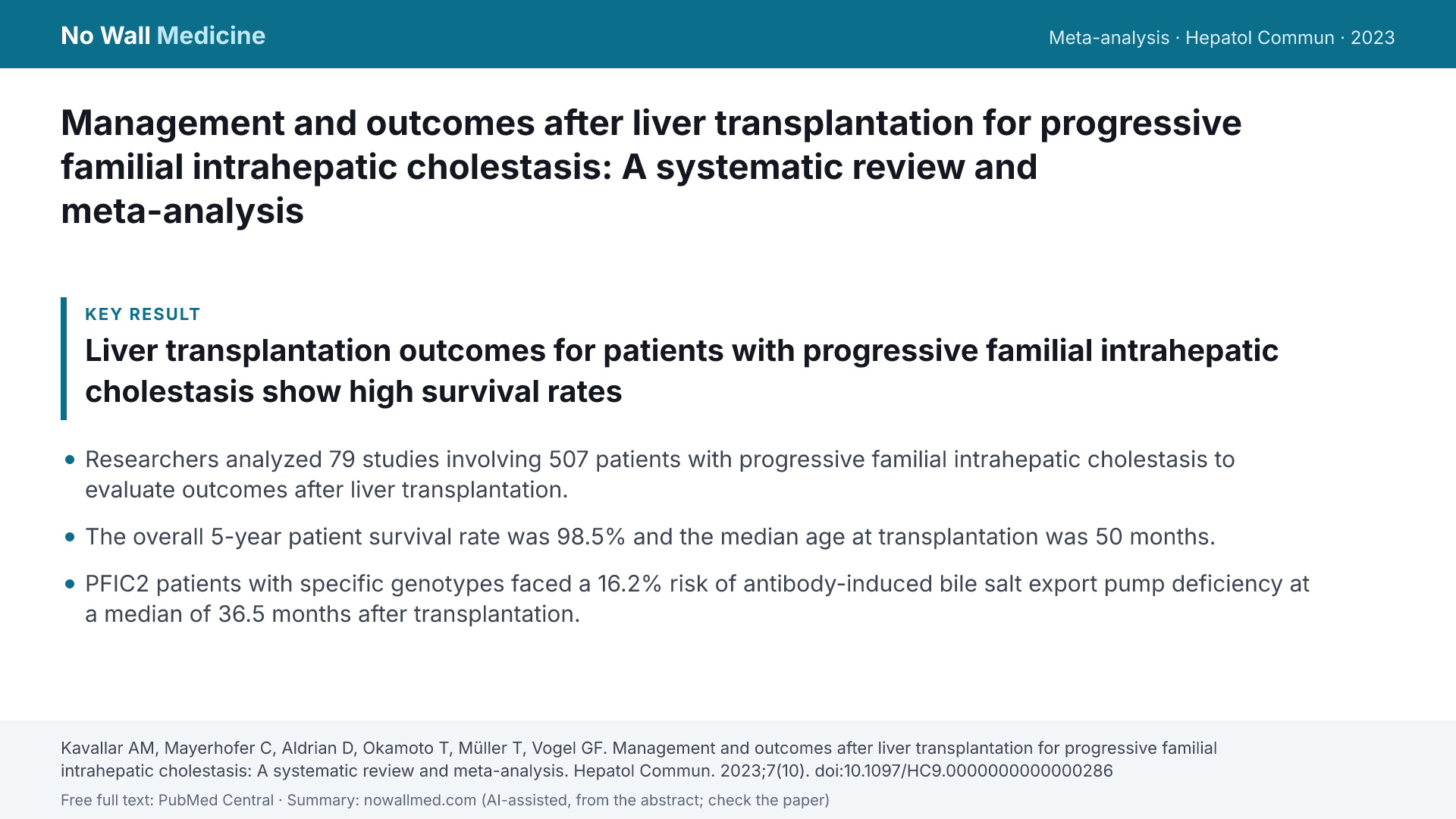
Liver transplantation outcomes for patients with progressive familial intrahepatic cholestasis show high survival rates
Management and outcomes after liver transplantation for progressive familial intrahepatic cholestasis: A systematic review and meta-analysis
Why it matters: The outcomes and specific complications for different types of progressive familial intrahepatic cholestasis following liver transplantation were not clearly described.
Key points
- Researchers analyzed 79 studies involving 507 patients with progressive familial intrahepatic cholestasis to evaluate outcomes after liver transplantation.
- The overall 5-year patient survival rate was 98.5% and the median age at transplantation was 50 months.
- PFIC2 patients with specific genotypes faced a 16.2% risk of antibody-induced bile salt export pump deficiency at a median of 36.5 months after transplantation.
Headline and key points written with AI from the paper’s abstract, with every number checked against it. Read the paper before relying on them.
Was this summary helpful?
Subject terms
Cite this article
Kavallar AM, Mayerhofer C, Aldrian D, Okamoto T, Müller T, Vogel GF. Management and outcomes after liver transplantation for progressive familial intrahepatic cholestasis: A systematic review and meta-analysis. Hepatol Commun. 2023. doi:10.1097/HC9.0000000000000286
Spotted a mistake? Suggest a correction
Top studies every Monday
The week’s key trials and guidelines in your specialties, plus any topics you follow. By email, free.
Get the weekly digest