Management and outcomes after liver transplantation for progressive familial intrahepatic cholestasis: A systematic review and meta-analysis
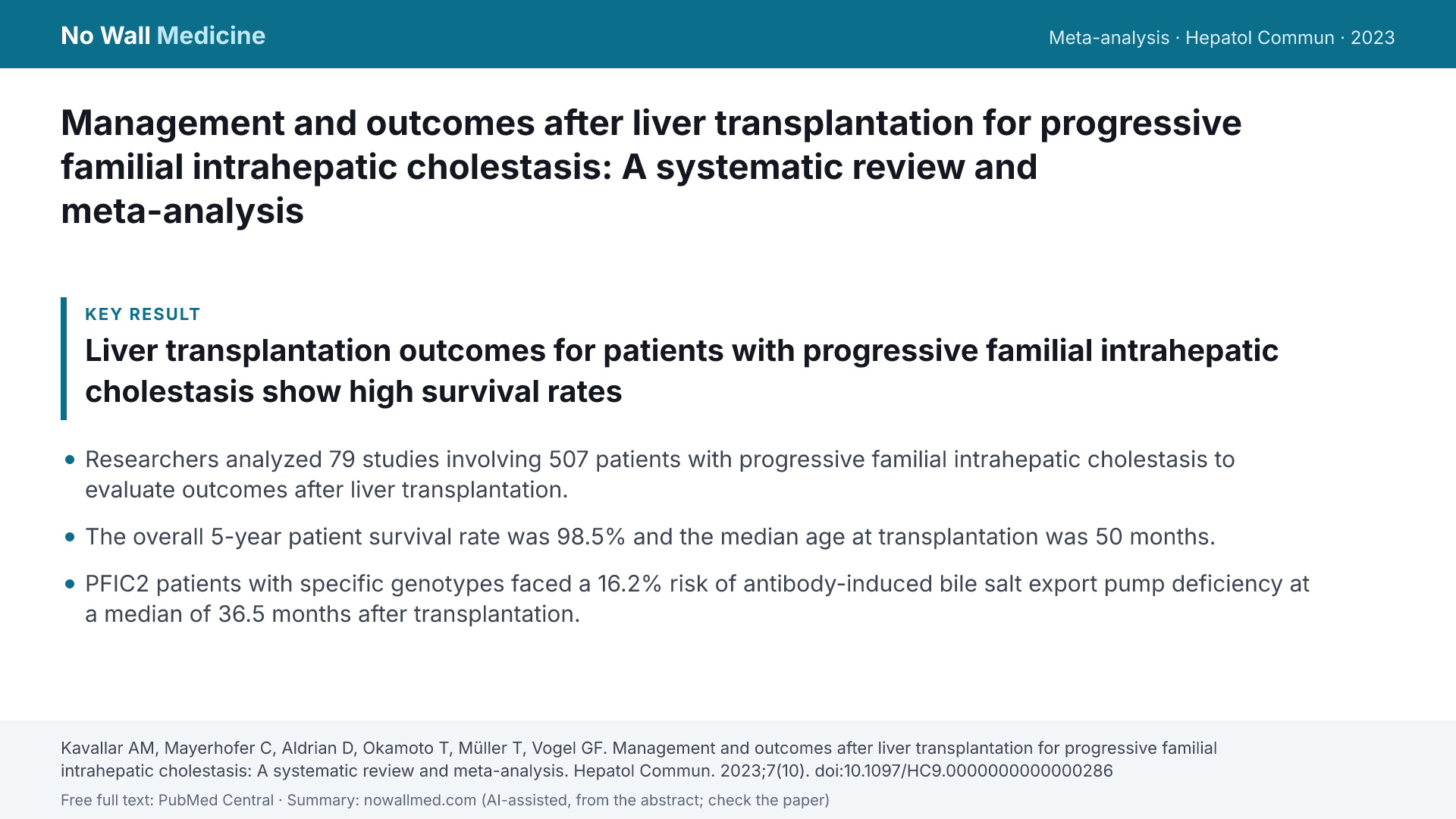
Key result: Liver transplantation outcomes for patients with progressive familial intrahepatic cholestasis show high survival rates
Key points
- Researchers analyzed 79 studies involving 507 patients with progressive familial intrahepatic cholestasis to evaluate outcomes after liver transplantation.
- The overall 5-year patient survival rate was 98.5% and the median age at transplantation was 50 months.
- PFIC2 patients with specific genotypes faced a 16.2% risk of antibody-induced bile salt export pump deficiency at a median of 36.5 months after transplantation.
Why it matters: The outcomes and specific complications for different types of progressive familial intrahepatic cholestasis following liver transplantation were not clearly described.
Discussion prompts
- Would these patients look like yours? Who was left out?
- Is the main outcome one that matters to patients?
- Is the difference large enough to change what you do?
Cite: Kavallar AM, Mayerhofer C, Aldrian D, Okamoto T, Müller T, Vogel GF. Management and outcomes after liver transplantation for progressive familial intrahepatic cholestasis: A systematic review and meta-analysis. Hepatol Commun. 2023;7(10). doi:10.1097/HC9.0000000000000286
Free full text: PubMed Central · Summary and visual abstract: nowallmed.com/a/management-and-outcomes-after-liver-transplantation-for-progressive-vw5a06/ (AI-assisted from the abstract; check the paper before relying on it).