Managing Symptom Distress: Key Factors for Patients on Adjuvant Endocrine Therapy for Breast Cancer
Randomized controlled trialMixed results
Do coping ability and self-efficacy moderate relationships between symptom distress and patient outcomes?
Who
Patients with breast cancer taking adjuvant endocrine therapy
Compared
Lower coping skills: higher symptom distress associated with worse depression and worse quality of life
Higher self-efficacy: higher symptom distress associated with worse depression, worse adherence, and less satisfaction
Main outcome
Mood, quality of life, therapy adherence, and satisfaction
Bottom line: Coping skills may buffer the effect of adjuvant endocrine therapy symptom distress on depression and quality of life.
J Pain Symptom Manage · 2023-10-09Download image
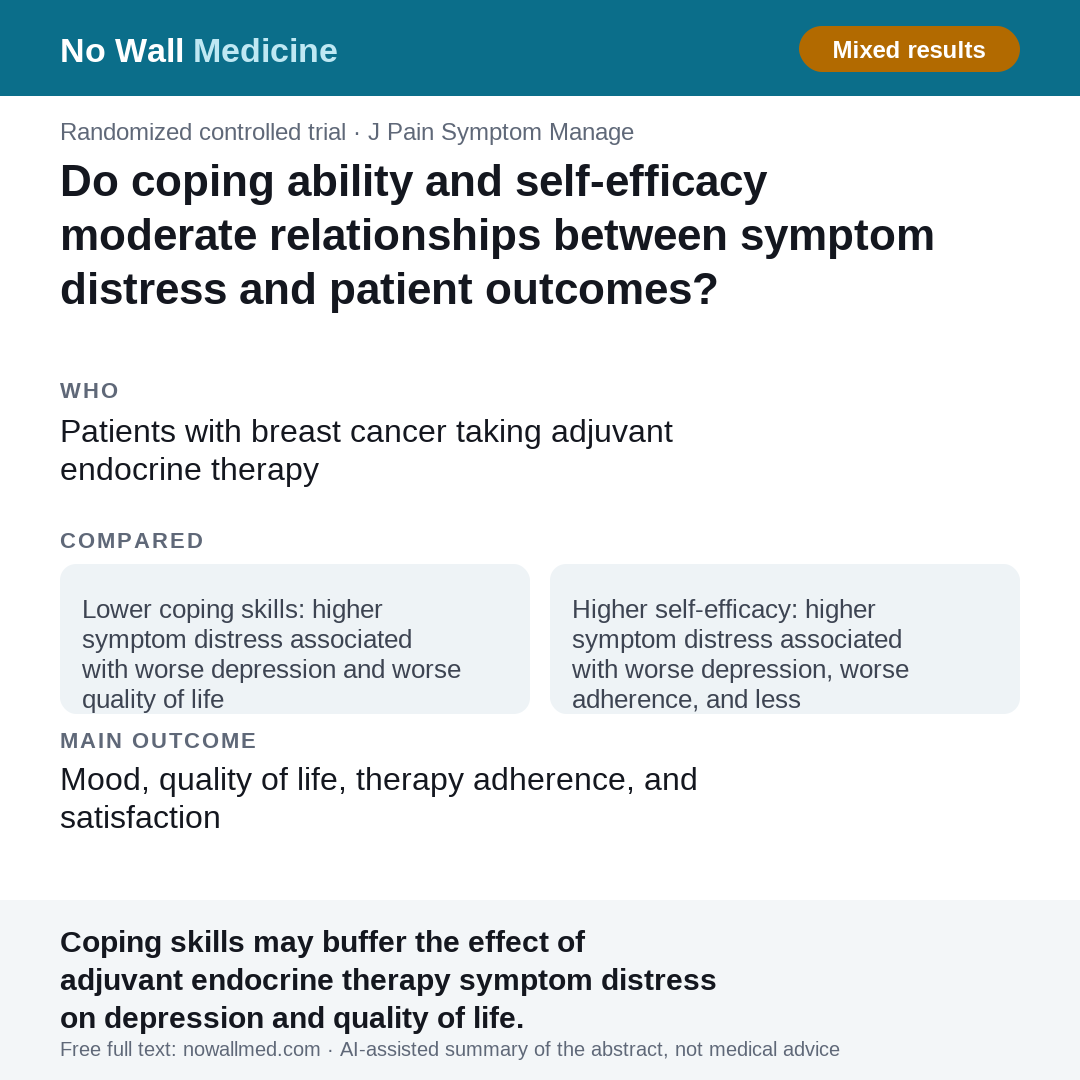
Clinical question: Do coping ability and self-efficacy moderate relationships between symptom distress and patient outcomes?
Abstract
Context
Patients with breast cancer taking adjuvant endocrine therapy (AET) experience significant symptoms impacting mood, quality of life (QOL), and AET adherence and satisfaction. Objectives
The aim of this study was to examine the extent to which coping ability and self-efficacy for symptom management moderate the relationships between patients' symptom distress and their mood, QOL, and AET adherence and satisfaction. Methods
As part of a randomized controlled trial, participants completed baseline measures including: sociodemographics, symptom distress (breast cancer prevention trial symptom checklist), coping skills (measure of current status), self-efficacy (self-efficacy for managing symptoms), anxiety and depression (hospital anxiety and depression scale), QOL (functional assessment of cancer therapy - general), AET adherence (medication adherence report scale), and AET satisfaction (cancer therapy satisfaction questionnaire). We conducted moderated regression analyses to examine whether coping and self-efficacy moderated the associations of symptom distress with baseline measures. Results
Coping skills moderated the associations of symptom distress with depression and QOL. Among those with lower coping, higher symptom distress was associated with worse depression symptoms (p=.04) and worse QOL (p < 0.001). Self-efficacy moderated the associations of symptom distress with depression symptoms and AET adherence and satisfaction. Among those with higher self-efficacy, higher symptom distress was associated with worse depression symptoms (p < 0.001), worse AET adherence (p < 0.001), and less AET satisfaction (p = 0.01). Conclusion
Coping skills may buffer the effect of AET symptom distress. Findings indicate the relationship between symptom distress and self-efficacy is more nuanced and requires further research to better understand.
Subject terms
Cite this article
Post KE, Ahmad Z, Jankauskaite G, Centracchio J, Oswald L, Horick N. Managing Symptom Distress: Key Factors for Patients on Adjuvant Endocrine Therapy for Breast Cancer. J Pain Symptom Manage. 2023. doi:10.1016/j.jpainsymman.2023.10.001
Spotted a mistake? Suggest a correction
Top studies every Monday
The week’s key trials and guidelines in your specialties, plus any topics you follow. By email, free.
Get the weekly digest