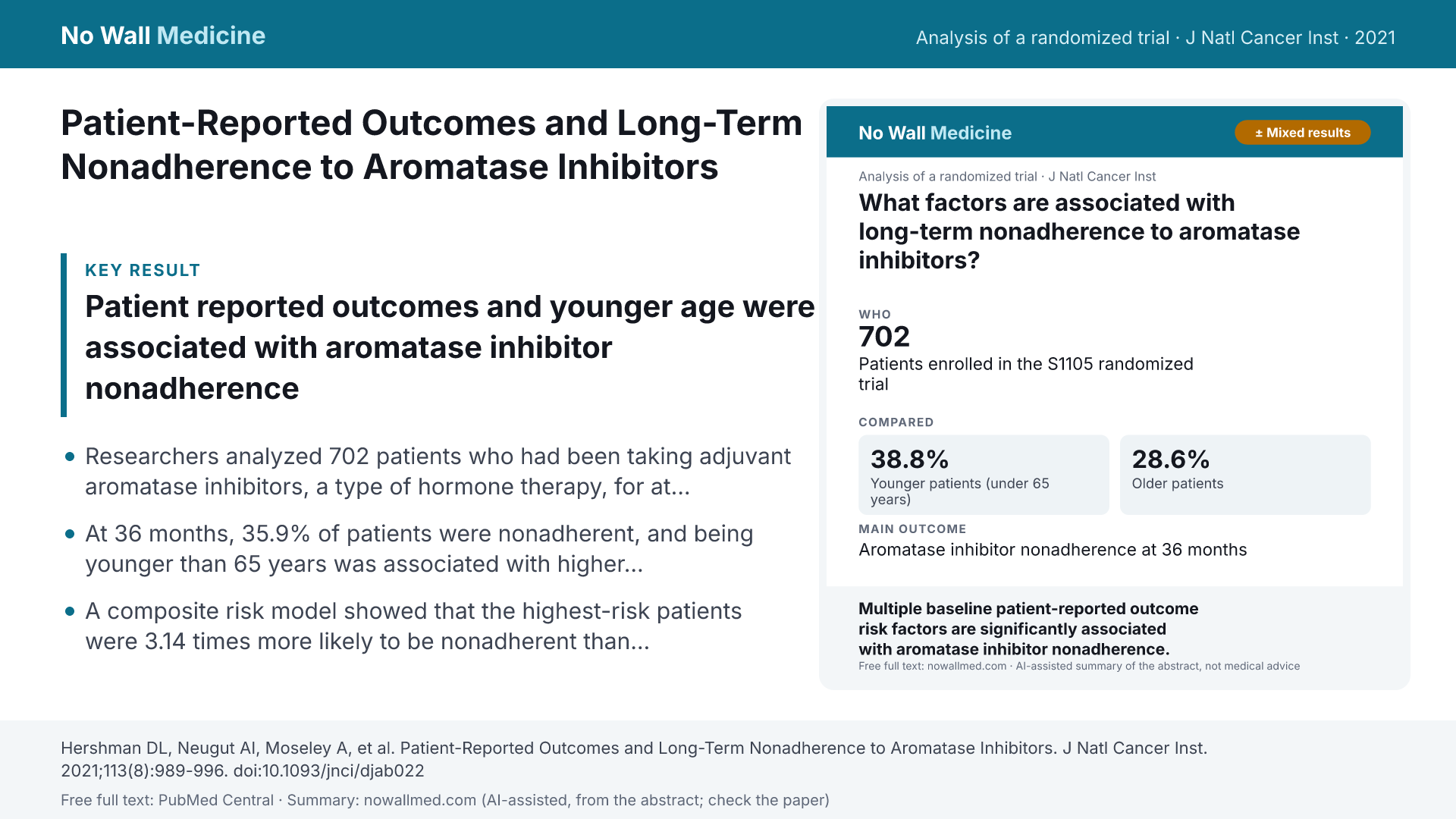
Patient reported outcomes and younger age were associated with aromatase inhibitor nonadherence
Patient-Reported Outcomes and Long-Term Nonadherence to Aromatase Inhibitors
Analysis of a randomized trialMixed results
What factors are associated with long-term nonadherence to aromatase inhibitors?
Who
702
Patients enrolled in the S1105 randomized trial
Compared
38.8%Younger patients (under 65 years)
28.6%Older patients
Main outcome
Aromatase inhibitor nonadherence at 36 months
Result: odds ratio 1.51 (95% CI 1.05 to 2.16)
Bottom line: Multiple baseline patient-reported outcome risk factors are significantly associated with aromatase inhibitor nonadherence.
J Natl Cancer Inst · 2021-02-26Download image
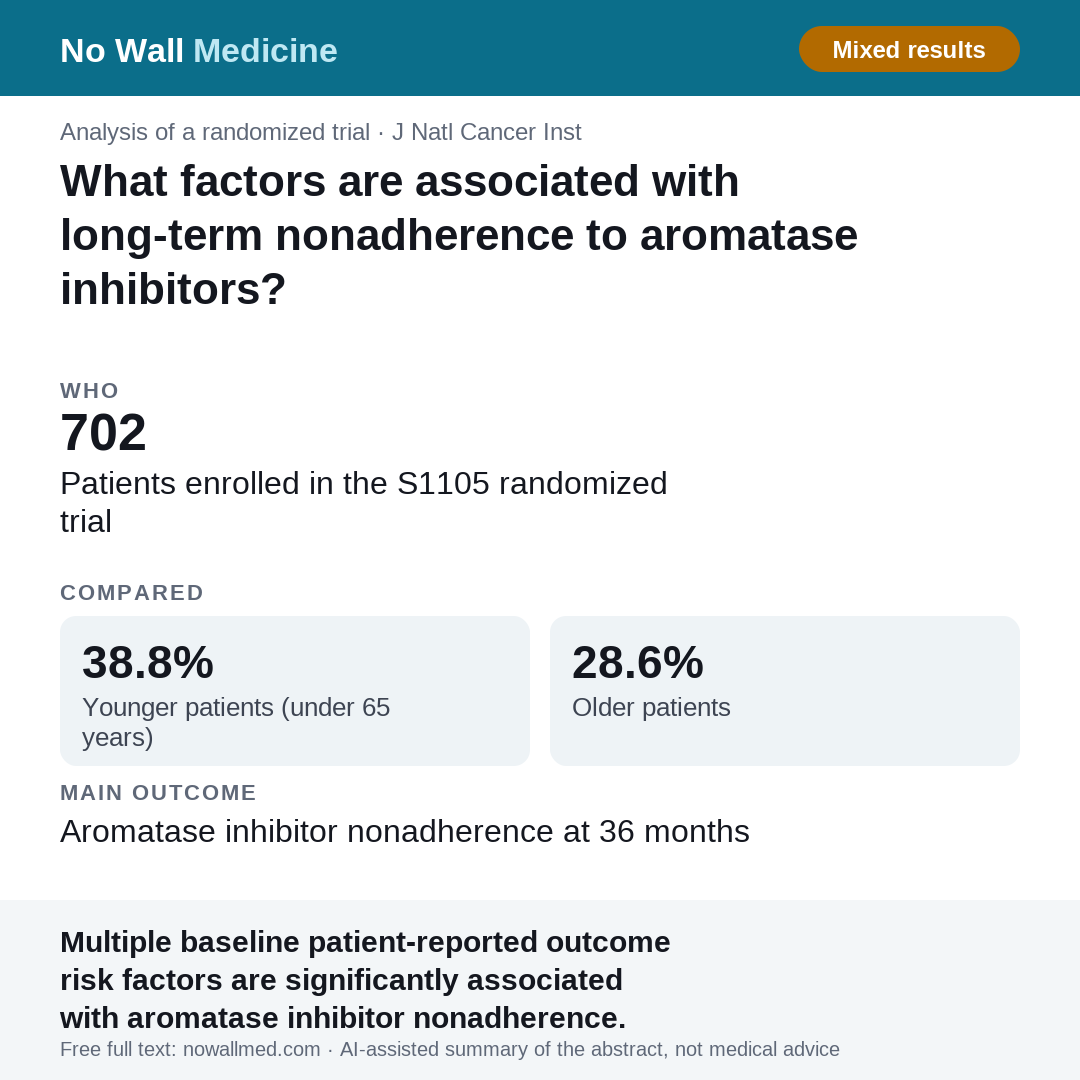
Clinical question: What factors are associated with long-term nonadherence to aromatase inhibitors?
Why it matters: It is unknown which patient-reported outcomes and baseline characteristics are associated with long-term nonadherence to aromatase inhibitor therapy.
Key points
- Researchers analyzed 702 patients who had been taking adjuvant aromatase inhibitors, a type of hormone therapy, for at least 30 days.
- At 36 months, 35.9% of patients were nonadherent, and being younger than 65 years was associated with higher nonadherence at 38.8% compared to 28.6%.
- A composite risk model showed that the highest-risk patients were 3.14 times more likely to be nonadherent than the lowest-risk patients.
Headline and key points written with AI from the paper’s abstract, with every number checked against it. Read the paper before relying on them.
Was this summary helpful?
Subject terms
Cite this article
Hershman DL, Neugut AI, Moseley A, et al. Patient-Reported Outcomes and Long-Term Nonadherence to Aromatase Inhibitors. J Natl Cancer Inst. 2021. doi:10.1093/jnci/djab022
Spotted a mistake? Suggest a correction