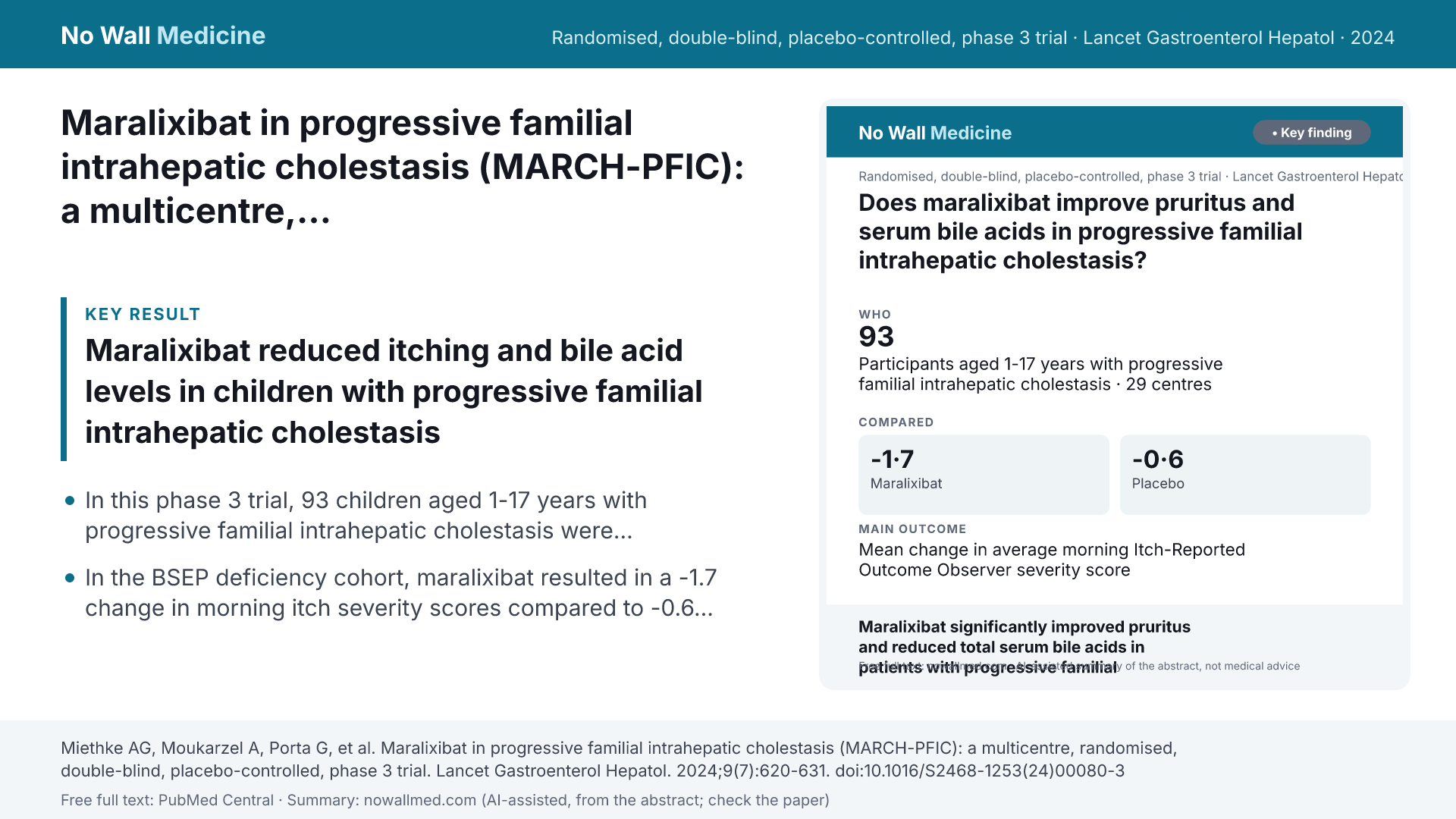
Maralixibat reduced itching and bile acid levels in children with progressive familial intrahepatic cholestasis
Maralixibat in progressive familial intrahepatic cholestasis (MARCH-PFIC): a multicentre, randomised, double-blind, placebo-controlled, phase 3 trial
Randomised, double-blind, placebo-controlled, phase 3 trialKey finding
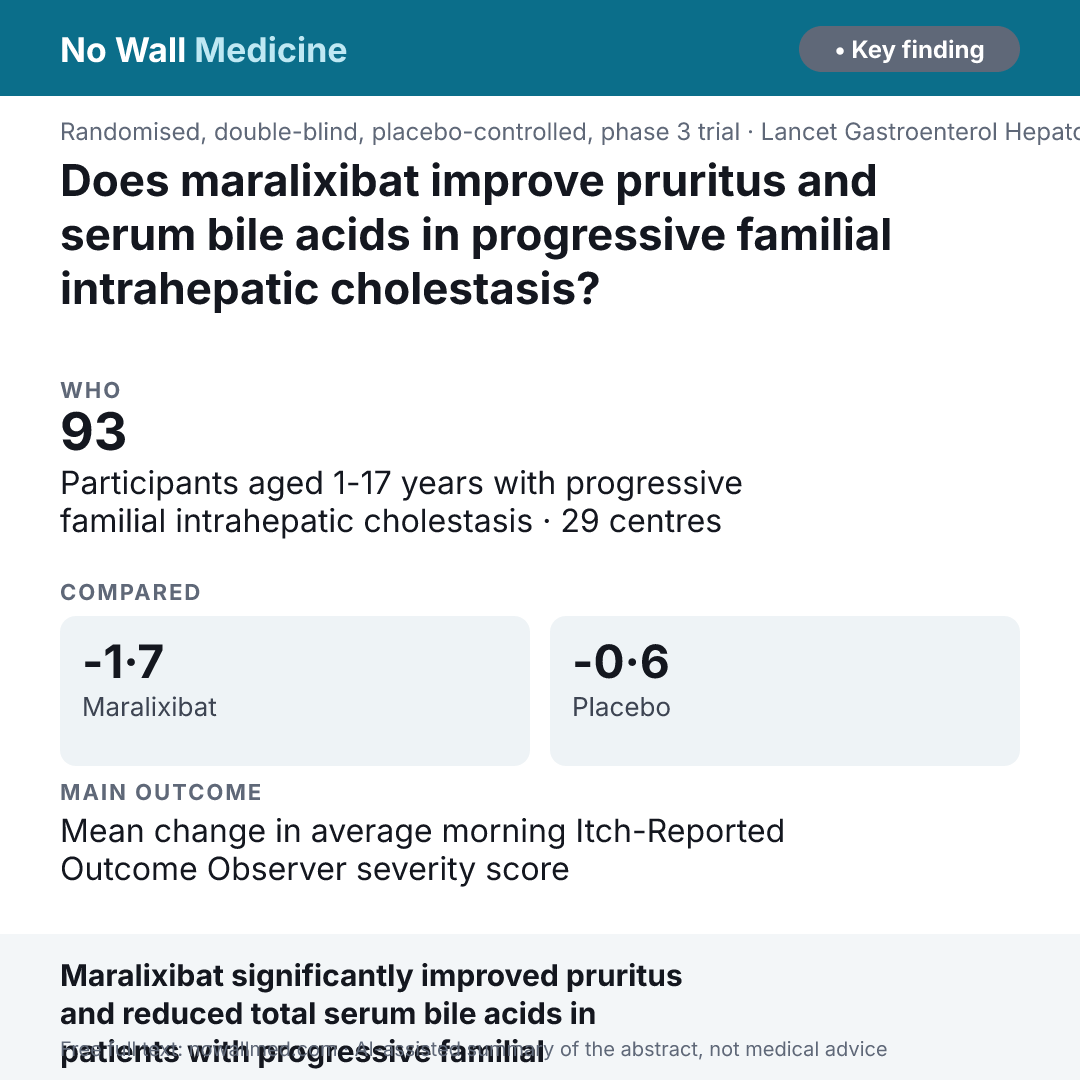
Does maralixibat improve pruritus and serum bile acids in progressive familial intrahepatic cholestasis?
Who
93
Participants aged 1-17 years with progressive familial intrahepatic cholestasis · 29 centres across 16 countries
Compared
-1·7Maralixibat (95% CI -2·3 to -1·2)
-0·6Placebo (-1·1 to -0·1)
Main outcome
Mean change in average morning Itch-Reported Outcome Observer severity score
Result: -1·1 (95% CI -1·8 to -0·3; p=0·0063)
Bottom line: Maralixibat significantly improved pruritus and reduced total serum bile acids in patients with progressive familial intrahepatic cholestasis.
Funded by: Mirum Pharmaceuticals
Lancet Gastroenterol Hepatol · 2024-05-06 · Save PNG
Clinical question: Does maralixibat improve pruritus and serum bile acids in progressive familial intrahepatic cholestasis?
Key points
- In this phase 3 trial, 93 children aged 1-17 years with progressive familial intrahepatic cholestasis were randomized to receive either maralixibat or a placebo twice daily for 26 weeks.
- In the BSEP deficiency cohort, maralixibat resulted in a -1.7 change in morning itch severity scores compared to -0.6 for placebo, and a -176 μmol/L change in total serum bile acids compared to 11 μmol/L for placebo.
- Diarrhea was the most common side effect, occurring in 57% of patients receiving maralixibat compared to 20% of those receiving placebo.
Headline and key points written with AI from the paper’s abstract, with every number checked against it. Read the paper before relying on them.
Was this summary helpful?
Subject terms
Headline, design, result, key points, caveat and citation as plain text.
Cite this article
Miethke AG, Moukarzel A, Porta G, et al. Maralixibat in progressive familial intrahepatic cholestasis (MARCH-PFIC): a multicentre, randomised, double-blind, placebo-controlled, phase 3 trial. Lancet Gastroenterol Hepatol. 2024;9(7):620-631. doi:10.1016/S2468-1253(24)00080-3
Spotted a mistake? Suggest a correction