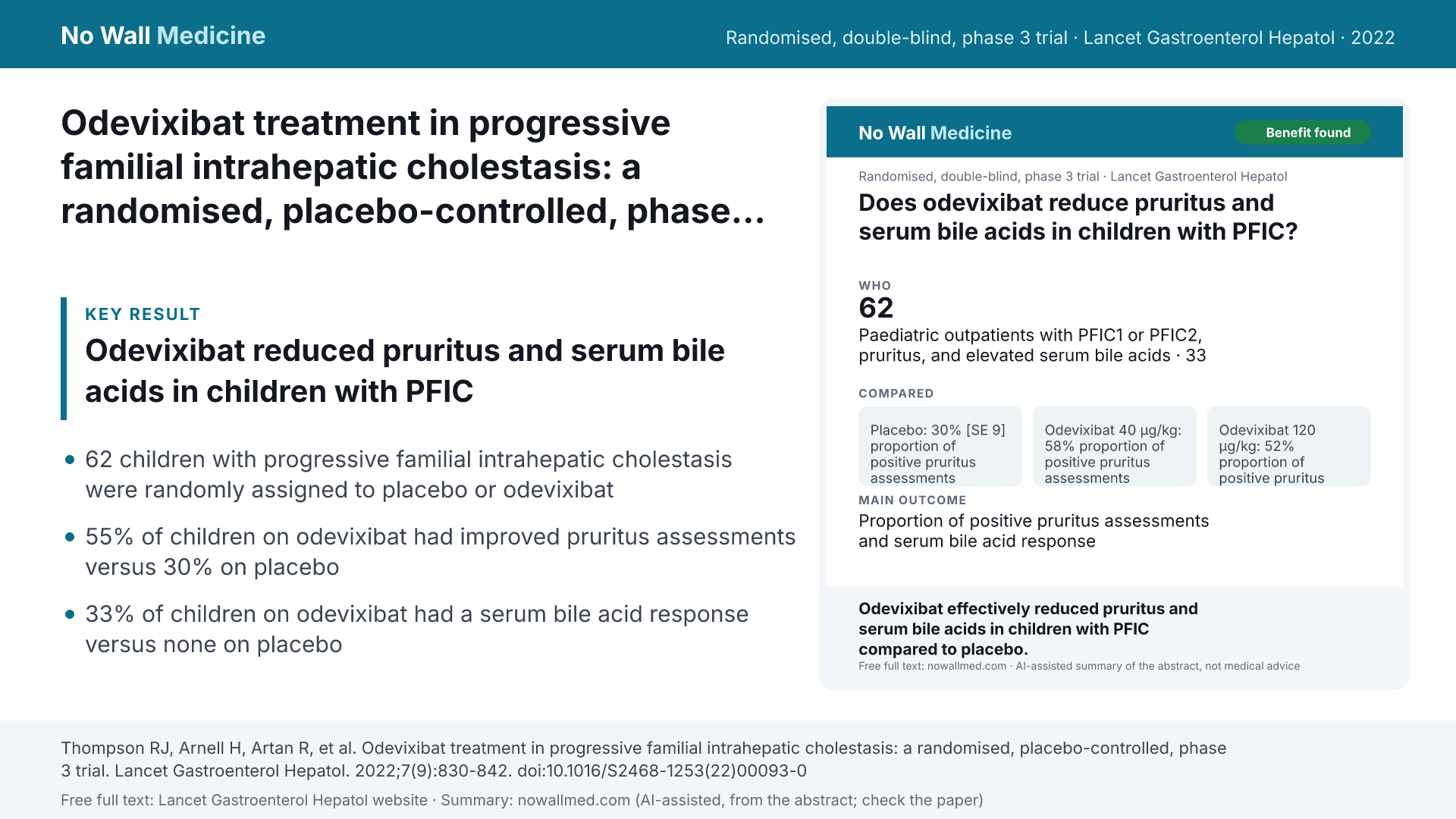
Odevixibat reduced pruritus and serum bile acids in children with PFIC
Odevixibat treatment in progressive familial intrahepatic cholestasis: a randomised, placebo-controlled, phase 3 trial
Randomised, double-blind, phase 3 trialBenefit found
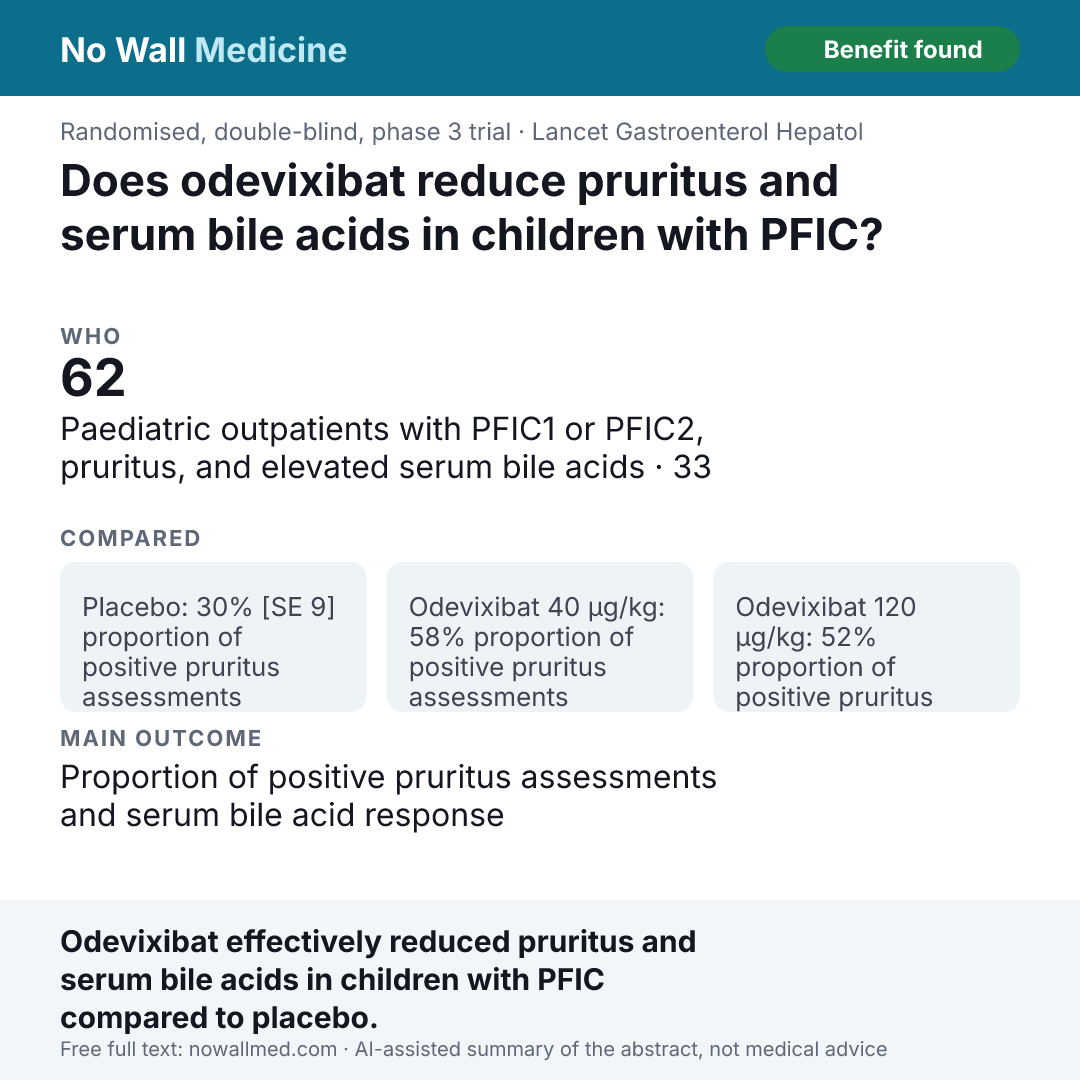
Does odevixibat reduce pruritus and serum bile acids in children with PFIC?
Who
62
Paediatric outpatients with PFIC1 or PFIC2, pruritus, and elevated serum bile acids · 33 global sites
Compared
Placebo: 30% [SE 9] proportion of positive pruritus assessments
Odevixibat 40 μg/kg: 58% proportion of positive pruritus assessments
Odevixibat 120 μg/kg: 52% proportion of positive pruritus assessments
Main outcome
Proportion of positive pruritus assessments and serum bile acid response
Result: model-adjusted mean difference 25·0% [95% CI 8·5-41·5]
Bottom line: Odevixibat effectively reduced pruritus and serum bile acids in children with PFIC compared to placebo.
Lancet Gastroenterol Hepatol · 2022-07-01 · Funded by Albireo Pharma · NCT03566238
Headline and visual abstract written with AI from the paper’s abstract, with every number checked against it. Read the paper before relying on them.
Was this summary helpful?
Abstract
Background
Progressive familial intrahepatic cholestasis (PFIC) is a group of inherited paediatric liver diseases resulting from mutations in genes that impact bile secretion. We aimed to evaluate the effects of odevixibat, an ileal bile acid transporter inhibitor, versus placebo in children with PFIC. Methods
Patients eligible for this 24-week, randomised, double-blind, completed, phase 3 study were paediatric outpatients diagnosed with PFIC1 or PFIC2 who had pruritus and elevated serum bile acids at screening. Patients were randomly assigned (1:1:1) using an interactive web-based system to once a day oral placebo, odevixibat 40 μg/kg, or odevixibat 120 μg/kg. Randomisation was done in a block size of six and stratified by PFIC type and patient age; patients, clinicians, and study staff were blinded to treatment allocation. Patients were enrolled at one of 33 global sites. Two primary endpoints were evaluated: proportion of positive pruritus assessments (PPAs; ie, scratching score of ≤1 or ≥1-point decrease as assessed by caregivers using the Albireo observer-reported outcome [ObsRO] PRUCISION instrument) over 24 weeks, and proportion of patients with serum bile acid response (ie, serum bile acids reduced by ≥70% from baseline or concentrations of ≤70 μmol/L) at week 24. Efficacy and safety were analysed in randomly allocated patients who received one or more doses of study drug. This study is registered with ClinicalTrials.gov, NCT03566238. Findings
Between June 21, 2018, and Feb 10, 2020, 62 patients (median age 3·2 [range 0·5-15·9] years) were randomly allocated to placebo (n=20), odevixibat 40 μg/kg per day (n=23), or odevixibat 120 μg/kg per day (n=19). Model-adjusted (least squares) mean proportion of PPAs was significantly higher with odevixibat versus placebo (55% [SE 8] in the combined odevixibat group [58% in the 40 μg/kg per day group and 52% in the 120 μg/kg per day group] vs 30% [SE 9] in the placebo group; model-adjusted mean difference 25·0% [95% CI 8·5-41·5]; p=0·0038). The percentage of patients with serum bile acid response was also significantly higher with odevixibat versus placebo (14 [33%] of 42 patients in the combined odevixibat group [10 in the 40 μg/kg per day group and four in the 120 μg/kg per day group] vs none of 20 in the placebo group; adjusting for stratification factor [PFIC type], the proportion difference was 30·7% [95% CI 12·6-48·8; p=0·0030]). The most common treatment-emergent adverse events (TEAEs) were diarrhoea or frequent bowel movements (13 [31%] of 42 for odevixibat vs two [10%] of 20 for placebo) and fever (12 [29%] of 42 vs five [25%] of 20); serious TEAEs occurred in three (7%) of 42 odevixibat-treated patients and in five (25%) of 20 placebo-treated patients. Interpretation
In children with PFIC, odevixibat effectively reduced pruritus and serum bile acids versus placebo and was generally well tolerated. Odevixibat, administered as once a day oral capsules, is a non-surgical, pharmacological option to interrupt the enterohepatic circulation in patients with PFIC. Funding
Albireo Pharma.
Abstract reproduced under the article’s CC BY licence.
Subject terms
Cite this article
Thompson RJ, Arnell H, Artan R, et al. Odevixibat treatment in progressive familial intrahepatic cholestasis: a randomised, placebo-controlled, phase 3 trial. Lancet Gastroenterol Hepatol. 2022;7(9):830-842. doi:10.1016/S2468-1253(22)00093-0
Spotted a mistake? Suggest a correction