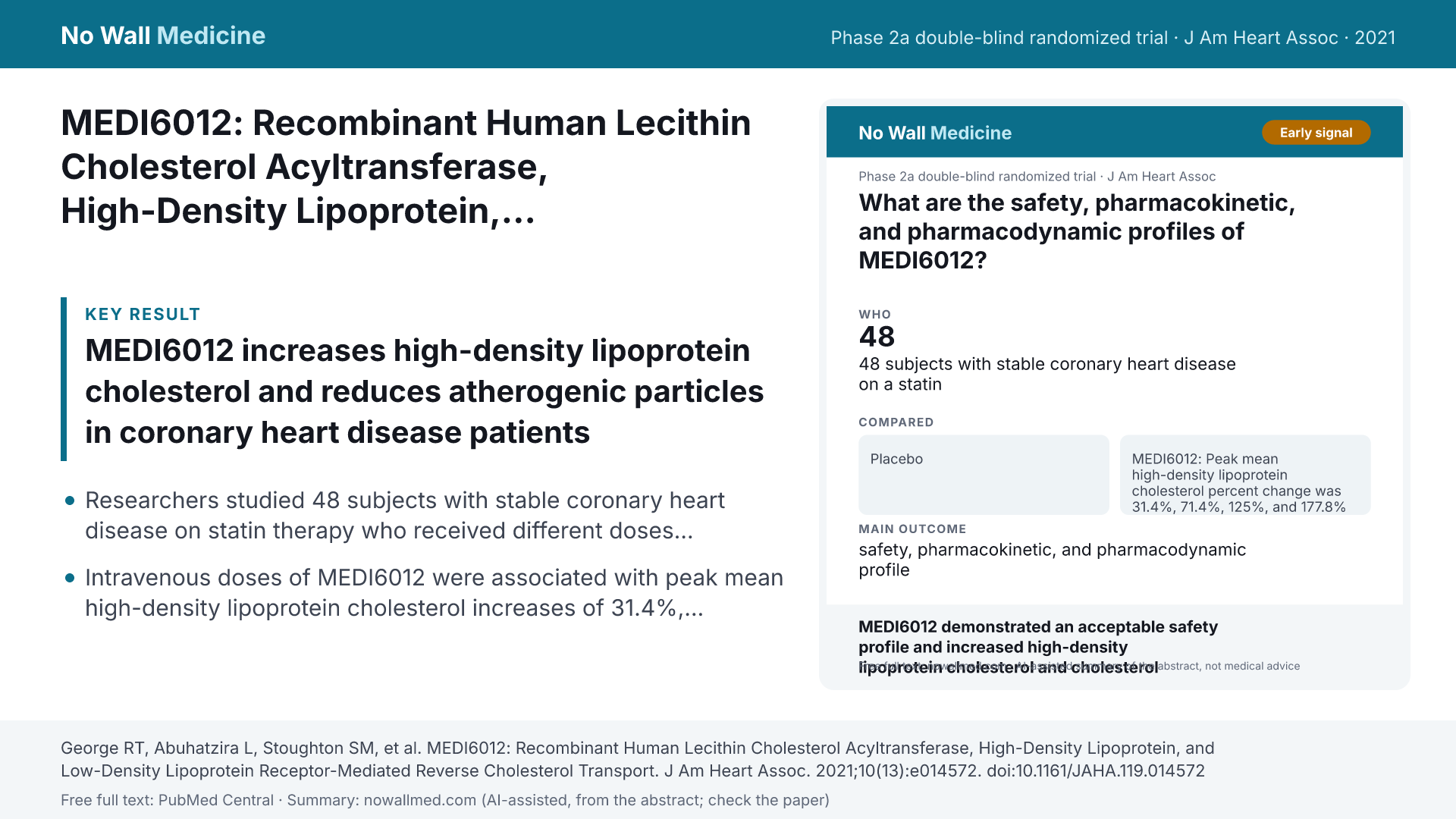
MEDI6012: Recombinant Human Lecithin Cholesterol Acyltransferase, High-Density Lipoprotein, and Low-Density Lipoprotein Receptor-Mediated Reverse Cholesterol Transport
Key result: MEDI6012 increases high-density lipoprotein cholesterol and reduces atherogenic particles in coronary heart disease patients
Key points
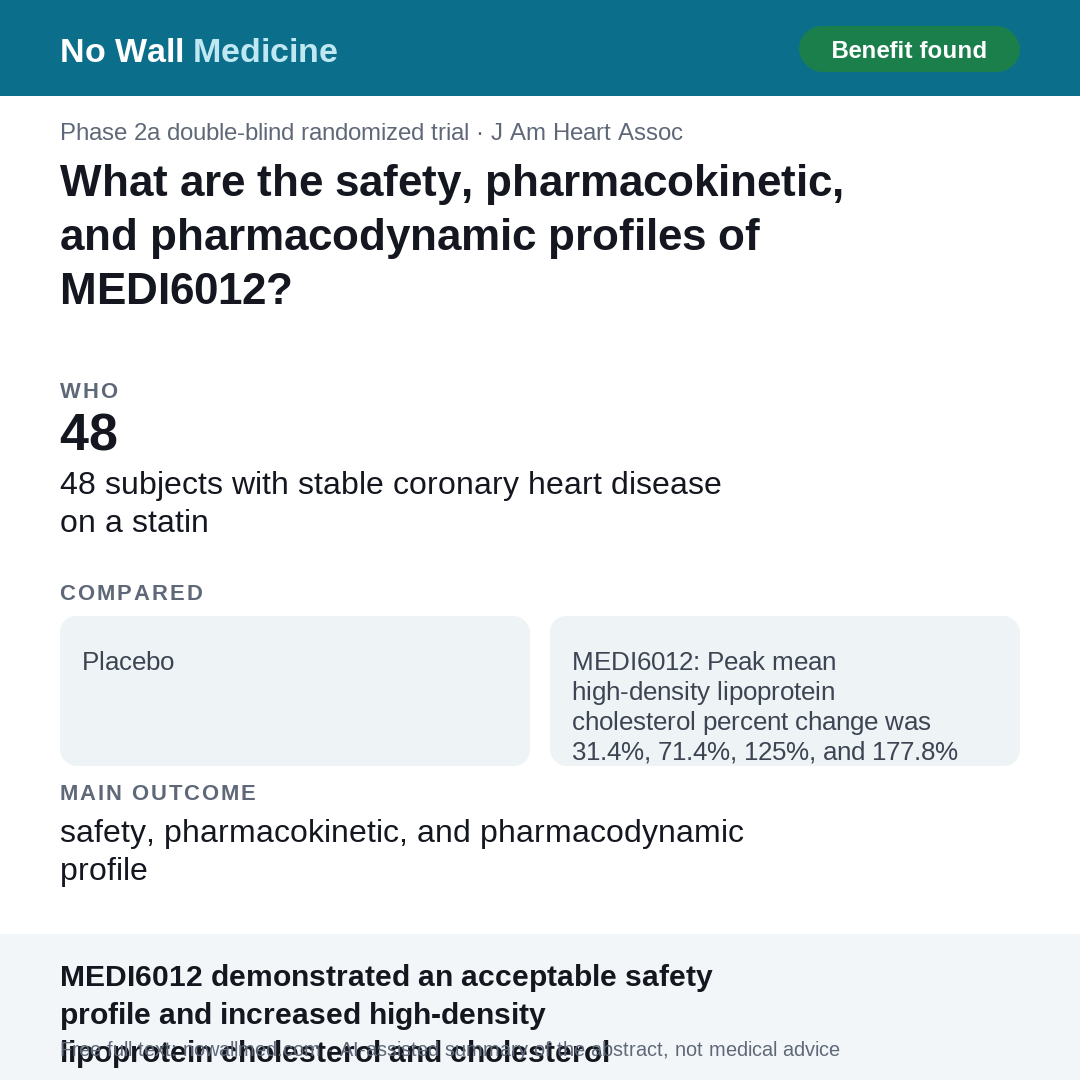
- Researchers studied 48 subjects with stable coronary heart disease on statin therapy who received different doses of MEDI6012 or a placebo.
- Intravenous doses of MEDI6012 were associated with peak mean high-density lipoprotein cholesterol increases of 31.4%, 71.4%, 125%, and 177.8%.
- The intravenous 80-, 240-, and 800-mg doses were associated with decreases in atherogenic small low-density lipoprotein particles by 41%, 88%, and 79%.
Why it matters: The safety, movement of the drug through the body, and effects on cholesterol transport for the enzyme MEDI6012 were unknown.
Discussion prompts
- Would these patients look like yours? Who was left out?
- Is the main outcome one that matters to patients?
- Is the difference large enough to change what you do?
Cite: George RT, Abuhatzira L, Stoughton SM, et al. MEDI6012: Recombinant Human Lecithin Cholesterol Acyltransferase, High-Density Lipoprotein, and Low-Density Lipoprotein Receptor-Mediated Reverse Cholesterol Transport. J Am Heart Assoc. 2021. doi:10.1161/JAHA.119.014572
Free full text: PubMed Central · Summary and visual abstract: nowallmed.com/a/medi6012-recombinant-human-lecithin-cholesterol-acyltransferase-high-r5pvg2/ (AI-assisted from the abstract; check the paper before relying on it).