Medical Therapy for Acute Severe Ulcerative Colitis: A Systematic Review With Meta-analysis
Systematic review with meta-analysisBenefit found
What is the efficacy and safety of medical treatments for acute severe ulcerative colitis?
Who
Hospitalized adults with acute severe ulcerative colitis
Compared
Infliximab: RR 0.56 (95% CI 0.38-0.81) for colectomy at discharge
Cyclosporine A
Main outcome
Colectomy rate and safety outcomes
Result: risk ratio 0.56 (95% CI 0.38-0.81) for colectomy at discharge
Bottom line: Infliximab may be more efficacious than cyclosporine A for reducing colectomy risk in acute severe ulcerative colitis.
Limitation: Low certainty evidence
Clin Gastroenterol Hepatol · 2025-05-06Download image
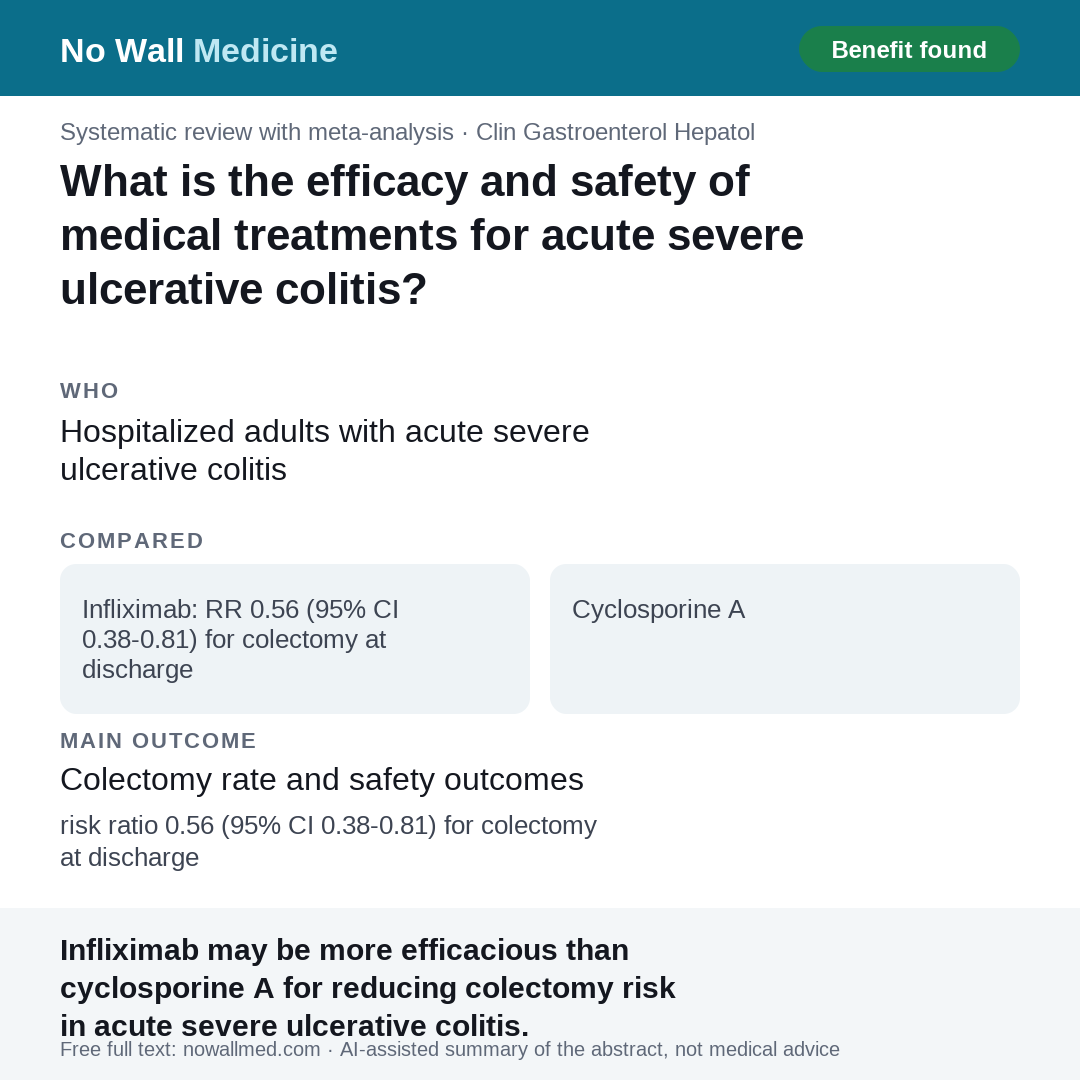
Clinical question: What is the efficacy and safety of medical treatments for acute severe ulcerative colitis?
Abstract
Background & aims
Acute severe ulcerative colitis (ASUC) is a medical emergency associated with high morbidity and mortality. We aimed to assess the efficacy and safety of medical treatments for ASUC. Methods
MEDLINE, EMBASE, and CENTRAL were searched to November 14, 2024 for randomized controlled trials (placebo or active comparator), and comparative cohort studies that evaluated medical therapies for hospitalized adults with ASUC. Primary outcomes were colectomy rate at discharge and at 3 and 12 months. Safety outcomes included adverse events, serious adverse events, and infections. Pooled risk ratios (RR) and 95% confidence intervals (CI) were calculated. Results
Forty-four studies (18 randomized controlled trials, and 26 cohort studies) assessing 22 different comparisons were included. Low certainty evidence suggests that infliximab (IFX) was significantly superior to cyclosporine A for reducing the risk of colectomy at discharge (RR, 0.56; 95% CI, 0.38-0.81; I2 = 30%), 3 months (RR, 0.67; 95% CI, 0.48-0.92; I2 = 36%), and 12 months (RR, 0.56; 95% CI, 0.42-0.75; I2 = 46%). IFX patients were significantly more likely than cyclosporine A patients to develop an infection (RR, 2.38; 95% CI, 1.27-4.47; I2 = 15%). There was no significant difference between accelerated and standard dosing regimens of IFX for colectomy at discharge or at 3 months. Tofacitinib in combination with intravenous corticosteroids was significantly superior to intravenous corticosteroids alone for induction of clinical response at Day 7; however, there was no difference in colectomy rate or infections at 3 months. Conclusions
IFX may be more efficacious than cyclosporine A for the treatment of ASUC. Janus kinase inhibitors are promising treatment options in select individuals. Future studies should explore the efficacy of other advanced therapies.
Topics
Cite this article
Vuyyuru SK, Shaban N, Yuan Y, Honap S, Alphonsus L, De Silva TA. Medical Therapy for Acute Severe Ulcerative Colitis: A Systematic Review With Meta-analysis. Clin Gastroenterol Hepatol. 2025. doi:10.1016/j.cgh.2025.03.007
Spotted a mistake? Suggest a correction
Top studies every Monday
The week’s key trials and guidelines in your specialties, by email. Free.
Get the weekly digest