Adding a pleural catheter to medical thoracoscopy did not reduce hospital stay for patients
Medical thoracoscopy with talc poudrage and indwelling pleural catheter insertion versus medical thoracoscopy with talc poudrage alone for patients with symptomatic malignant pleural effusion (TACTIC): a randomised, controlled phase 3 trial
Unblinded, phase 3, randomised controlled trialNo clear difference
Does adding an indwelling pleural catheter to medical thoracoscopy and talc poudrage reduce hospital stay and dyspnoea?
Who
124
Patients with symptomatic malignant pleural effusion and confirmed malignancy · 11 UK hospitals
Compared
Medical thoracoscopy, talc poudrage, and indwelling pleural catheter: Median 1 day (IQR 1-3, 95% CI 1-2)
Medical thoracoscopy, talc poudrage, and usual care: Median 2 days (IQR 1-3, 95% CI 1-2)
Main outcome
Time in hospital and average breathlessness scores
Result: p=0·26 for hospital stay; p=0·26 for dyspnoea scores
Bottom line: Adding an indwelling pleural catheter did not reduce hospital stay or dyspnoea but reduced additional invasive pleural procedures.
Funded by: National Institute of Health Research, Research for Patient Benefit
Lancet Respir Med · 2026-02-25Download image
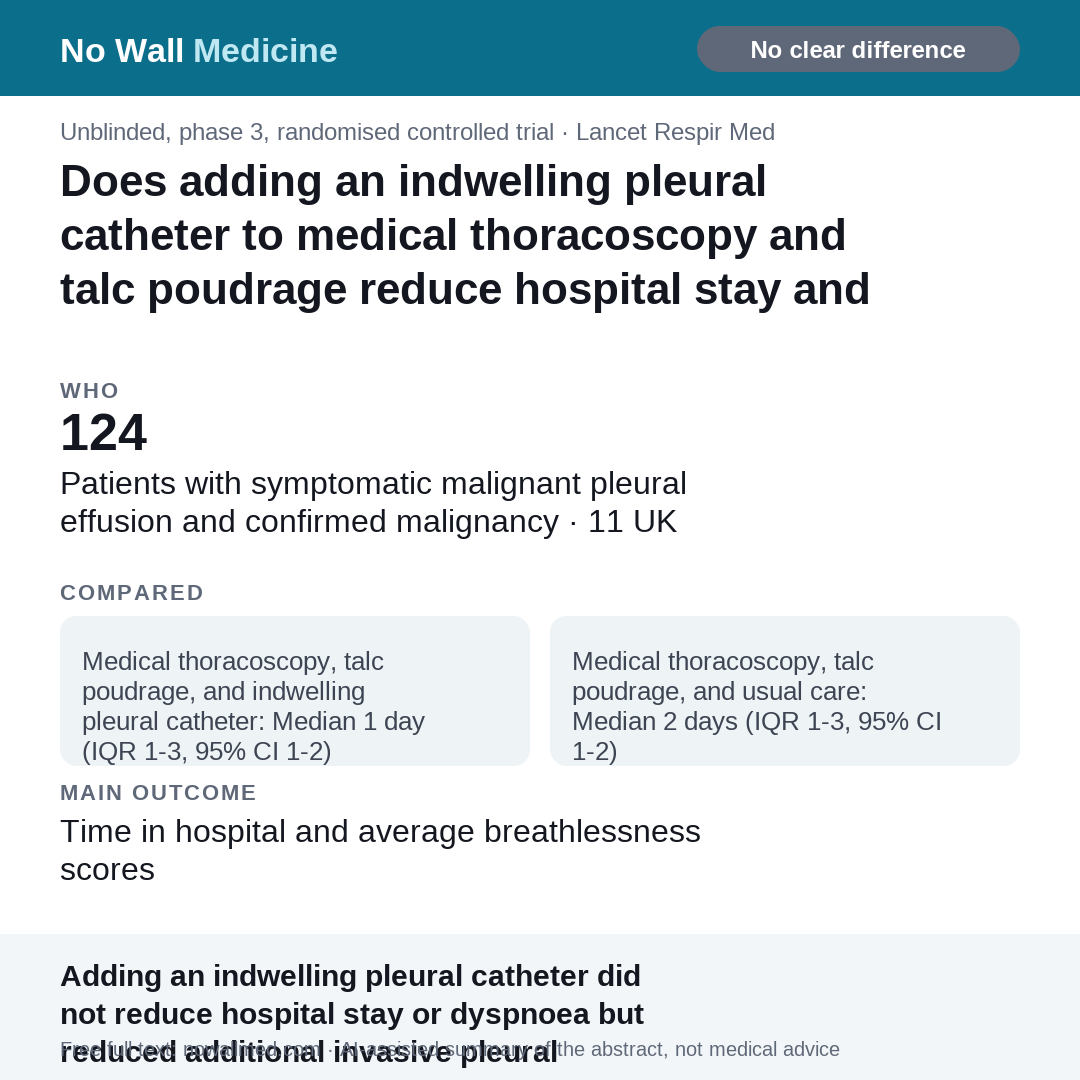
Clinical question: Does adding an indwelling pleural catheter to medical thoracoscopy and talc poudrage reduce hospital stay and dyspnoea?
Why it matters: It was unknown if combining medical thoracoscopy and talc powder with an indwelling pleural catheter would reduce hospital stays and improve breathlessness.
Key points
- Researchers studied 124 patients with malignant pleural effusion, comparing medical thoracoscopy with talc powder and a catheter to standard care with a large tube.
- The median hospital stay was 1 day in the intervention group versus 2 days in the standard care group, which was not a statistically significant difference.
- The intervention group required fewer additional invasive pleural procedures by 12 weeks, with 3% in the intervention group compared to 34% in the standard care group.
Headline and key points written with AI from the paper’s abstract, with every number checked against it. Read the paper before relying on them.
Abstract
Background
Patients with suspected malignant pleural effusions (MPE) are often in need of both a confirmatory diagnosis and symptom control. Therapeutic options include talc pleurodesis via chest drain, poudrage during medical thoracoscopy, or alternatively an indwelling pleural catheter (IPC). Combining the diagnostic and therapeutic efficacy of medical thoracoscopy and poudrage with the ambulatory benefits of an IPC has not been studied within a randomised controlled trial. The aim of the TACTIC trial was to determine whether this approach resulted in a reduced length of hospital stay and improvements in dyspnoea. Methods
This unblinded, phase 3, randomised controlled trial was undertaken in 11 UK hospitals. Patients with MPE and confirmed malignancy (during medical thoracoscopy or beforehand) received talc poudrage and were randomly assigned by a centralised web-based system to an IPC at the time of medical thoracoscopy or usual care (ie, medical thoracoscopy, poudrage, and admission with large bore tube). Co-primary outcomes were time in hospital (including initial admission for trial procedure and any subsequent readmissions over 4 weeks post procedure) and average breathlessness assessed with visual analogue scale dyspnoea scores, measuring severity of dyspnoea from 0 mm to 100 mm, over a 4-week period. All randomised patients in whom an outcome was available were included in the analysis on a modified intention-to-treat basis. TACTIC was registered with ISRCTN on Aug 8, 2021 (ISRCTN11058680). Findings
Participants were recruited from between Dec 15, 2021, and Jan 3, 2024. 124 participants were randomised: 62 to the intervention and 62 to standard care. Leading diagnoses were pleural mesothelioma (46%), lung cancer (28%), and breast cancer (10%). Co-primary outcome data were available for 102 patients for total length of hospital stay (52 in intervention group vs 50 in standard care group) and 108 patients for breathlessness (57 vs 51). Median time in hospital was 1 day (IQR 1-3, 95% CI 1-2) in the intervention group versus 2 days (IQR 1-3, 95% CI 1-2) in standard care group (p=0·26). Median visual analogue scale dyspnoea scores did not differ between groups: 14·0 mm (IQR 8·8-32·4) in the intervention group versus 19·6 mm (8·1-38·7) in standard care group (p=0·26). Participants in the intervention group required fewer additional invasive pleural procedures by 12 weeks (two [3%] of 60 vs 19 [34%] of 56, p<0·0001) Trial related adverse events rates were similar in both groups (46 [74%] of 62 vs 44 [71%] of 62, p=0·84). Three related serious adverse events were recorded, all occurring in the intervention group. Interpretation
The combination of medical thoracoscopy, poudrage, and IPC did not result in shorter hospital stay but was safe and resulted in similar dyspnoea control compared with standard care. For patients with symptomatic MPE undergoing medical thoracoscopy for pleurodesis who prioritise minimising the length of hospital stay or the need for further invasive pleural procedures, the addition of an IPC alongside poudrage might help to achieve this goal. Funding
National Institute of Health Research, Research for Patient Benefit.
Abstract reproduced under the article’s CC BY licence.
Topics
Cite this article
Dipper A, Sundaralingam A, Hedley E, Gudur S, Mills J, Sowden S. Medical thoracoscopy with talc poudrage and indwelling pleural catheter insertion versus medical thoracoscopy with talc poudrage alone for patients with symptomatic malignant pleural effusion (TACTIC): a randomised, controlled phase 3 trial. Lancet Respir Med. 2026. doi:10.1016/S2213-2600(25)00409-6
Spotted a mistake? Suggest a correction