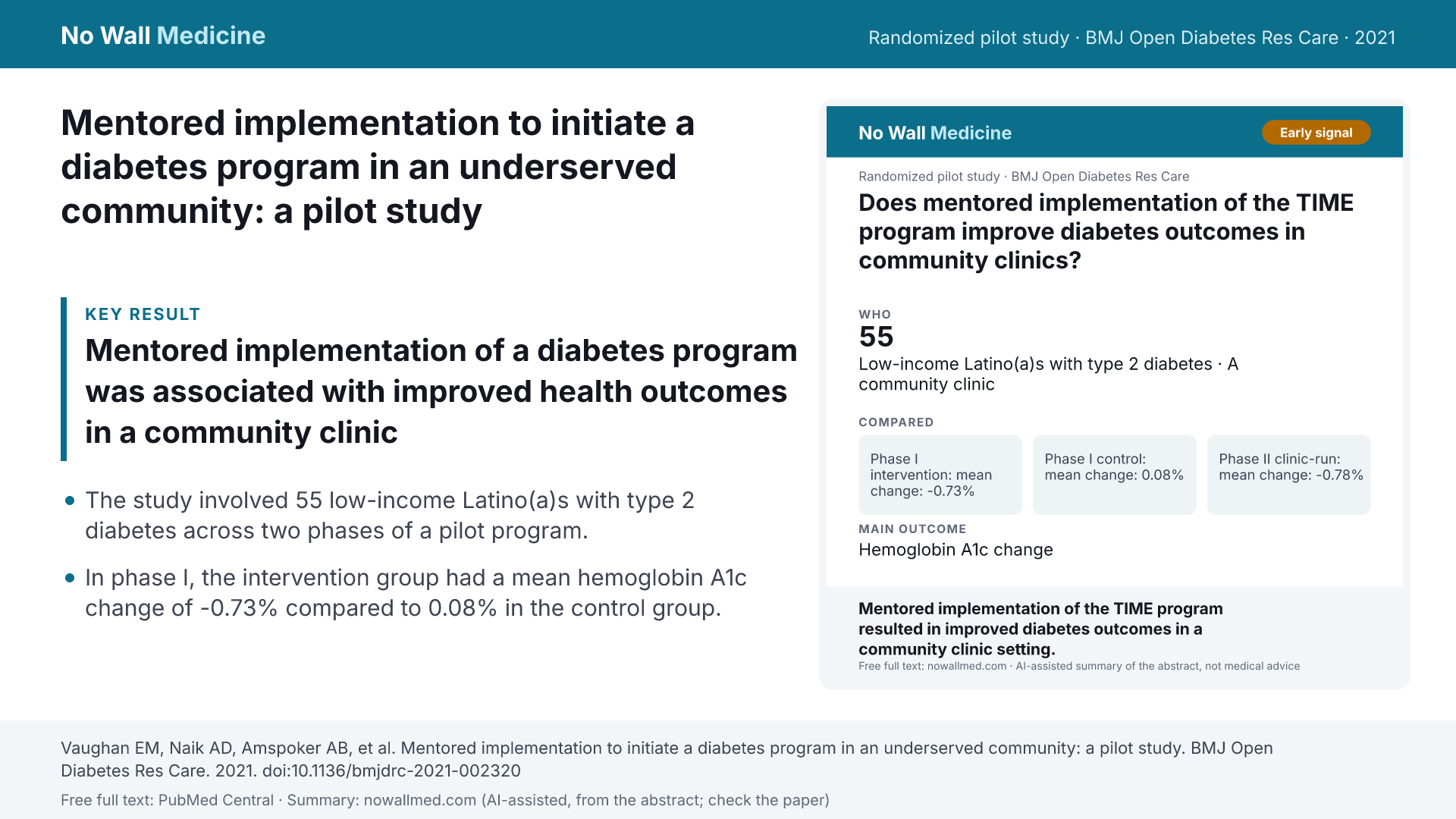
Mentored implementation of a diabetes program was associated with improved health outcomes in a community clinic
Mentored implementation to initiate a diabetes program in an underserved community: a pilot study
Randomized pilot studyEarly signal
Does mentored implementation of the TIME program improve diabetes outcomes in community clinics?
Who
55
Low-income Latino(a)s with type 2 diabetes · A community clinic
Compared
Phase I intervention: mean change: -0.73%
Phase I control: mean change: 0.08%
Phase II clinic-run: mean change: -0.78%
Main outcome
Hemoglobin A1c change
Bottom line: Mentored implementation of the TIME program resulted in improved diabetes outcomes in a community clinic setting.
BMJ Open Diabetes Res Care · 2021-08-13 · Save PNG
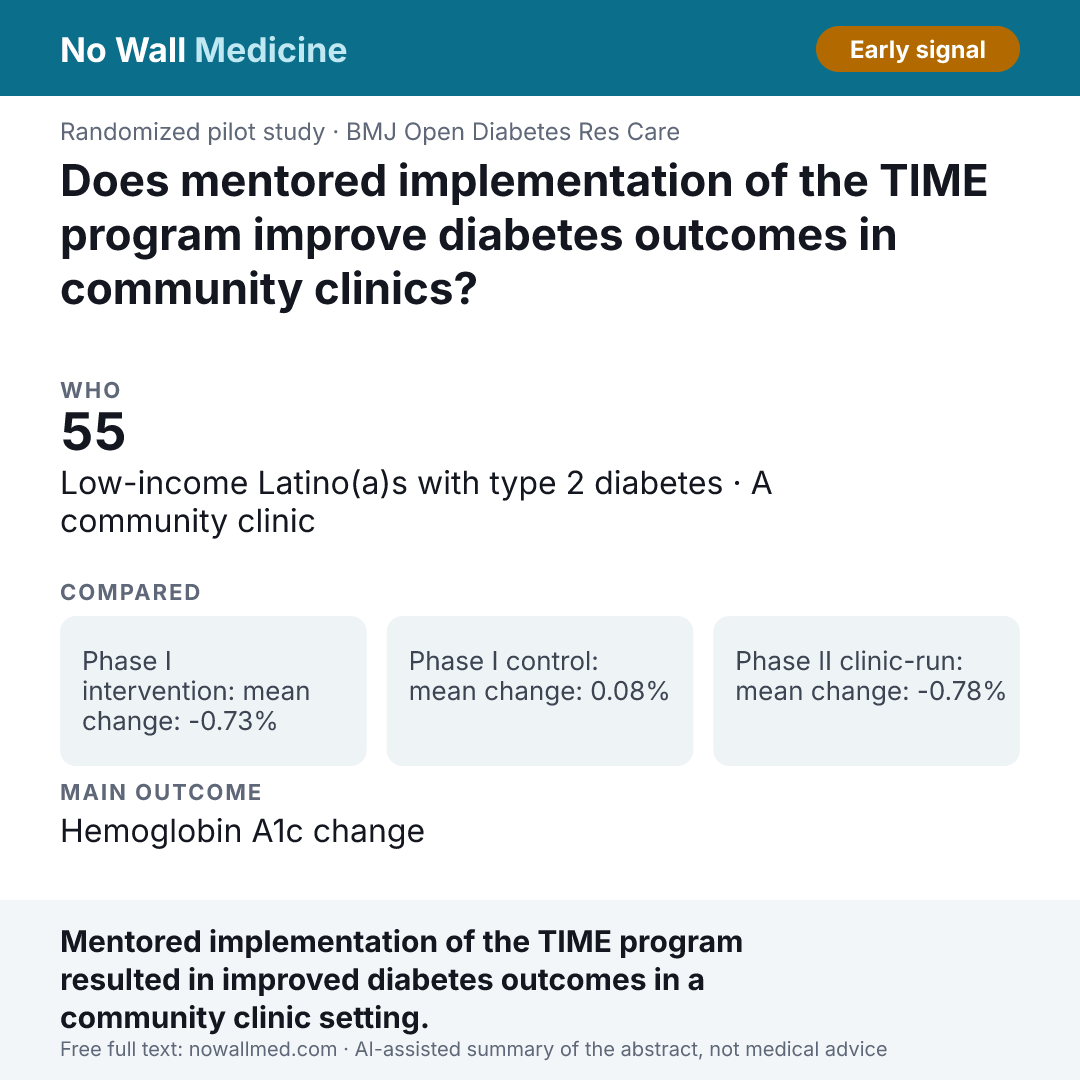
Clinical question: Does mentored implementation of the TIME program improve diabetes outcomes in community clinics?
Why it matters: Community clinics face practical barriers that make it difficult to start new programs or replicate results from controlled research trials.
Key points
- The study involved 55 low-income Latino(a)s with type 2 diabetes across two phases of a pilot program.
- In phase I, the intervention group had a mean hemoglobin A1c change of -0.73% compared to 0.08% in the control group.
- In phase II, participants had a mean hemoglobin A1c change of -0.78% and community health workers improved their knowledge scores.
Limitation the authors note: Larger studies of longer duration are needed to fully evaluate the potential of mentoring community clinics.
Headline and key points written with AI from the paper’s abstract, with every number checked against it. Read the paper before relying on them.
Was this summary helpful?
Abstract
Introduction
Community clinics often face pragmatic barriers, hindering program initiation and replication of controlled research trial results. Mentoring is a potential strategy to overcome these barriers. We piloted an in-person and telehealth mentoring strategy to implement the Telehealth-supported, Integrated Community Health Workers (CHWs), Medication-access, group visit Education (TIME) program in a community clinic. Research design and methods
Participants (n=55) were low-income Latino(a)s with type 2 diabetes. The study occurred in two, 6-month phases. Phase I provided proof-of-concept and an observational experience for the clinic team; participants (n=37) were randomized to the intervention (TIME) or control (usual care), and the research team conducted TIME while the clinic team observed. Phase II provided mentorship to implement TIME, and the research team mentored the clinic team as they conducted TIME for a new single-arm cohort of participants (n=18) with no previous exposure to the program. Analyses included baseline to 6-month comparisons of diabetes outcomes (primary outcome: hemoglobin A1c (HbA1c)): phase I intervention versus control, phase II (within group), and research-run (phase I intervention) versus clinic-run (phase II) arms. We also evaluated baseline to 6-month CHW knowledge changes. Results
Phase I: compared with the control, intervention participants had superior baseline to 6-month improvements for HbA1c (mean change: intervention: -0.73% vs control: 0.08%, p=0.016), weight (p=0.044), target HbA1c (p=0.035), hypoglycemia (p=0.021), medication non-adherence (p=0.0003), and five of six American Diabetes Association (ADA) measures (p<0.001-0.002). Phase II: participants had significant reductions in HbA1c (mean change: -0.78%, p=0.006), diastolic blood pressure (p=0.004), body mass index (0.012), weight (p=0.010), medication non-adherence (p<0.001), and six ADA measures (p=0.007-0.005). Phase I intervention versus phase II outcomes were comparable. CHWs improved knowledge from pre-test to post-tests (p<0.001). Conclusions
A novel, mentored approach to implement TIME into a community clinic resulted in improved diabetes outcomes. Larger studies of longer duration are needed to fully evaluate the potential of mentoring community clinics.
Abstract reproduced under the article’s CC BY NC licence.
Subject terms
Headline, design, result, key points, caveat and citation as plain text.
Cite this article
Vaughan EM, Naik AD, Amspoker AB, et al. Mentored implementation to initiate a diabetes program in an underserved community: a pilot study. BMJ Open Diabetes Res Care. 2021. doi:10.1136/bmjdrc-2021-002320
Spotted a mistake? Suggest a correction