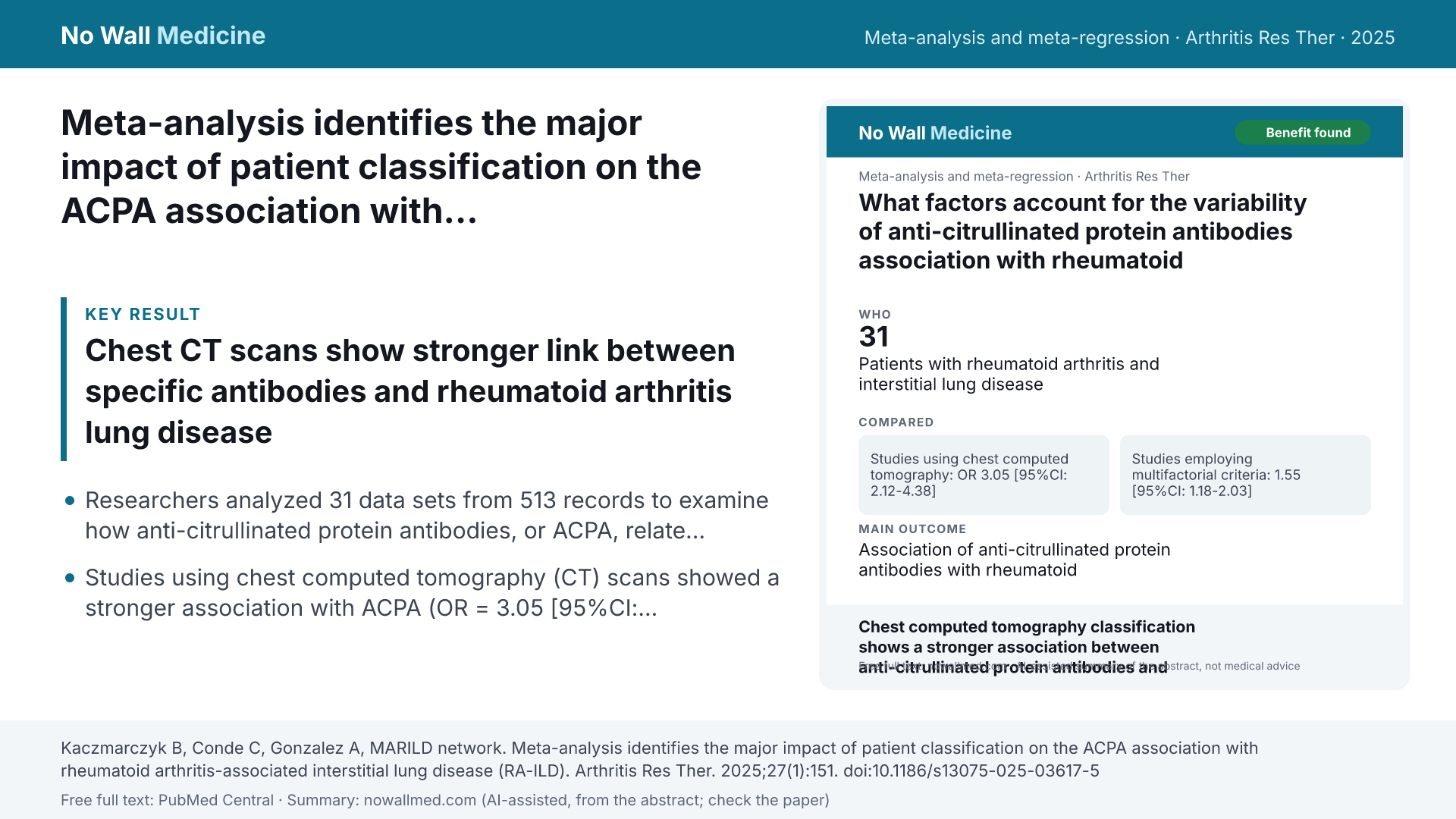
Chest CT scans show stronger link between specific antibodies and rheumatoid arthritis lung disease
Meta-analysis identifies the major impact of patient classification on the ACPA association with rheumatoid arthritis-associated interstitial lung disease (RA-ILD)
Meta-analysis and meta-regressionBenefit found
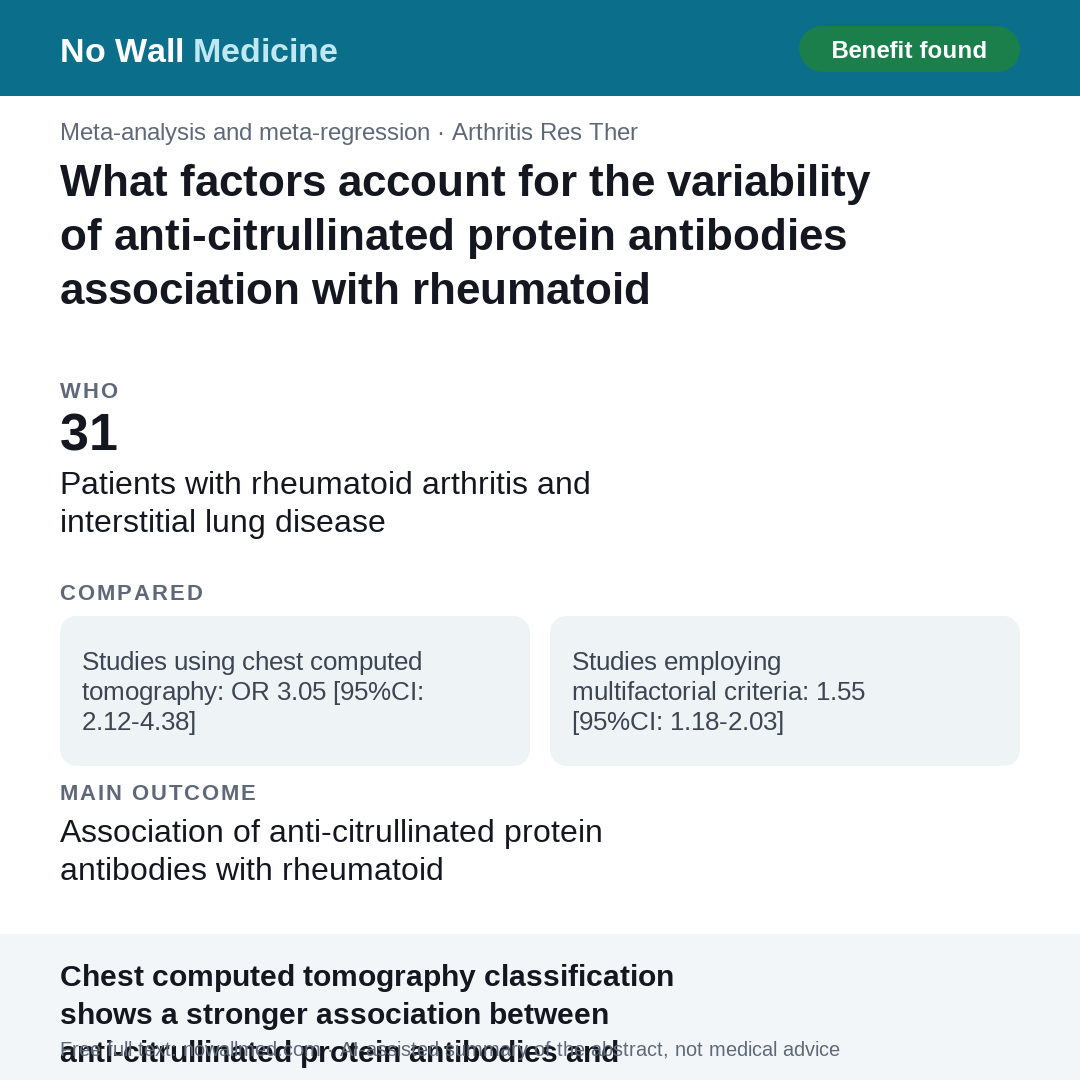
What factors account for the variability of anti-citrullinated protein antibodies association with rheumatoid arthritis-associated interstitial lung disease?
Who
31
Patients with rheumatoid arthritis and interstitial lung disease
Compared
Studies using chest computed tomography: OR 3.05 [95%CI: 2.12-4.38]
Studies employing multifactorial criteria: 1.55 [95%CI: 1.18-2.03]
Main outcome
Association of anti-citrullinated protein antibodies with rheumatoid arthritis-associated interstitial lung disease
Result: OR 3.05 [95%CI: 2.12-4.38] vs 1.55 [95%CI: 1.18-2.03]
Bottom line: Chest computed tomography classification shows a stronger association between anti-citrullinated protein antibodies and rheumatoid arthritis-associated interstitial lung disease.
Limitation: One outlier study recruited cases and controls in different place and time contexts.
Arthritis Res Ther · 2025-07-19Download image
Clinical question: What factors account for the variability of anti-citrullinated protein antibodies association with rheumatoid arthritis-associated interstitial lung disease?
Why it matters: Existing screenings disagree regarding the association of anti-citrullinated protein antibodies with rheumatoid arthritis-associated interstitial lung disease.
Key points
- Researchers analyzed 31 data sets from 513 records to examine how anti-citrullinated protein antibodies, or ACPA, relate to rheumatoid arthritis-associated interstitial lung disease.
- Studies using chest computed tomography (CT) scans showed a stronger association with ACPA (OR = 3.05 [95%CI: 2.12-4.38]) than those using multifactorial criteria (1.55 [95%CI: 1.18-2.03]).
- One outlier study accounted for 58.1% of the initial heterogeneity in the results due to different recruitment contexts.
Headline and key points written with AI from the paper’s abstract, with every number checked against it. Read the paper before relying on them.
Was this summary helpful?
Subject terms
Cite this article
Kaczmarczyk B, Conde C, Gonzalez A, MARILD network. Meta-analysis identifies the major impact of patient classification on the ACPA association with rheumatoid arthritis-associated interstitial lung disease (RA-ILD). Arthritis Res Ther. 2025. doi:10.1186/s13075-025-03617-5
Spotted a mistake? Suggest a correction