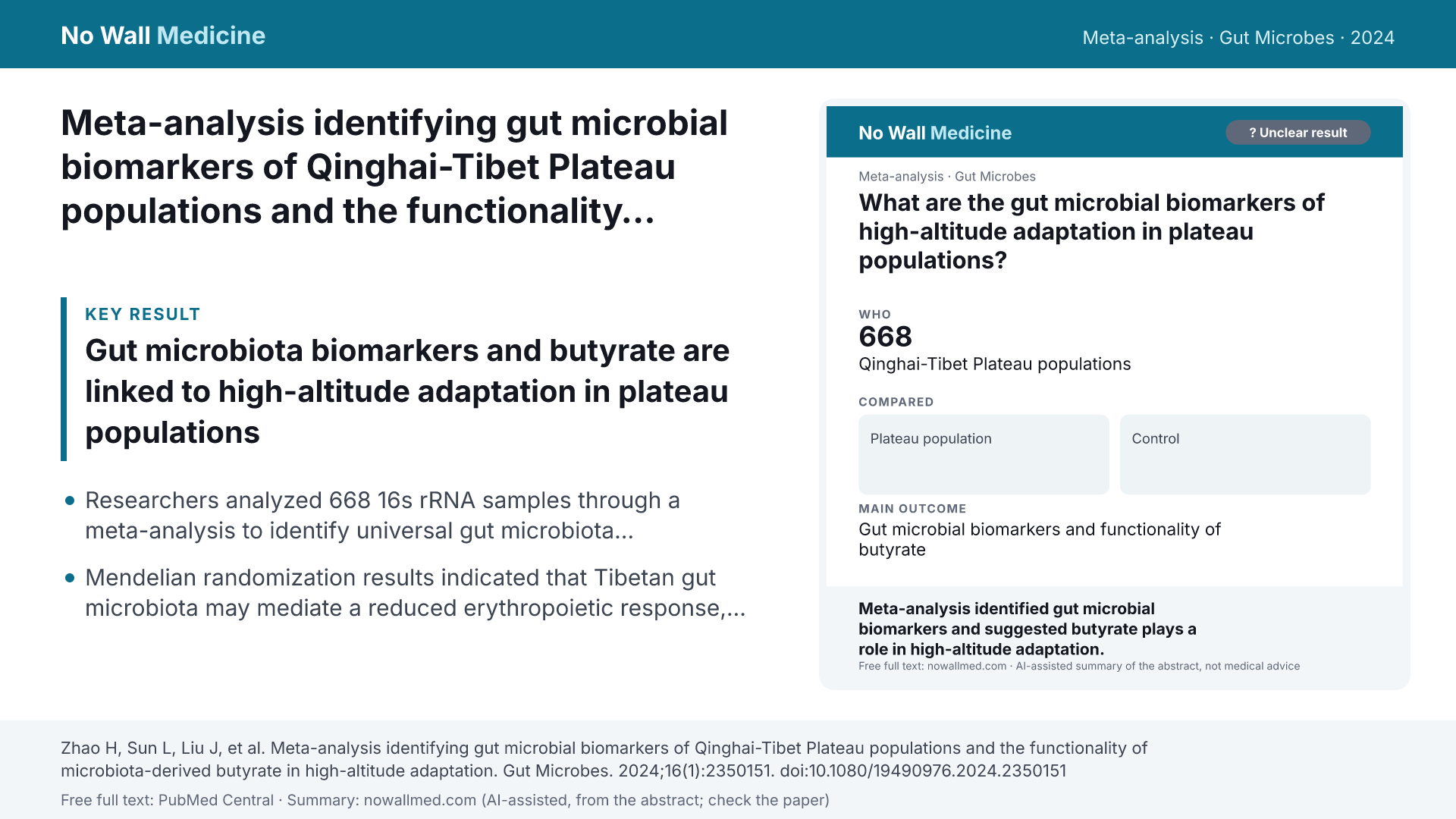
Gut microbiota biomarkers and butyrate are linked to high-altitude adaptation in plateau populations
Meta-analysis identifying gut microbial biomarkers of Qinghai-Tibet Plateau populations and the functionality of microbiota-derived butyrate in high-altitude adaptation
Meta-analysisUnclear result
What are the gut microbial biomarkers of high-altitude adaptation in plateau populations?
Who
668
Qinghai-Tibet Plateau populations
Compared
Plateau population
Control
Main outcome
Gut microbial biomarkers and functionality of butyrate
Bottom line: Meta-analysis identified gut microbial biomarkers and suggested butyrate plays a role in high-altitude adaptation.
Gut Microbes · 2024-05-07Download image

Clinical question: What are the gut microbial biomarkers of high-altitude adaptation in plateau populations?
Why it matters: Universal gut microbiota biomarkers for plateau populations have not been identified, which limits research into how gut microbes relate to high-altitude adaptation.
Key points
- Researchers analyzed 668 16s rRNA samples through a meta-analysis to identify universal gut microbiota biomarkers in plateau populations.
- Mendelian randomization results indicated that Tibetan gut microbiota may mediate a reduced erythropoietic response, which is the process of red blood cell production.
- Functional analysis and cell experiments suggested that butyrate may downregulate hypoxia-inducible factor-1α expression and blunt cellular responses to low oxygen stress.
Headline and key points written with AI from the paper’s abstract, with every number checked against it. Read the paper before relying on them.
Was this summary helpful?
Subject terms
Cite this article
Zhao H, Sun L, Liu J, et al. Meta-analysis identifying gut microbial biomarkers of Qinghai-Tibet Plateau populations and the functionality of microbiota-derived butyrate in high-altitude adaptation. Gut Microbes. 2024. doi:10.1080/19490976.2024.2350151
Spotted a mistake? Suggest a correction