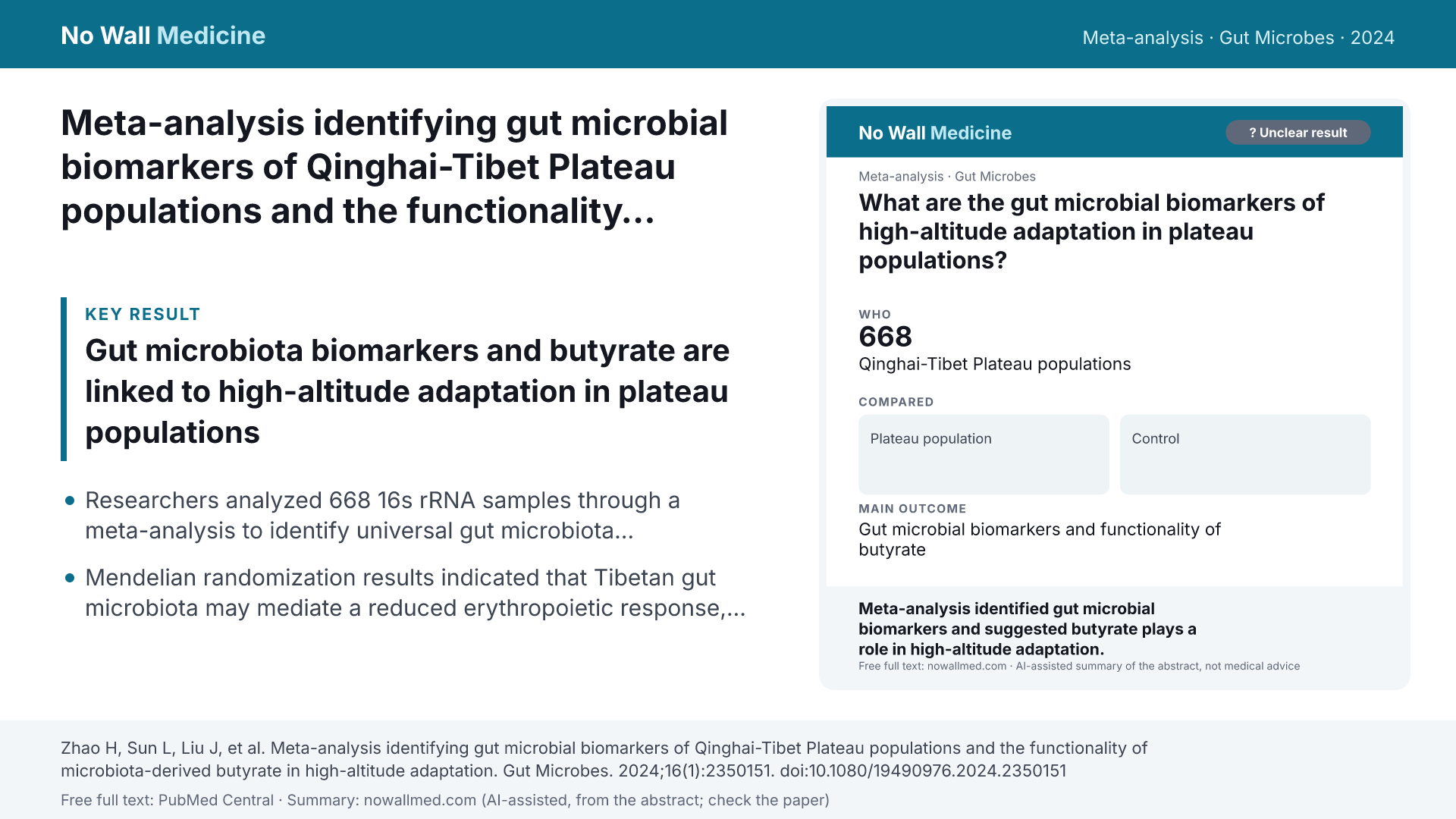
Meta-analysis identifying gut microbial biomarkers of Qinghai-Tibet Plateau populations and the functionality of microbiota-derived butyrate in high-altitude adaptation
Key result: Gut microbiota biomarkers and butyrate are linked to high-altitude adaptation in plateau populations
Key points
- Researchers analyzed 668 16s rRNA samples through a meta-analysis to identify universal gut microbiota biomarkers in plateau populations.
- Mendelian randomization results indicated that Tibetan gut microbiota may mediate a reduced erythropoietic response, which is the process of red blood cell production.
- Functional analysis and cell experiments suggested that butyrate may downregulate hypoxia-inducible factor-1α expression and blunt cellular responses to low oxygen stress.
Why it matters: Universal gut microbiota biomarkers for plateau populations have not been identified, which limits research into how gut microbes relate to high-altitude adaptation.
Discussion prompts
- Would these patients look like yours? Who was left out?
- Is the main outcome one that matters to patients?
- Is the difference large enough to change what you do?
Cite: Zhao H, Sun L, Liu J, et al. Meta-analysis identifying gut microbial biomarkers of Qinghai-Tibet Plateau populations and the functionality of microbiota-derived butyrate in high-altitude adaptation. Gut Microbes. 2024;16(1):2350151. doi:10.1080/19490976.2024.2350151
Free full text: PubMed Central · Summary and visual abstract: nowallmed.com/a/meta-analysis-identifying-gut-microbial-biomarkers-of-qinghai-tibet-ptd2yi/ (AI-assisted from the abstract; check the paper before relying on it).