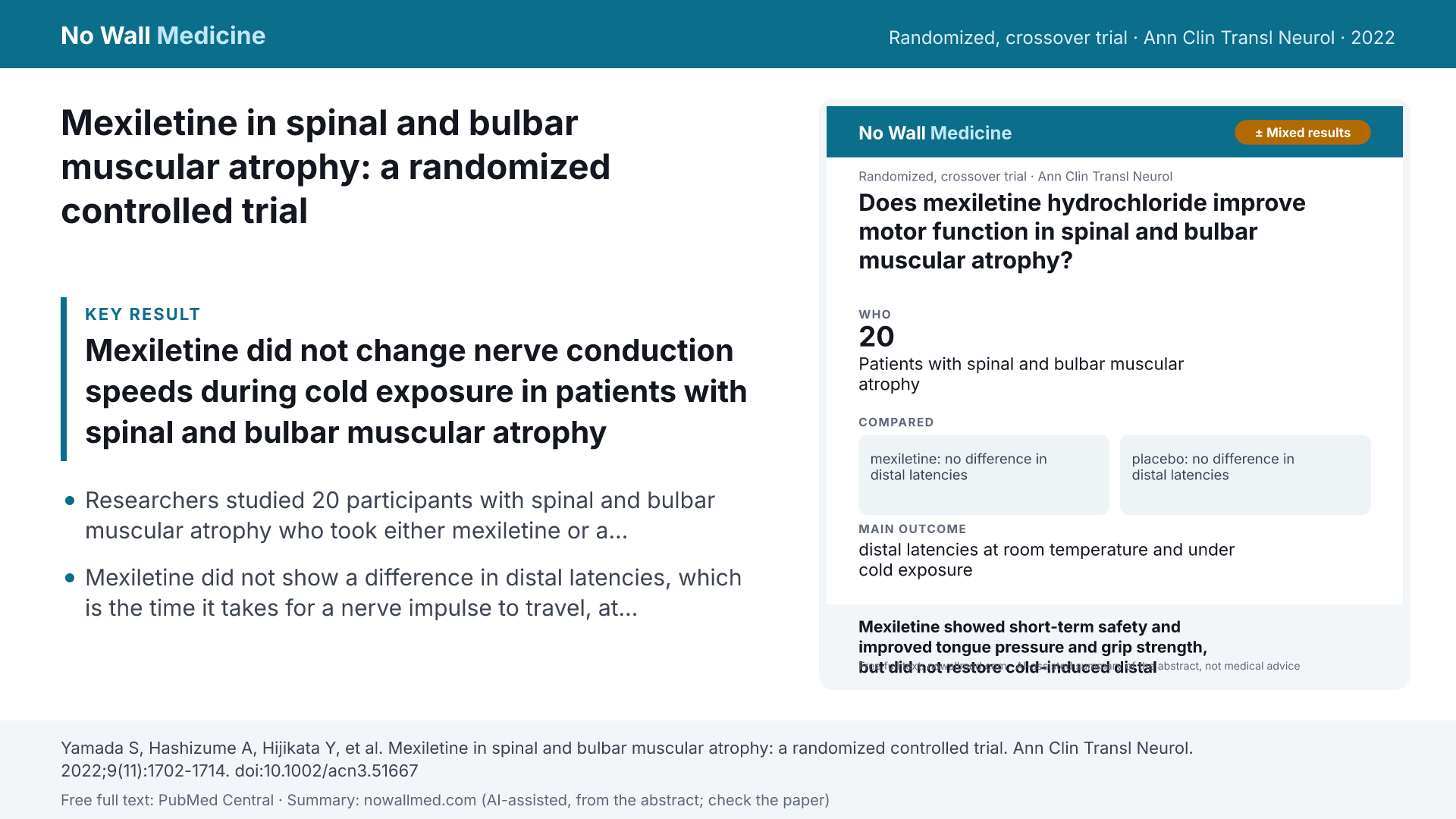
Mexiletine did not change nerve conduction speeds during cold exposure in patients with spinal and bulbar muscular atrophy
Mexiletine in spinal and bulbar muscular atrophy: a randomized controlled trial
Randomized, crossover trialMixed results
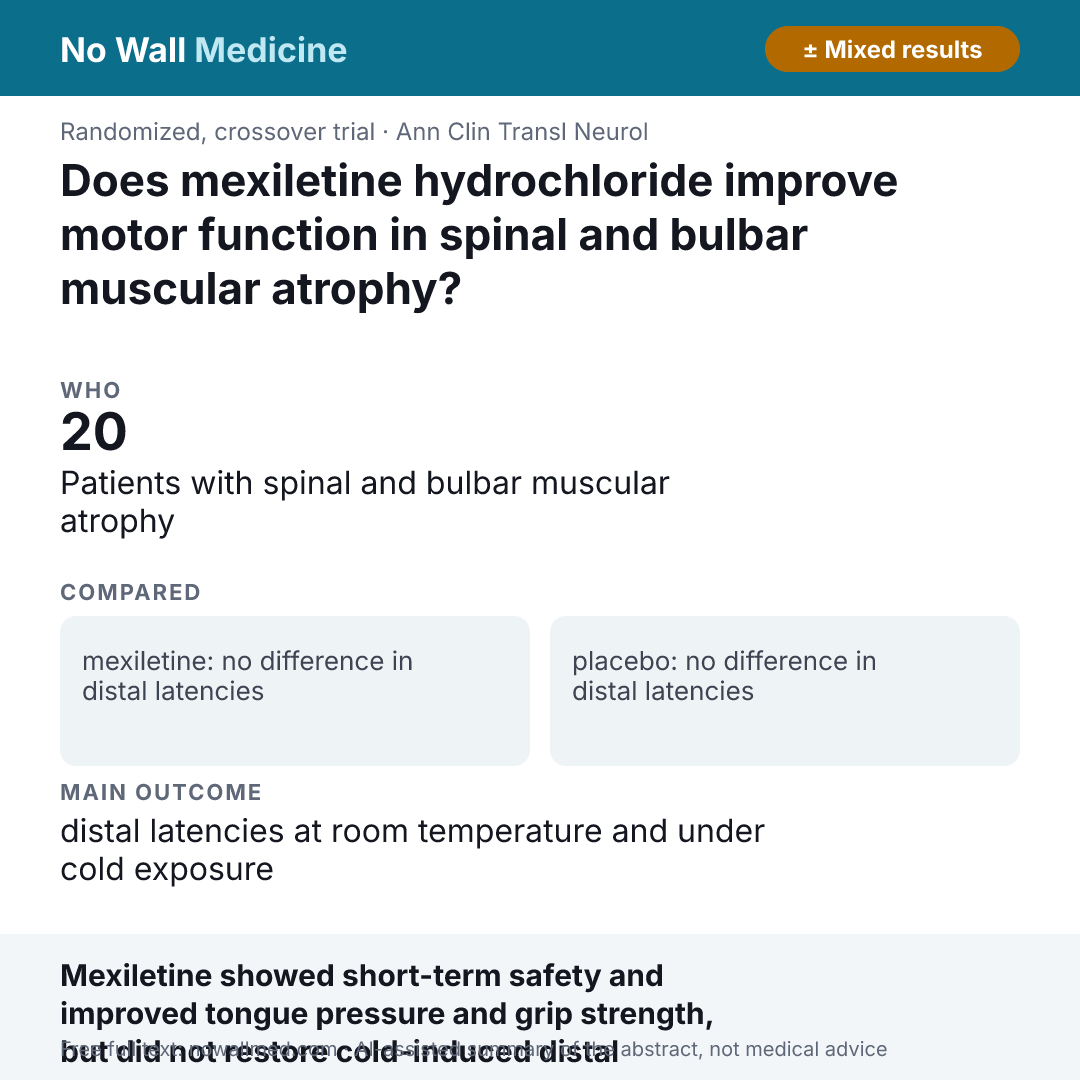
Does mexiletine hydrochloride improve motor function in spinal and bulbar muscular atrophy?
Who
20
Patients with spinal and bulbar muscular atrophy
Compared
mexiletine: no difference in distal latencies
placebo: no difference in distal latencies
Main outcome
distal latencies at room temperature and under cold exposure
Bottom line: Mexiletine showed short-term safety and improved tongue pressure and grip strength, but did not restore cold-induced distal latency prolongation.
Limitation: This was a phase II clinical trial with 20 participants.
Ann Clin Transl Neurol · 2022-10-08 · Save PNG
Clinical question: Does mexiletine hydrochloride improve motor function in spinal and bulbar muscular atrophy?
Key points
- Researchers studied 20 participants with spinal and bulbar muscular atrophy who took either mexiletine or a lactose placebo three times a day for 4 weeks.
- Mexiletine did not show a difference in distal latencies, which is the time it takes for a nerve impulse to travel, at room temperature or during cold exposure.
- In the mexiletine group, tongue pressure and the 10-second grip and release test under cold exposure were improved, and no serious adverse events occurred.
Headline and key points written with AI from the paper’s abstract, with every number checked against it. Read the paper before relying on them.
Was this summary helpful?
Subject terms
Headline, design, result, key points, caveat and citation as plain text.
Cite this article
Yamada S, Hashizume A, Hijikata Y, et al. Mexiletine in spinal and bulbar muscular atrophy: a randomized controlled trial. Ann Clin Transl Neurol. 2022;9(11):1702-1714. doi:10.1002/acn3.51667
Spotted a mistake? Suggest a correction