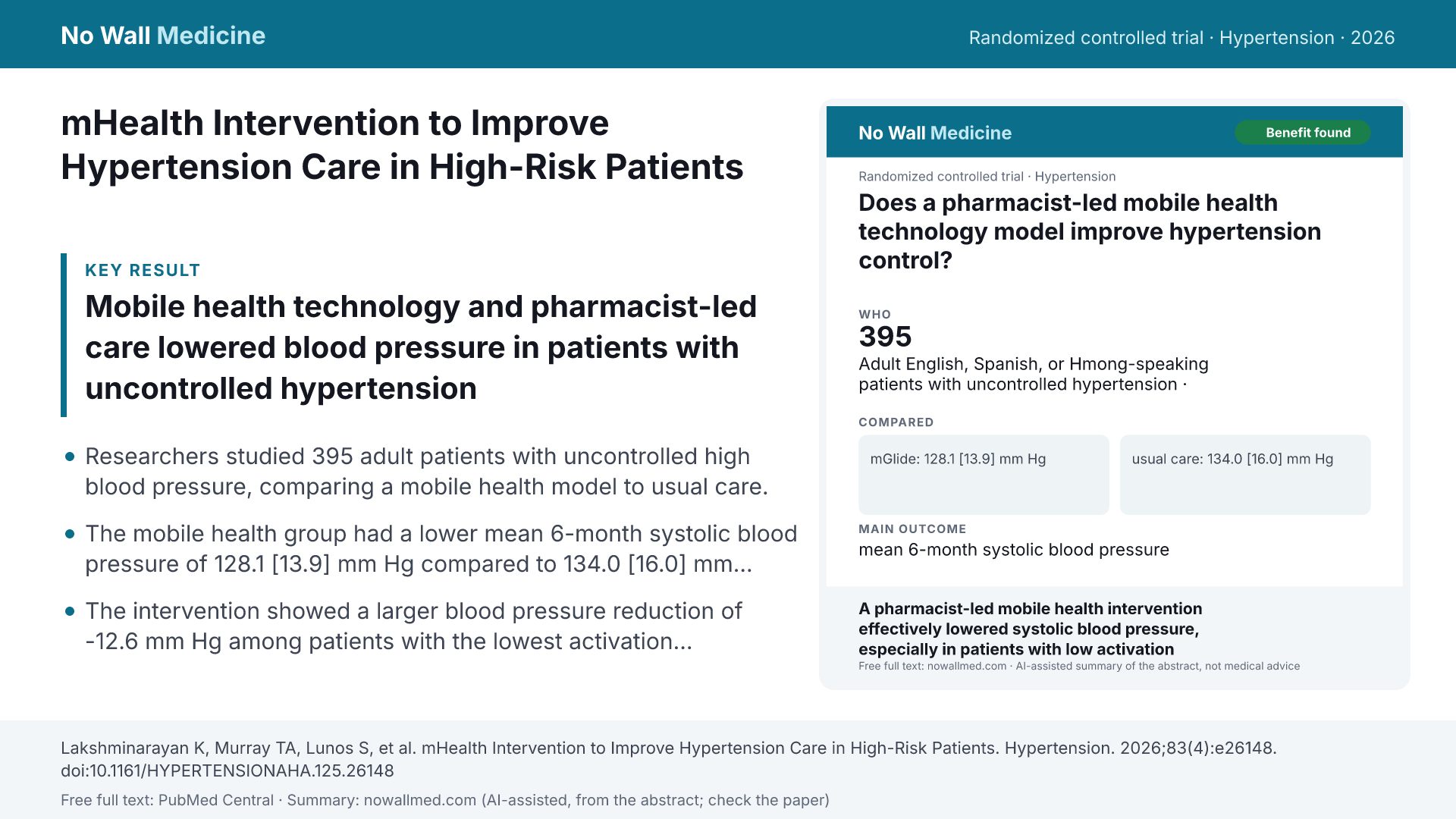
Mobile health technology and pharmacist-led care lowered blood pressure in patients with uncontrolled hypertension
mHealth Intervention to Improve Hypertension Care in High-Risk Patients
Randomized controlled trialBenefit found
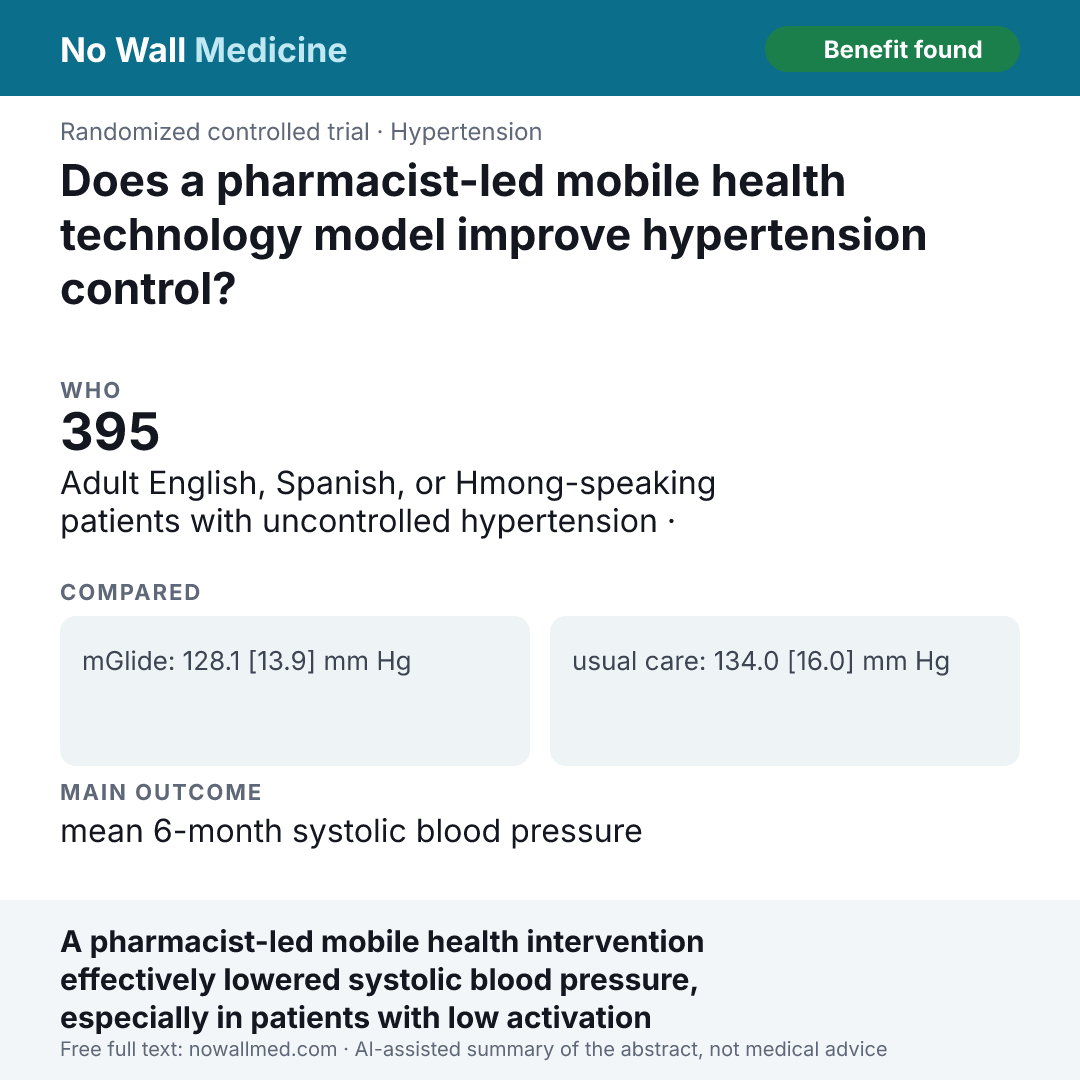
Does a pharmacist-led mobile health technology model improve hypertension control?
Who
395
Adult English, Spanish, or Hmong-speaking patients with uncontrolled hypertension · Large health care system and community clinics
Compared
mGlide: 128.1 [13.9] mm Hg
usual care: 134.0 [16.0] mm Hg
Main outcome
mean 6-month systolic blood pressure
Result: -5.8 mm Hg (95% CI, -8.6 to -3.0)
Bottom line: A pharmacist-led mobile health intervention effectively lowered systolic blood pressure, especially in patients with low activation levels.
Hypertension · 2026-02-20 · Save PNG
Clinical question: Does a pharmacist-led mobile health technology model improve hypertension control?
Key points
- Researchers studied 395 adult patients with uncontrolled high blood pressure, comparing a mobile health model to usual care.
- The mobile health group had a lower mean 6-month systolic blood pressure of 128.1 [13.9] mm Hg compared to 134.0 [16.0] mm Hg in the usual care group.
- The intervention showed a larger blood pressure reduction of -12.6 mm Hg among patients with the lowest activation levels compared to -2.5 mm Hg in those with the highest levels.
Headline and key points written with AI from the paper’s abstract, with every number checked against it. Read the paper before relying on them.
Was this summary helpful?
Subject terms
Headline, design, result, key points, caveat and citation as plain text.
Cite this article
Lakshminarayan K, Murray TA, Lunos S, et al. mHealth Intervention to Improve Hypertension Care in High-Risk Patients. Hypertension. 2026;83(4):e26148. doi:10.1161/HYPERTENSIONAHA.125.26148
Spotted a mistake? Suggest a correction