Self-Measured Blood Pressure-Guided Pharmacotherapy: A Systematic Review and Meta-Analysis of United States-Based Telemedicine Trials
Systematic review and meta-analysisBenefit found
Is telemedicine hypertension management more effective than usual clinic-based care?
Who
Patients in United States-based randomized trials · United States
Compared
Telemedicine hypertension management
Usual clinic-based care
Main outcome
Systolic blood pressure, diastolic blood pressure, and blood pressure control
Result: systolic BP difference -7.3 mm Hg (95% CI, -9.4 to -5.2), diastolic BP difference -2.7 mm Hg (-4.0 to -1.5), and BP control rate 10.1% (0.4%-19.9%)
Bottom line: Telemedicine hypertension management is more effective than clinic-based care in the United States.
Hypertension · 2024-01-08Download image
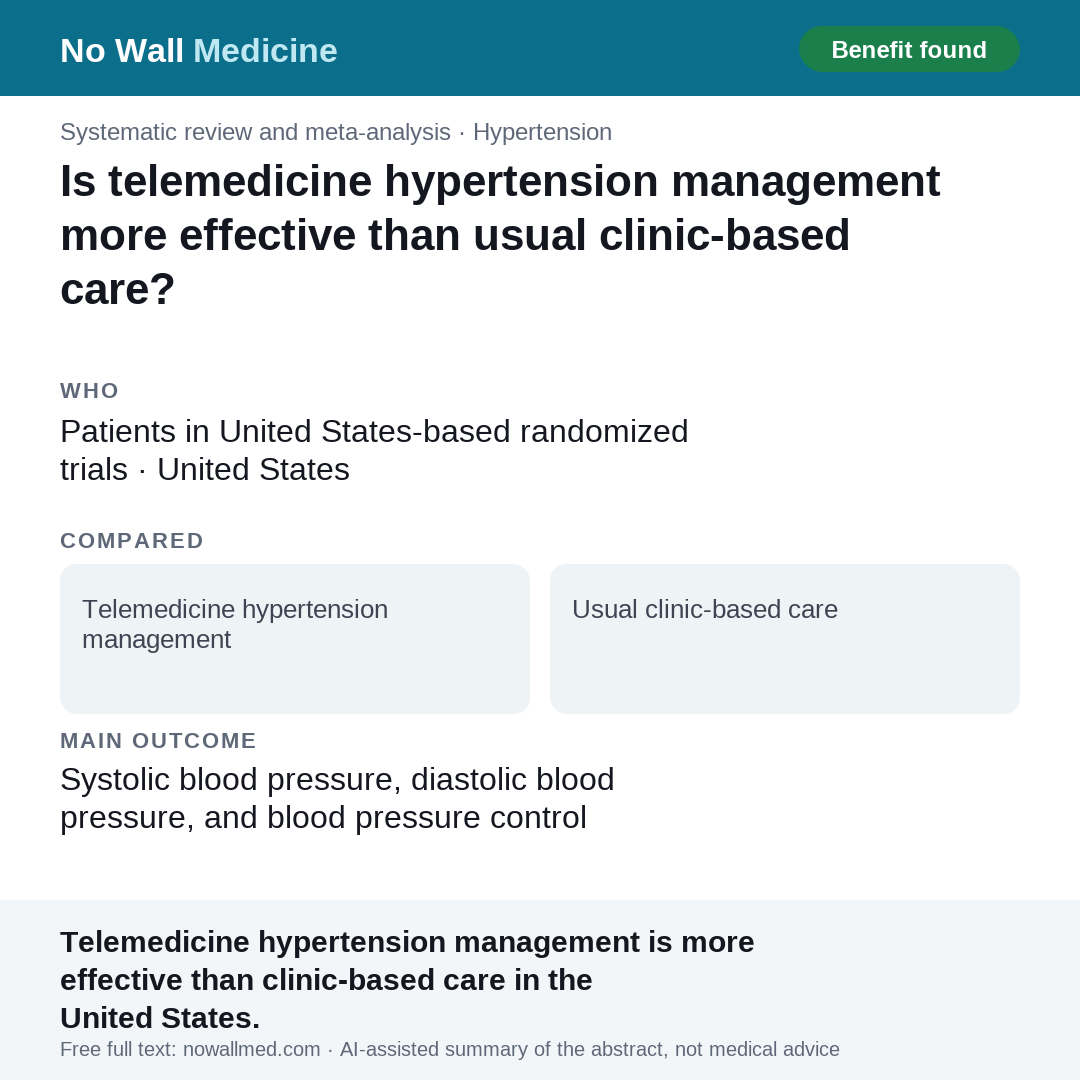
Clinical question: Is telemedicine hypertension management more effective than usual clinic-based care?
Abstract
Background
The optimal approach to implementing telemedicine hypertension management in the United States is unknown. Methods
We examined telemedicine hypertension management versus the effect of usual clinic-based care on blood pressure (BP) and patient/clinician-related heterogeneity in a systematic review/meta-analysis. We searched United States-based randomized trials from Medline, Embase, CENTRAL, CINAHL, PsycINFO, Compendex, Web of Science Core Collection, Scopus, and 2 trial registries. We used trial-level differences in BP and its control rate at ≥6 months using random-effects models. We examined heterogeneity in univariable metaregression and in prespecified subgroups (clinicians leading pharmacotherapy [physician/nonphysician], self-management support [pharmacist/nurse], White versus non-White patient predominant trials [>50% patients/trial], diabetes predominant trials [≥25% patients/trial], and White patient predominant but not diabetes predominant trials versus both non-White and diabetes patient predominant trials]. Results
Thirteen, 11, and 7 trials were eligible for systolic and diastolic BP difference and BP control, respectively. Differences in systolic and diastolic BP and BP control rate were -7.3 mm Hg (95% CI, -9.4 to -5.2), -2.7 mm Hg (-4.0 to -1.5), and 10.1% (0.4%-19.9%), respectively, favoring telemedicine. Greater BP reduction occurred in trials where nonphysicians led pharmacotherapy, pharmacists provided self-management support, White patient predominant trials, and White patient predominant but not diabetes predominant trials, with no difference by diabetes predominant trials. Conclusions
Telemedicine hypertension management is more effective than clinic-based care in the United States, particularly when nonphysicians lead pharmacotherapy and pharmacists provide self-management support. Non-White patient predominant trials achieved less BP reduction. Equity-conscious, locally informed adaptation of telemedicine interventions is needed before wider implementation.
Topics
Cite this article
Acharya S, Neupane G, Seals A, Kc M, Giustini D, Sharma S. Self-Measured Blood Pressure-Guided Pharmacotherapy: A Systematic Review and Meta-Analysis of United States-Based Telemedicine Trials. Hypertension. 2024. doi:10.1161/HYPERTENSIONAHA.123.22109
Spotted a mistake? Suggest a correction
Top studies every Monday
The week’s key trials and guidelines in your specialties, plus any topics you follow. By email, free.
Get the weekly digest