Stereotactic body radiotherapy and microwave ablation showed similar local disease control in colorectal liver metastases
Microwave ablation versus stereotactic body radiotherapy for oligometastatic colorectal liver metastases (LAVA-CRLM): a prospective, randomised, phase II trial
Randomised, phase II trialNo clear difference
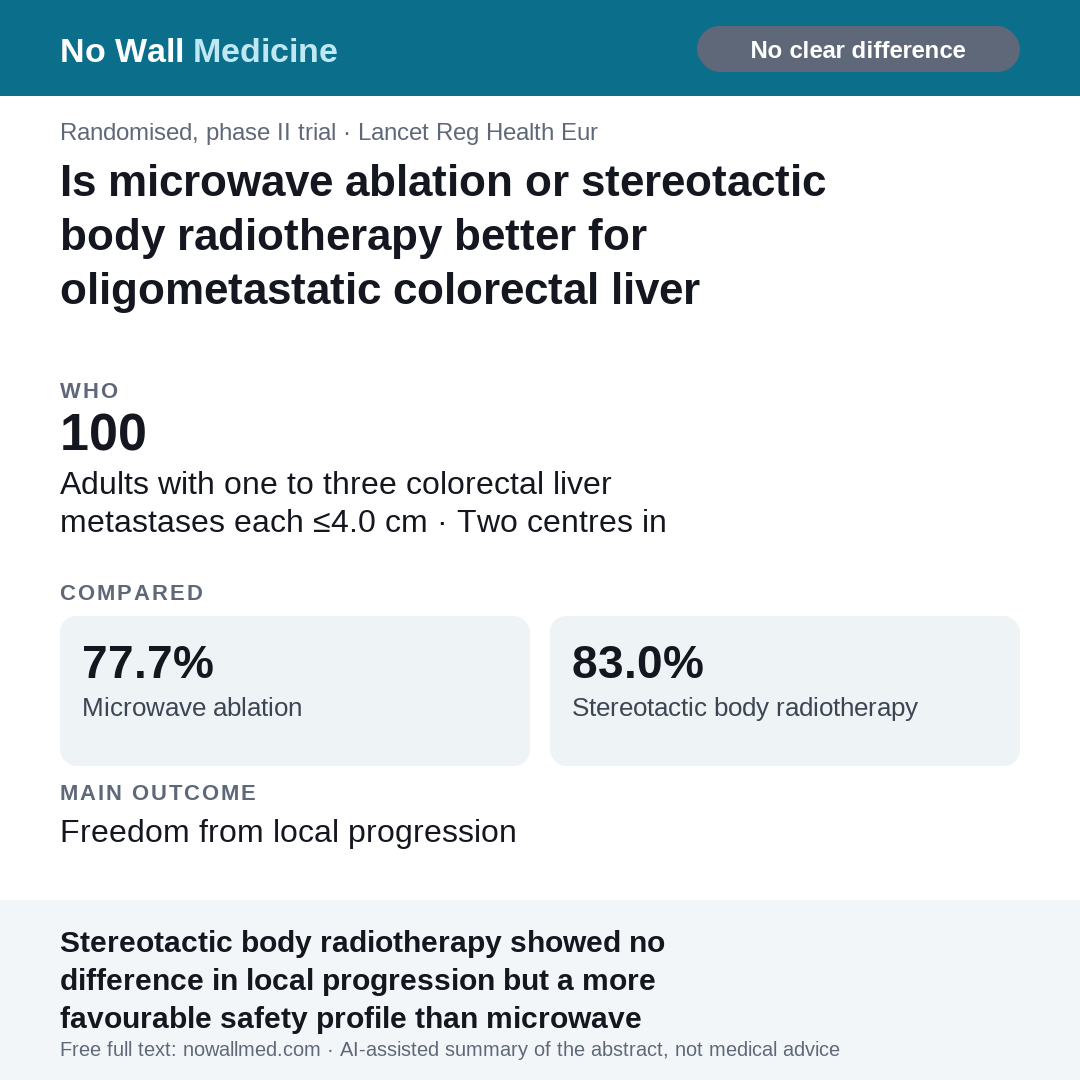
Is microwave ablation or stereotactic body radiotherapy better for oligometastatic colorectal liver metastases?
Who
100
Adults with one to three colorectal liver metastases each ≤4.0 cm · Two centres in Copenhagen, Denmark
Compared
77.7%Microwave ablation (95% CI 66.5-90.9)
83.0%Stereotactic body radiotherapy (72.3-95.4)
Main outcome
Freedom from local progression
Result: hazard ratio 0.87, 95% CI 0.43-1.74
Bottom line: Stereotactic body radiotherapy showed no difference in local progression but a more favourable safety profile than microwave ablation.
Funded by: Danish Cancer Society
Lancet Reg Health Eur · 2026-09-25Download image
Clinical question: Is microwave ablation or stereotactic body radiotherapy better for oligometastatic colorectal liver metastases?
Why it matters: There is limited prospective comparative evidence regarding the use of stereotactic body radiotherapy as a non-invasive alternative to microwave ablation for treating colorectal liver metastases.
Key points
- Researchers studied 100 adults with one to three colorectal liver metastases measuring 4.0 cm or less, comparing microwave ablation to stereotactic body radiotherapy.
- At a median follow-up of 34.9 months, 1-year freedom from local progression was 77.7% for microwave ablation and 83.0% for stereotactic body radiotherapy.
- Grade 2 or higher treatment-related toxicity occurred in 25% of microwave ablation patients compared to 3% of stereotactic body radiotherapy patients.
Headline and key points written with AI from the paper’s abstract, with every number checked against it. Read the paper before relying on them.
Spotted a mistake? Suggest a correction