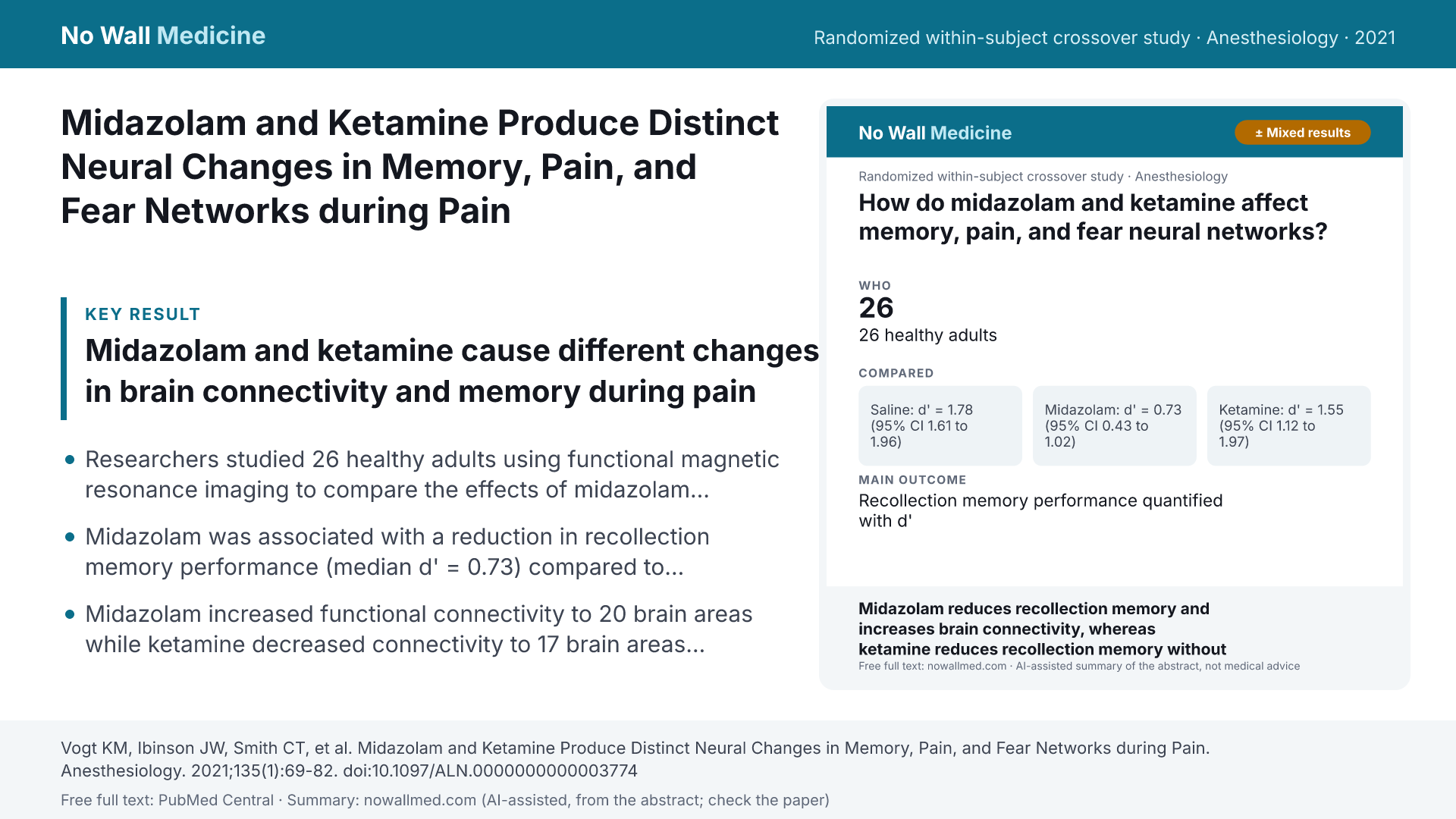
Midazolam and ketamine cause different changes in brain connectivity and memory during pain
Midazolam and Ketamine Produce Distinct Neural Changes in Memory, Pain, and Fear Networks during Pain
Randomized within-subject crossover studyMixed results
How do midazolam and ketamine affect memory, pain, and fear neural networks?
Who
26
26 healthy adults
Compared
Saline: d' = 1.78 (95% CI 1.61 to 1.96)
Midazolam: d' = 0.73 (95% CI 0.43 to 1.02)
Ketamine: d' = 1.55 (95% CI 1.12 to 1.97)
Main outcome
Recollection memory performance quantified with d'
Bottom line: Midazolam reduces recollection memory and increases brain connectivity, whereas ketamine reduces recollection memory without increasing connectivity.
Anesthesiology · 2021-04-20Download image
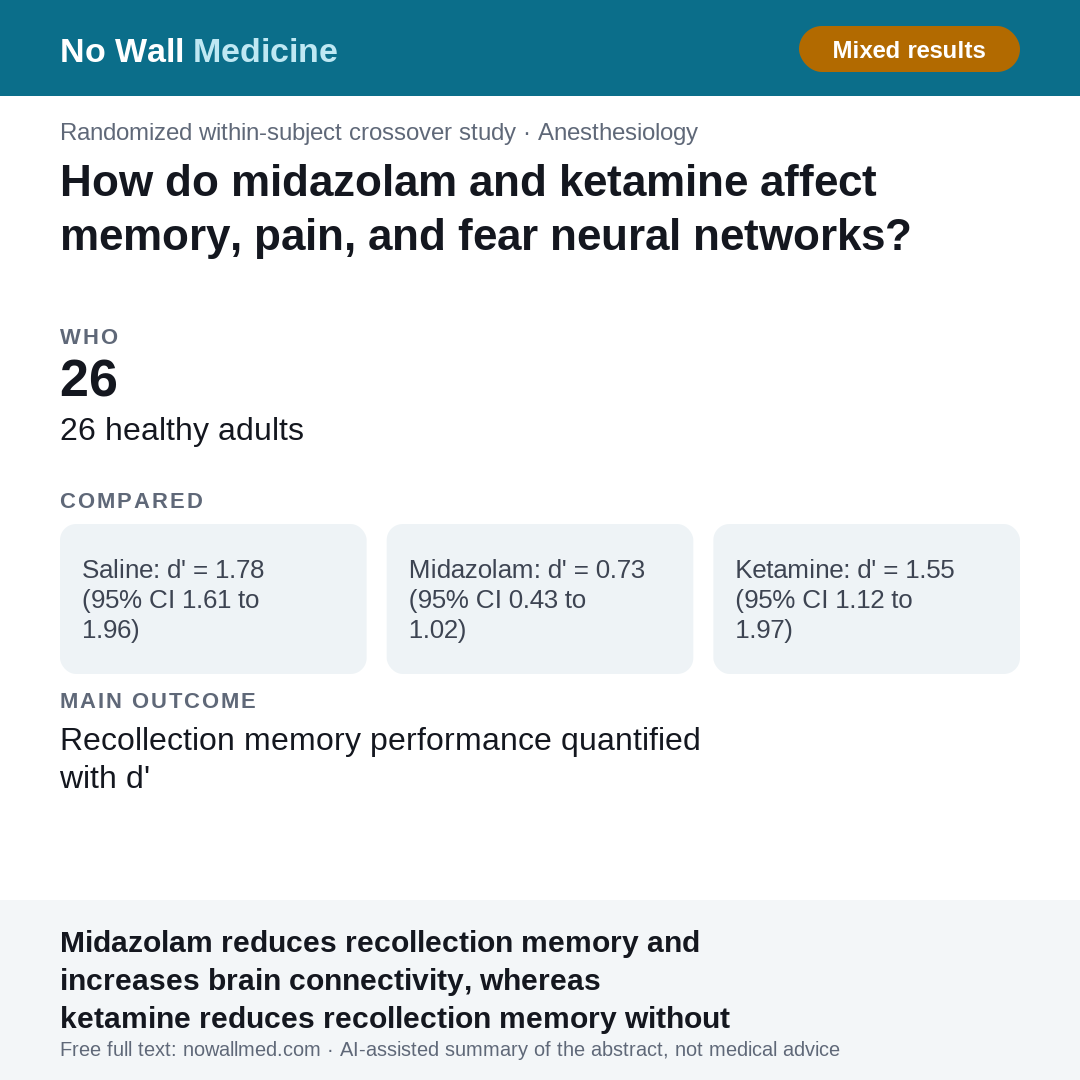
Clinical question: How do midazolam and ketamine affect memory, pain, and fear neural networks?
Why it matters: The neural mechanisms of how midazolam and ketamine affect the brain systems for memory, pain, and fear are incompletely understood.
Key points
- Researchers studied 26 healthy adults using functional magnetic resonance imaging to compare the effects of midazolam and ketamine against saline during periodic pain.
- Midazolam was associated with a reduction in recollection memory performance (median d' = 0.73) compared to saline (median d' = 1.78) and ketamine (median d' = 1.55).
- Midazolam increased functional connectivity to 20 brain areas while ketamine decreased connectivity to 17 brain areas from various seed regions.
Headline and key points written with AI from the paper’s abstract, with every number checked against it. Read the paper before relying on them.
Was this summary helpful?
Subject terms
Cite this article
Vogt KM, Ibinson JW, Smith CT, et al. Midazolam and Ketamine Produce Distinct Neural Changes in Memory, Pain, and Fear Networks during Pain. Anesthesiology. 2021. doi:10.1097/ALN.0000000000003774
Spotted a mistake? Suggest a correction