Midazolam and Ketamine Produce Distinct Neural Changes in Memory, Pain, and Fear Networks during Pain
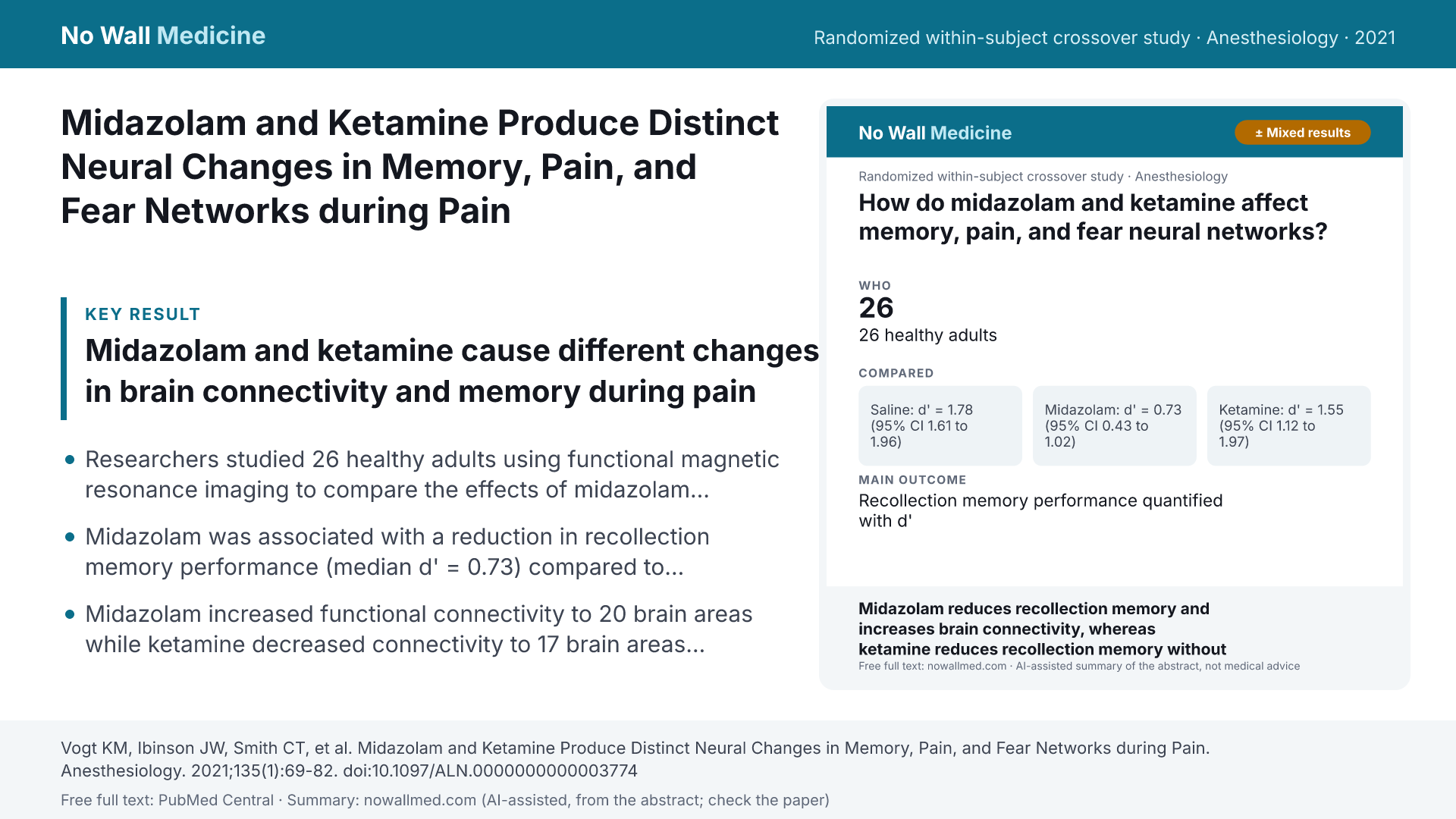
Key result: Midazolam and ketamine cause different changes in brain connectivity and memory during pain
Randomized within-subject crossover studyMixed results
How do midazolam and ketamine affect memory, pain, and fear neural networks?
Who
26
26 healthy adults
Compared
Saline: d' = 1.78 (95% CI 1.61 to 1.96)
Midazolam: d' = 0.73 (95% CI 0.43 to 1.02)
Ketamine: d' = 1.55 (95% CI 1.12 to 1.97)
Main outcome
Recollection memory performance quantified with d'
Bottom line: Midazolam reduces recollection memory and increases brain connectivity, whereas ketamine reduces recollection memory without increasing connectivity.
Anesthesiology · 2021-04-20
Key points
- Researchers studied 26 healthy adults using functional magnetic resonance imaging to compare the effects of midazolam and ketamine against saline during periodic pain.
- Midazolam was associated with a reduction in recollection memory performance (median d' = 0.73) compared to saline (median d' = 1.78) and ketamine (median d' = 1.55).
- Midazolam increased functional connectivity to 20 brain areas while ketamine decreased connectivity to 17 brain areas from various seed regions.
Why it matters: The neural mechanisms of how midazolam and ketamine affect the brain systems for memory, pain, and fear are incompletely understood.
Discussion prompts
- Would these patients look like yours? Who was left out?
- Is the main outcome one that matters to patients?
- Is the difference large enough to change what you do?
Cite: Vogt KM, Ibinson JW, Smith CT, et al. Midazolam and Ketamine Produce Distinct Neural Changes in Memory, Pain, and Fear Networks during Pain. Anesthesiology. 2021;135(1):69-82. doi:10.1097/ALN.0000000000003774
Free full text: PubMed Central · Summary and visual abstract: nowallmed.com/a/midazolam-and-ketamine-produce-distinct-neural-changes-in-memory-pain-luhjwc/ (AI-assisted from the abstract; check the paper before relying on it).