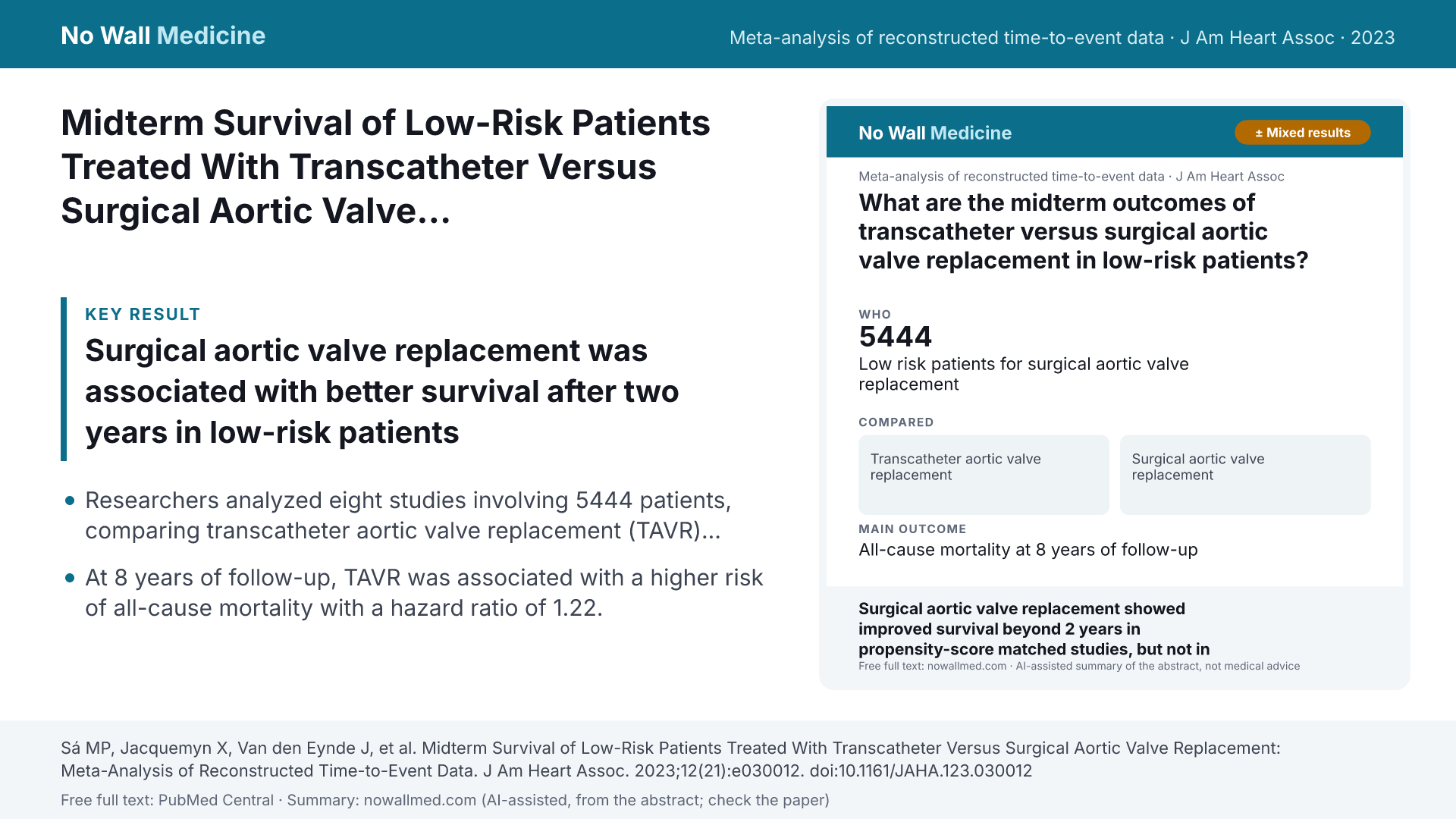
Surgical aortic valve replacement was associated with better survival after two years in low-risk patients
Midterm Survival of Low-Risk Patients Treated With Transcatheter Versus Surgical Aortic Valve Replacement: Meta-Analysis of Reconstructed Time-to-Event Data
Meta-analysis of reconstructed time-to-event dataMixed results
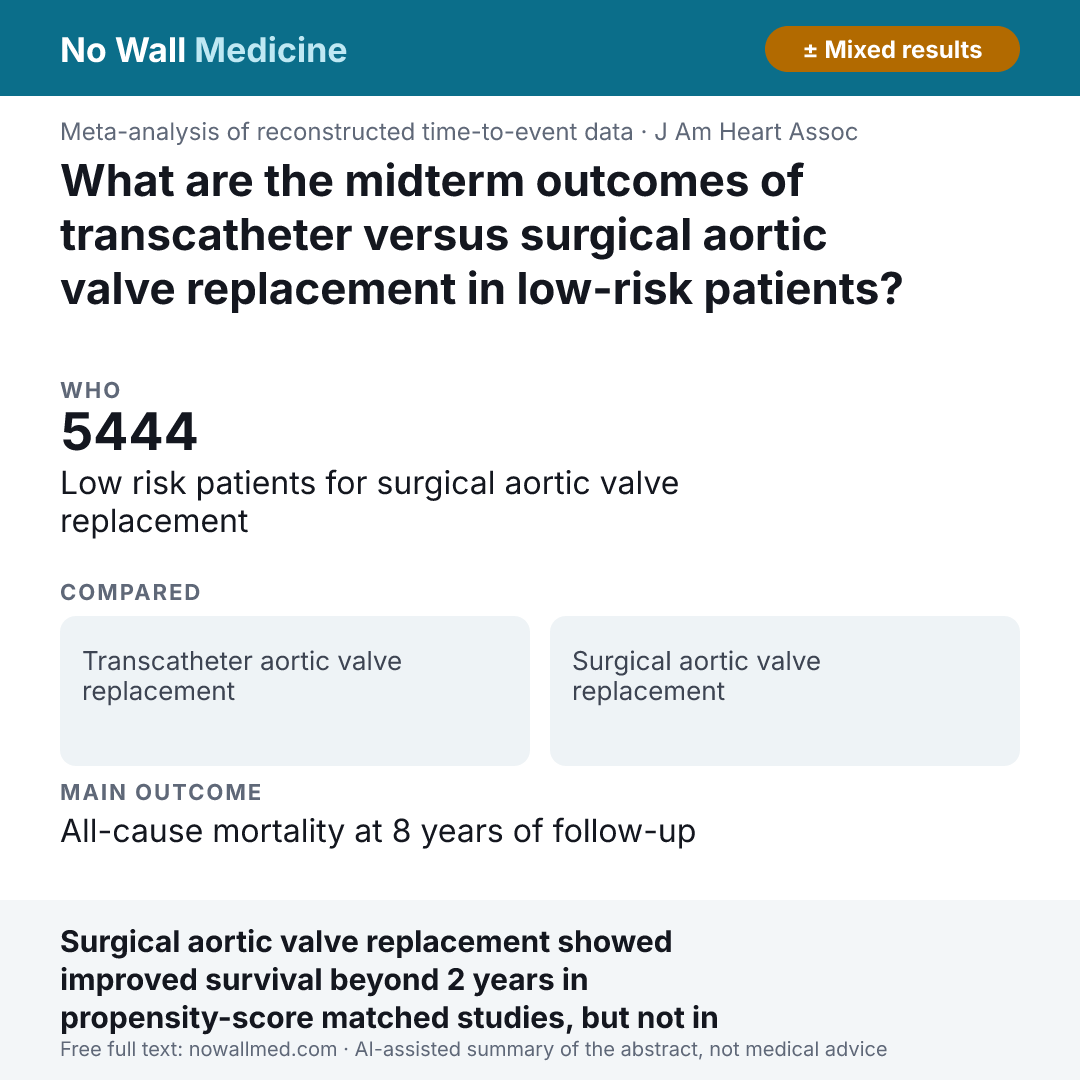
What are the midterm outcomes of transcatheter versus surgical aortic valve replacement in low-risk patients?
Who
5444
Low risk patients for surgical aortic valve replacement
Compared
Transcatheter aortic valve replacement
Surgical aortic valve replacement
Main outcome
All-cause mortality at 8 years of follow-up
Result: hazard ratio 1.22 (95% CI 1.03-1.43)
Bottom line: Surgical aortic valve replacement showed improved survival beyond 2 years in propensity-score matched studies, but not in randomized controlled trials.
Limitation: The survival benefit of surgical aortic valve replacement was observed only in propensity-score matched studies and not in randomized controlled trials.
J Am Heart Assoc · 2023-11-06 · Save PNG
Clinical question: What are the midterm outcomes of transcatheter versus surgical aortic valve replacement in low-risk patients?
Key points
- Researchers analyzed eight studies involving 5444 patients, comparing transcatheter aortic valve replacement (TAVR) to surgical aortic valve replacement (SAVR).
- At 8 years of follow-up, TAVR was associated with a higher risk of all-cause mortality with a hazard ratio of 1.22.
- While TAVR was not inferior to SAVR up to 2 years, a significant difference in mortality was observed after 2 years in propensity-score matched studies.
Headline and key points written with AI from the paper’s abstract, with every number checked against it. Read the paper before relying on them.
Was this summary helpful?
Subject terms
Headline, design, result, key points, caveat and citation as plain text.
Cite this article
Sá MP, Jacquemyn X, Van den Eynde J, et al. Midterm Survival of Low-Risk Patients Treated With Transcatheter Versus Surgical Aortic Valve Replacement: Meta-Analysis of Reconstructed Time-to-Event Data. J Am Heart Assoc. 2023;12(21):e030012. doi:10.1161/JAHA.123.030012
Spotted a mistake? Suggest a correction