Most studies show small effects of mindfulness mobile apps on well-being in nonclinical populations
Mindfulness-Based Mobile Apps and Their Impact on Well-Being in Nonclinical Populations: Systematic Review of Randomized Controlled Trials
Meta-analysis of 28 trialsMixed results
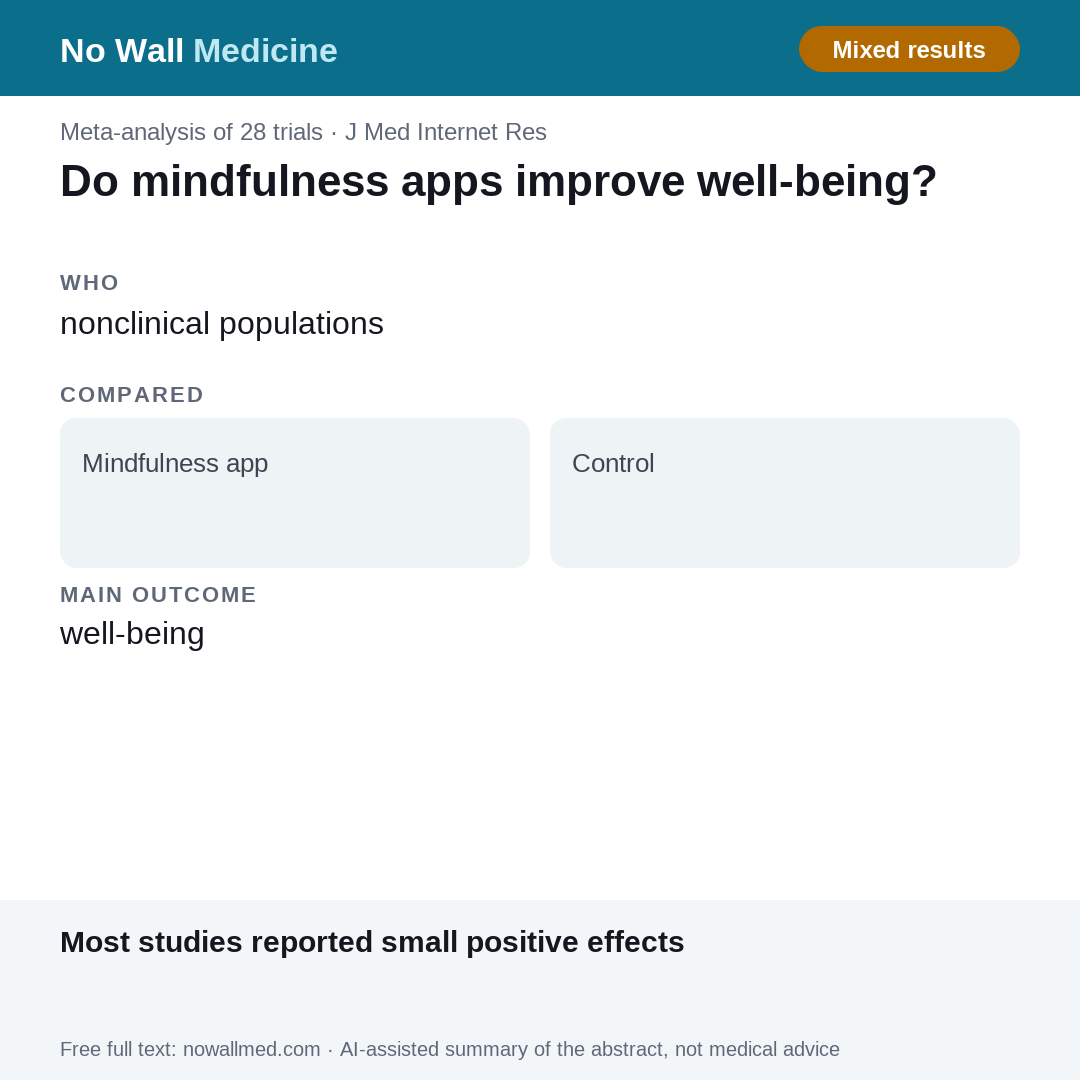
Do mindfulness apps improve well-being?
Who
nonclinical populations
Compared
Mindfulness app
Control
Main outcome
well-being
Bottom line: Most studies reported small positive effects
Limitation: high risk of bias and limited comparability
J Med Internet Res · 2023-08-04Download image
Clinical question: Do mindfulness apps improve well-being?
Why it matters: It is unknown how effective mindfulness-based mobile apps are for enhancing well-being in people without clinical diagnoses due to a lack of theoretical frameworks.
Key points
- Researchers reviewed 28 randomized controlled trials involving sample sizes ranging from 12 to 2282 people and intervention durations from 7 to 56 days.
- Most studies, representing 19/28 or 68%, reported positive effects on at least one aspect of well-being, though effects were primarily small or small to medium.
- The review found a wide range of attrition rates, which is the percentage of participants who dropped out, from 0% to 84.7%.
Limitation the authors note: The wide range of sample sizes, attrition rates, intervention periods, well-being measures, and mobile apps used limited the comparability and generalizability of the results.
Headline and key points written with AI from the paper’s abstract, with every number checked against it. Read the paper before relying on them.
Was this summary helpful?
Subject terms
Cite this article
Schwartz K, Ganster FM, Tran US. Mindfulness-Based Mobile Apps and Their Impact on Well-Being in Nonclinical Populations: Systematic Review of Randomized Controlled Trials. J Med Internet Res. 2023. doi:10.2196/44638
Spotted a mistake? Suggest a correction
Top studies every Monday
The week’s key trials and guidelines in your specialties, plus any topics you follow. By email, free.
Get the weekly digest