Researchers establish minimal clinically important difference ranges for the Short Musculoskeletal Function Assessment in trauma patients
Minimal Clinically Important Difference (MCID) for the Short Musculoskeletal Function Assessment (SMFA) in Severe Lower Extremity Trauma: Pooled Data from 7 Multicenter, Prospective Clinical Trials
Pooled data from 7 multicenter prospective clinical trialsUnclear result
What is the minimal clinically important difference for the Short Musculoskeletal Function Assessment?
Who
3185
Patients with severe lower extremity traumatic injuries · 60 Level-I trauma centers
Compared
Short Musculoskeletal Function Assessment Dysfunction Index: 7.7 to 10.7
Short Musculoskeletal Function Assessment Bother Index: 11.0 to 16.8
Main outcome
Minimal clinically important difference for Short Musculoskeletal Function Assessment indices
Bottom line: Minimal clinically important difference is between 7 and 11 points for Dysfunction and 11 and 17 for Bother.
J Bone Joint Surg Am · 2024-07-02Download image
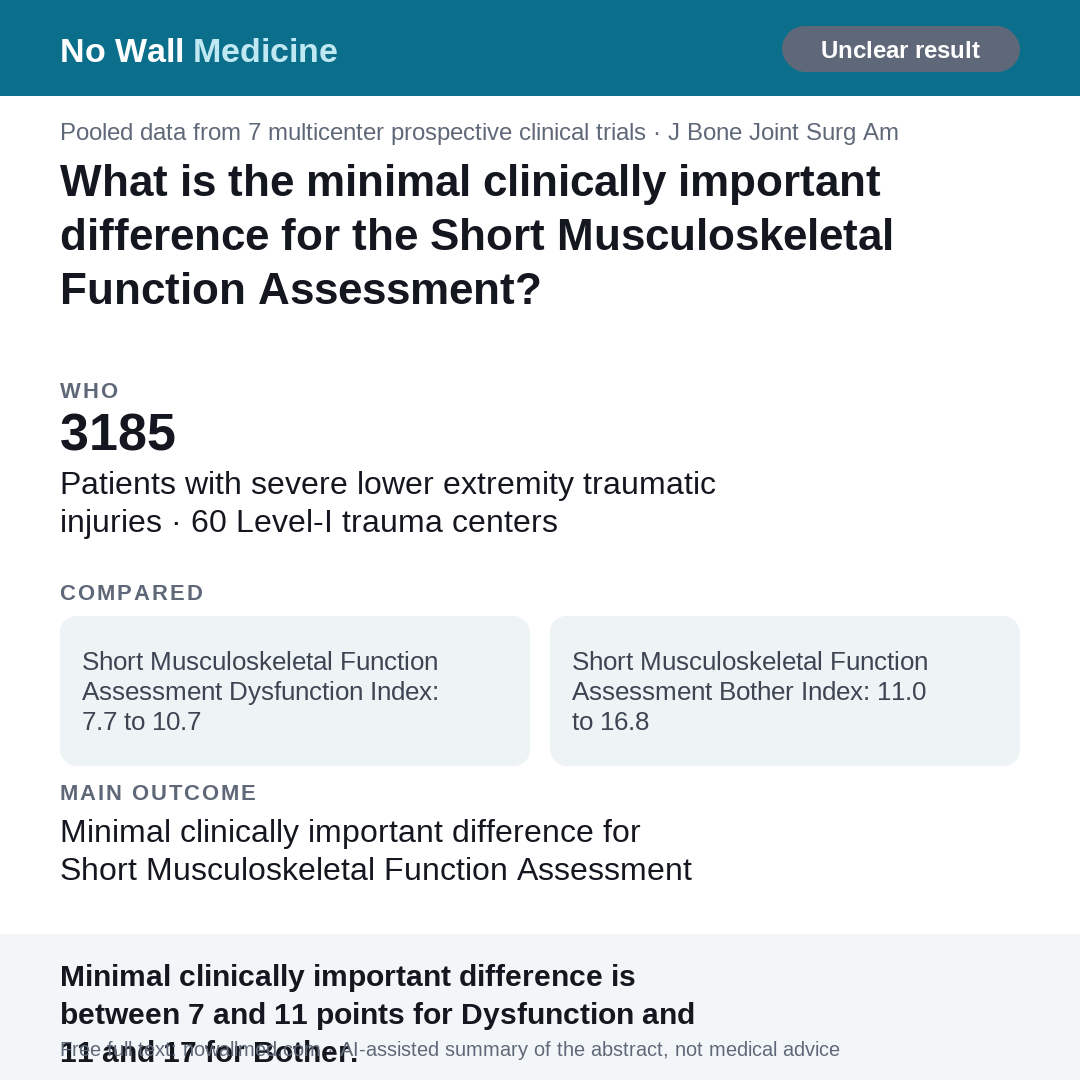
Clinical question: What is the minimal clinically important difference for the Short Musculoskeletal Function Assessment?
Why it matters: There is no agreed upon minimal clinically important difference for the Short Musculoskeletal Function Assessment, a widely used patient-reported outcome measure in orthopaedic care.
Key points
- Researchers analyzed 4,298 assessments from 3,185 patients with severe lower extremity fractures treated at 60 Level-I trauma centers.
- The calculated minimal clinically important difference for the Dysfunction Index ranged from 7.7 to 10.7, while the Bother Index ranged from 11.0 to 16.8.
- Variability in Dysfunction Index scores was small (<5%) within sex and age subgroups but was 12% to 18% across different assessment timings.
Headline and key points written with AI from the paper’s abstract, with every number checked against it. Read the paper before relying on them.
Was this summary helpful?
Subject terms
Cite this article
Carlini AR, Agel J, Bosse MJ, Frey KP, Staguhn ED, Vallier HA. Minimal Clinically Important Difference (MCID) for the Short Musculoskeletal Function Assessment (SMFA) in Severe Lower Extremity Trauma: Pooled Data from 7 Multicenter, Prospective Clinical Trials. J Bone Joint Surg Am. 2024. doi:10.2106/JBJS.23.01201
Spotted a mistake? Suggest a correction
Top studies every Monday
The week’s key trials and guidelines in your specialties, plus any topics you follow. By email, free.
Get the weekly digest