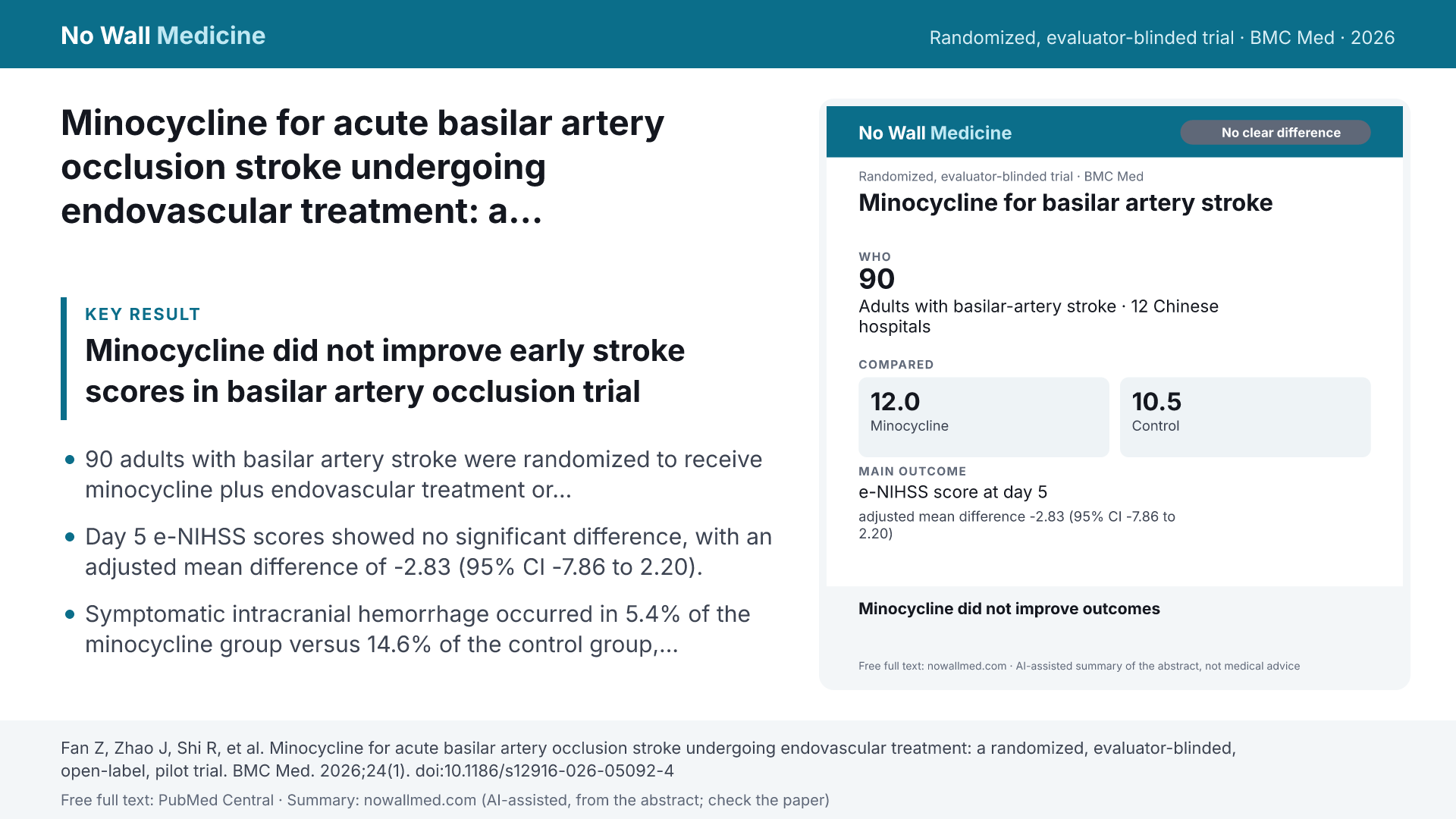
Minocycline for acute basilar artery occlusion stroke undergoing endovascular treatment: a randomized, evaluator-blinded, open-label, pilot trial
Key result: Minocycline did not improve early stroke scores in basilar artery occlusion trial
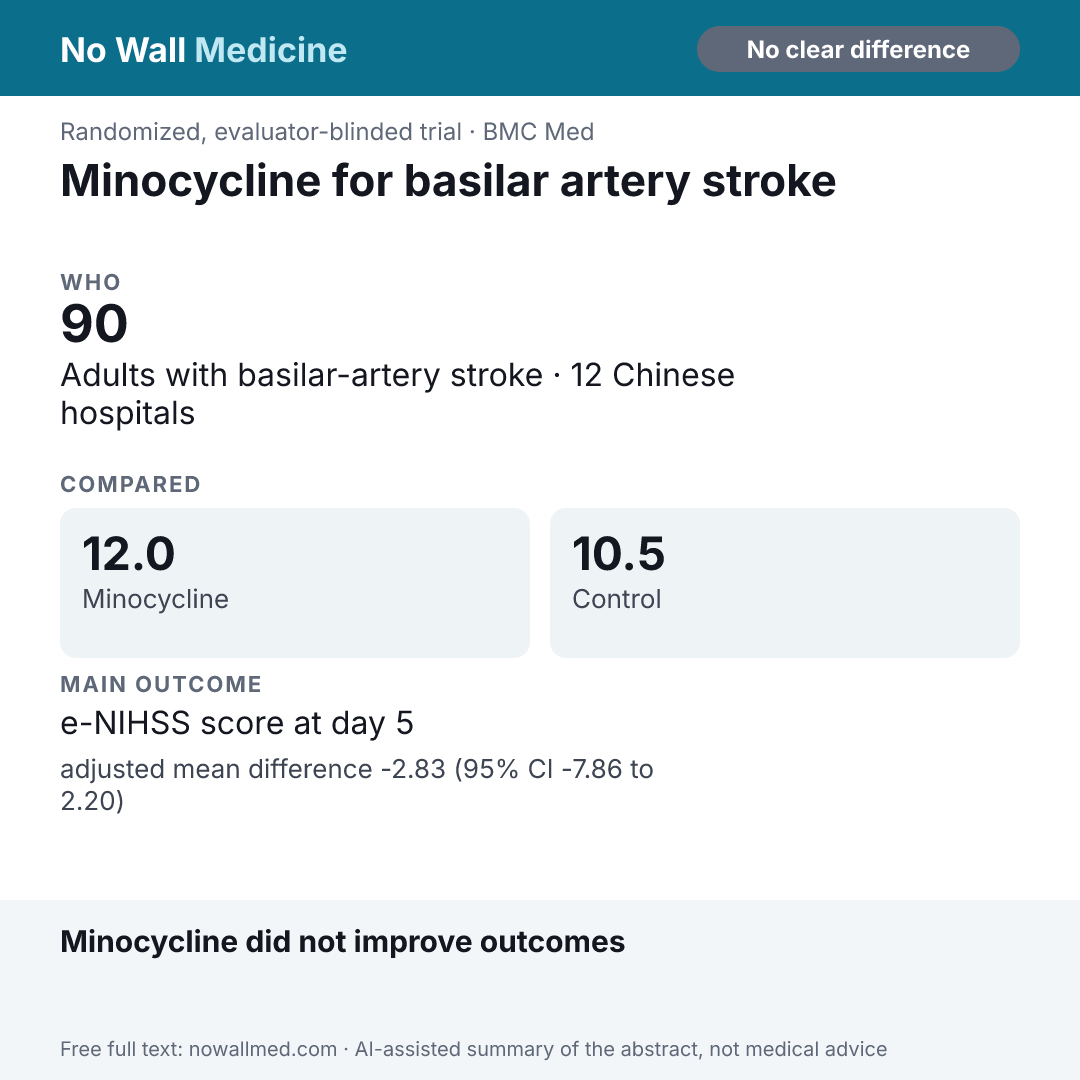
Randomized, evaluator-blinded trialNo clear difference
Minocycline for basilar artery stroke
Who
90
Adults with basilar-artery stroke · 12 Chinese hospitals
Compared
12.0Minocycline (IQR 3.5 to 30.0)
10.5Control (IQR 2.0 to 35.0)
Main outcome
e-NIHSS score at day 5
Result: adjusted mean difference -2.83 (95% CI -7.86 to 2.20)
Bottom line: Minocycline did not improve outcomes
Limitation: small sample size
BMC Med · 2026-07-27 · Save PNG
Key points
- 90 adults with basilar artery stroke were randomized to receive minocycline plus endovascular treatment or endovascular treatment alone.
- Day 5 e-NIHSS scores showed no significant difference, with an adjusted mean difference of -2.83 (95% CI -7.86 to 2.20).
- Symptomatic intracranial hemorrhage occurred in 5.4% of the minocycline group versus 14.6% of the control group, a non-significant difference.
Why it matters: It remained unclear whether adding minocycline to endovascular therapy improves clinical outcomes in patients with basilar artery stroke.
Discussion prompts
- Would these patients look like yours? Who was left out?
- Is the main outcome one that matters to patients?
- Is the difference large enough to change what you do?
Cite: Fan Z, Zhao J, Shi R, et al. Minocycline for acute basilar artery occlusion stroke undergoing endovascular treatment: a randomized, evaluator-blinded, open-label, pilot trial. BMC Med. 2026;24(1). doi:10.1186/s12916-026-05092-4
Free full text: PubMed Central · Summary and visual abstract: nowallmed.com/a/minocycline-for-acute-basilar-artery-occlusion-stroke-undergoing-1fnwz72/ (AI-assisted from the abstract; check the paper before relying on it).