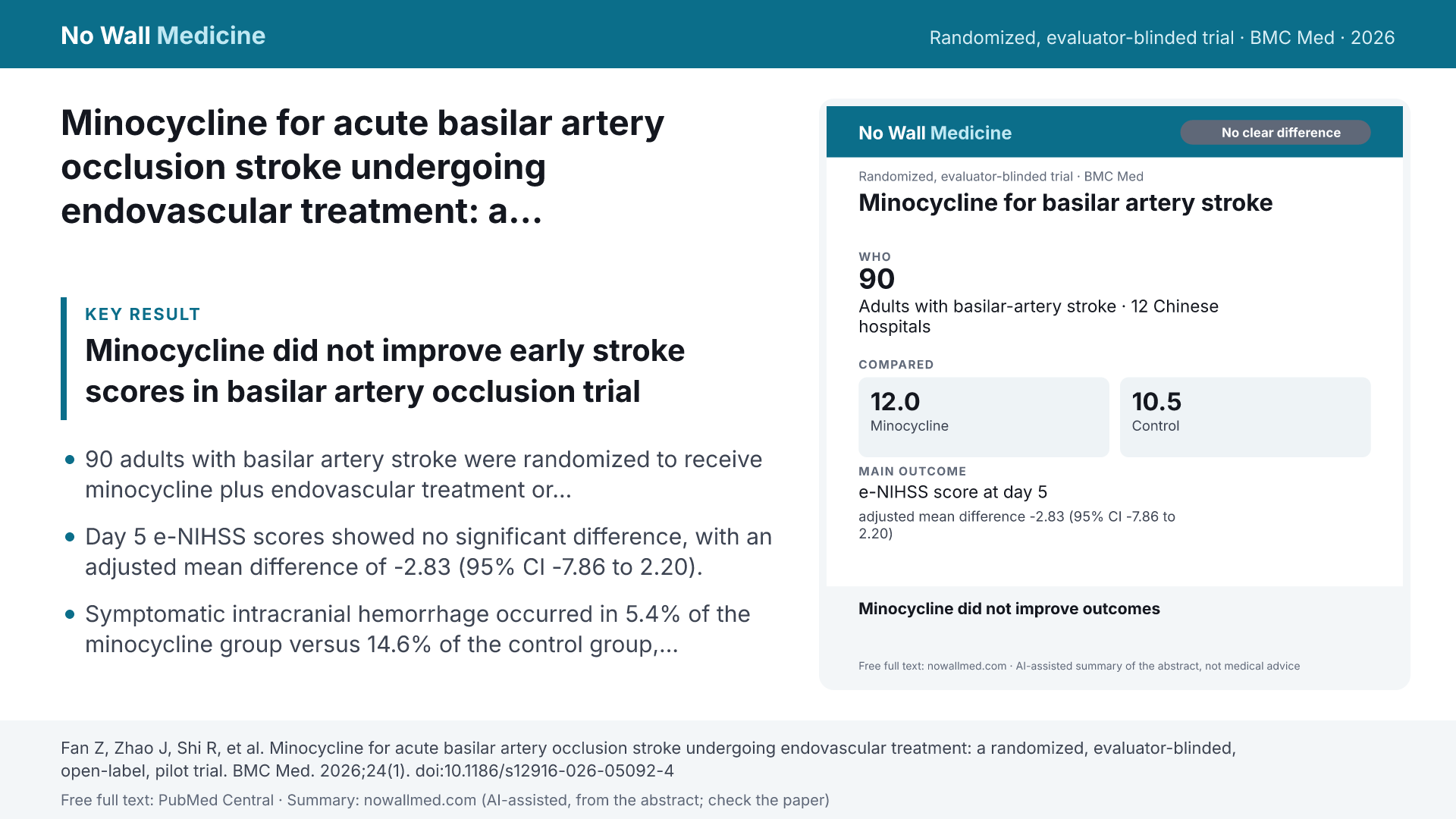
Minocycline did not improve neurological outcomes for patients with basilar artery stroke undergoing endovascular treatment
Minocycline for acute basilar artery occlusion stroke undergoing endovascular treatment: a randomized, evaluator-blinded, open-label, pilot trial
Randomized, evaluator-blinded trialNo clear difference
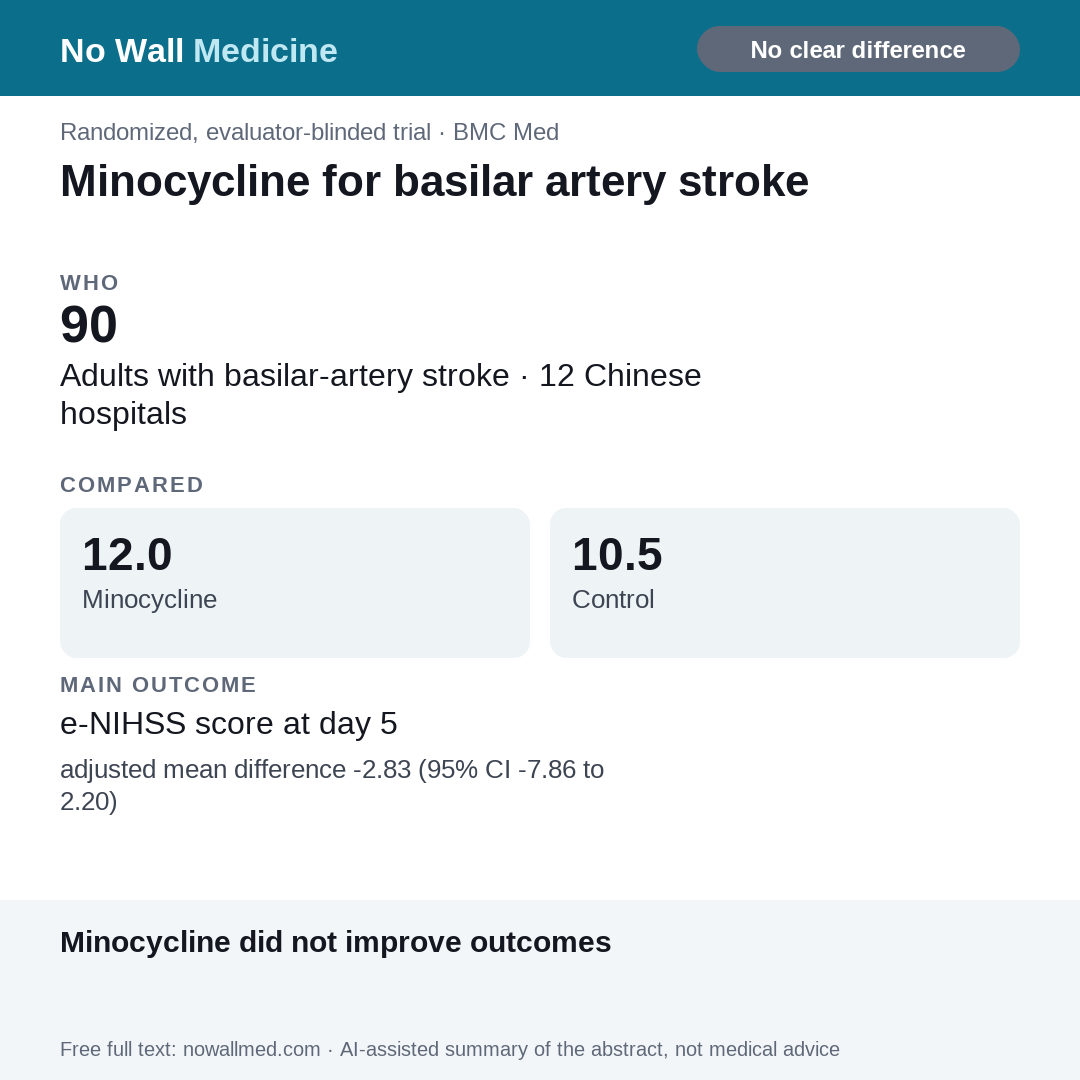
Minocycline for basilar artery stroke
Who
90
Adults with basilar-artery stroke · 12 Chinese hospitals
Compared
12.0Minocycline (IQR 3.5 to 30.0)
10.5Control (IQR 2.0 to 35.0)
Main outcome
e-NIHSS score at day 5
Result: adjusted mean difference -2.83 (95% CI -7.86 to 2.20)
Bottom line: Minocycline did not improve outcomes
Limitation: small sample size
BMC Med · 2026-07-27Download image
Why it matters: It is unclear if adding the anti-inflammatory agent minocycline to endovascular therapy improves clinical outcomes for patients with basilar-artery stroke.
Key points
- Researchers studied 89 adults with basilar-artery stroke who received either oral minocycline plus endovascular therapy or endovascular therapy alone.
- At day 5, the adjusted mean difference in the expanded National Institutes of Health Stroke Scale score was -2.83 (95% CI -7.86 to 2.20; P = 0.27).
- Symptomatic intracranial hemorrhage, or bleeding in the brain, occurred in 2/37 (5.4%) of the minocycline group compared to 6/41 (14.6%) in the control group.
Headline and key points written with AI from the paper’s abstract, with every number checked against it. Read the paper before relying on them.
Was this summary helpful?
Subject terms
Cite this article
Fan Z, Zhao J, Shi R, et al. Minocycline for acute basilar artery occlusion stroke undergoing endovascular treatment: a randomized, evaluator-blinded, open-label, pilot trial. BMC Med. 2026. doi:10.1186/s12916-026-05092-4
Spotted a mistake? Suggest a correction