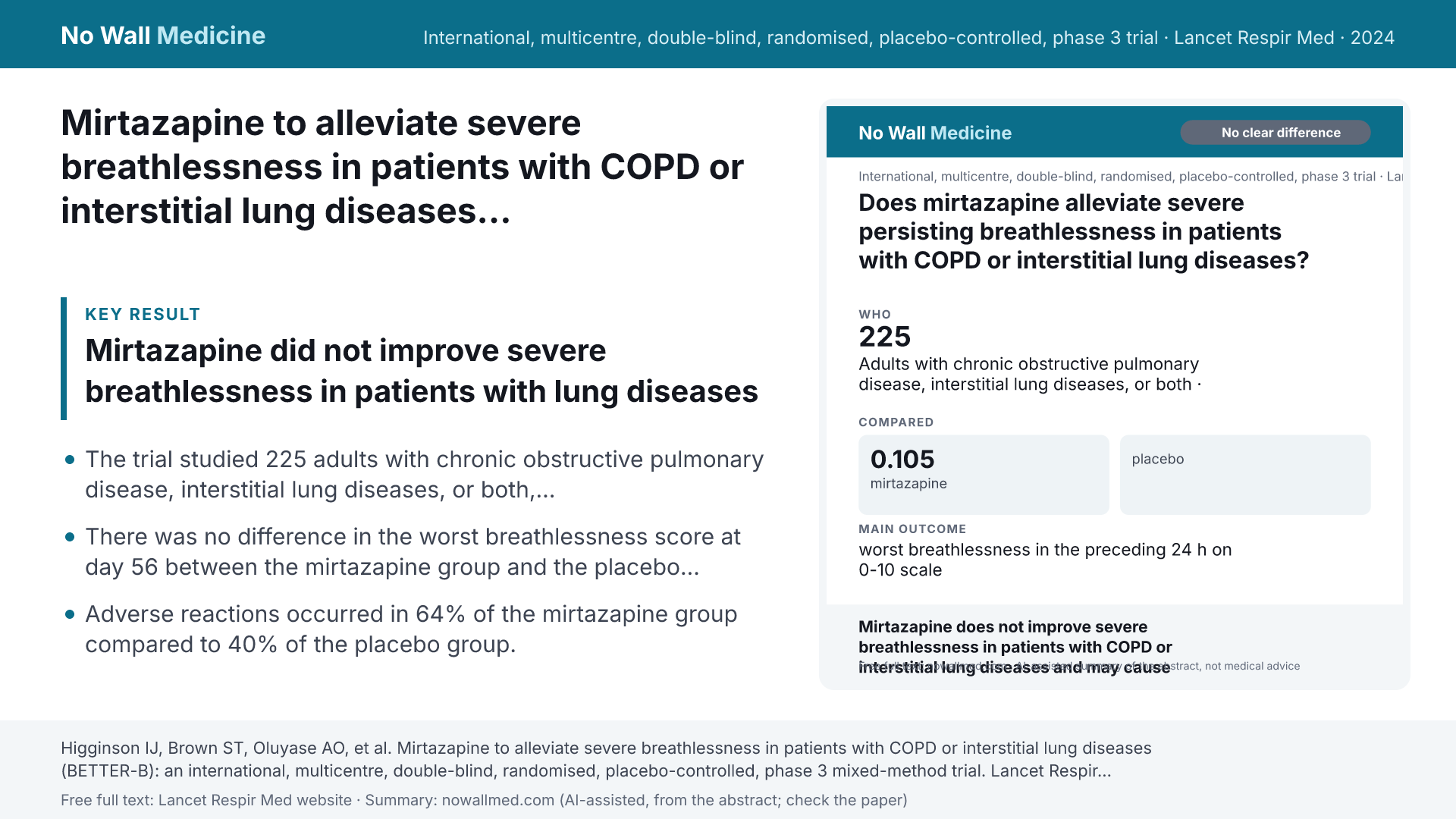
Mirtazapine did not improve severe breathlessness in patients with lung diseases
Mirtazapine to alleviate severe breathlessness in patients with COPD or interstitial lung diseases (BETTER-B): an international, multicentre, double-blind, randomised, placebo-controlled, phase 3 mixed-method trial
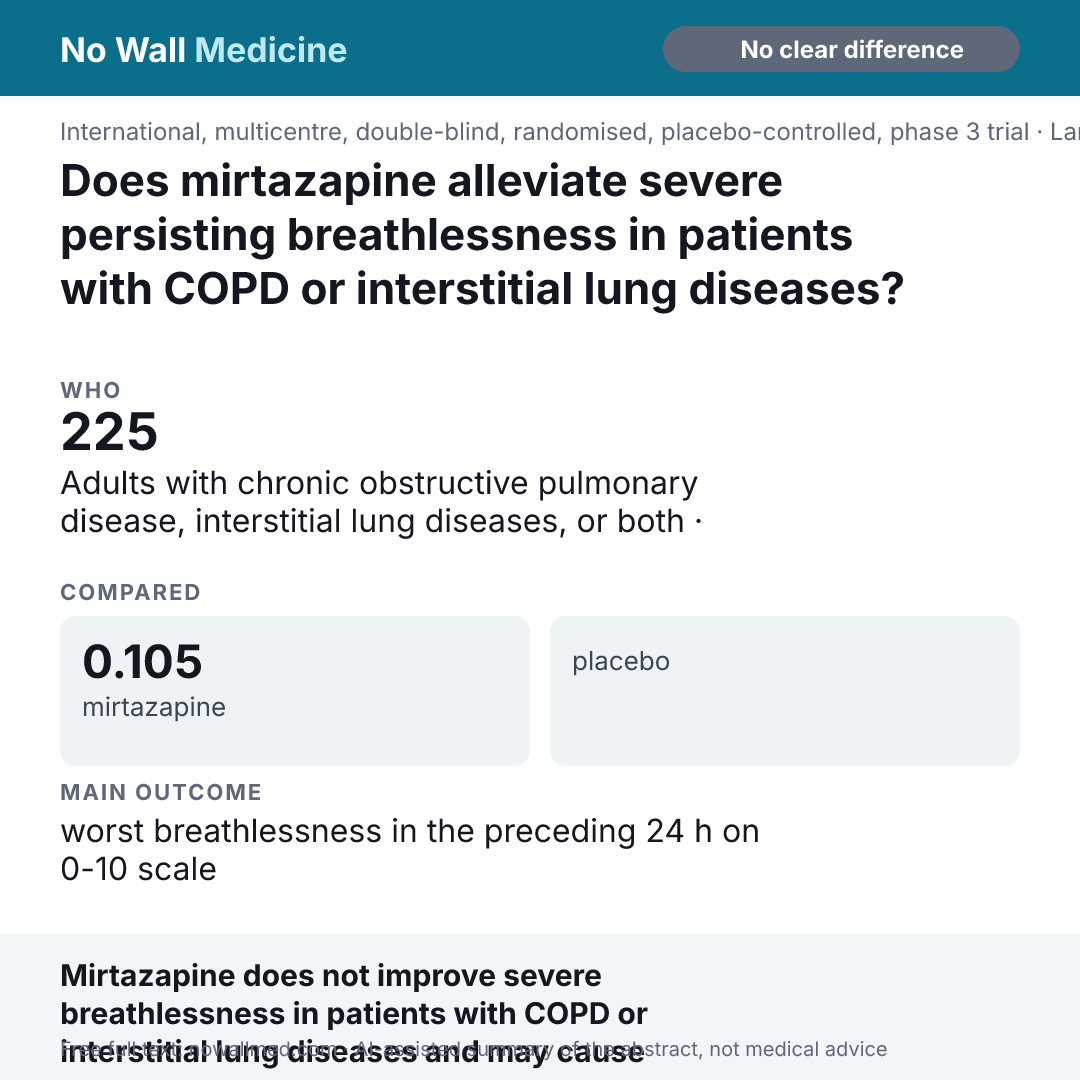
International, multicentre, double-blind, randomised, placebo-controlled, phase 3 trialNo clear difference
Does mirtazapine alleviate severe persisting breathlessness in patients with COPD or interstitial lung diseases?
Who
225
Adults with chronic obstructive pulmonary disease, interstitial lung diseases, or both · 16 centres in seven countries
Compared
0.105mirtazapine (95% CI -0.407 to 0.618)
placebo
Main outcome
worst breathlessness in the preceding 24 h on 0-10 scale
Result: difference in adjusted mean NRS score 0.105 (95% CI -0.407 to 0.618)
Bottom line: Mirtazapine does not improve severe breathlessness in patients with COPD or interstitial lung diseases and may cause adverse reactions.
Lancet Respir Med · 2024-09-09 · Funded by EU Horizon 2020, Cicely Saunders International, NIHR, Australian NHMRC-EU · ISRCTN10487976 · ISRCTN15751764
Headline and visual abstract written with AI from the paper’s abstract, with every number checked against it. Read the paper before relying on them.
Was this summary helpful?
Abstract
Background
Breathlessness frequently becomes severe among people with respiratory disease. Mirtazapine, a widely used antidepressant, has shown promise in the modulation of respiratory sensation and the response to it, as well as reducing feelings of panic, which often accompanies breathlessness. We aimed to determine the effectiveness of mirtazapine to alleviate severe persisting breathlessness. Methods
This international, multicentre, phase 3, parallel-group, double-blind, randomised, placebo-controlled trial across 16 centres in seven countries (Australia, Germany, Ireland, Italy, New Zealand, Poland, and the UK), recruited adults with chronic obstructive pulmonary disease (COPD), interstitial lung diseases, or both, and grade 3 or 4 of the modified Medical Research Council breathlessness scale. Consenting participants were randomly assigned (1:1) to receive oral mirtazapine or matching placebo for 56 days. Randomisation was by minimisation. The initial mirtazapine dose was 15 mg, escalating to a maximum of 45 mg per day, tapered at treatment end. Participants, caregivers, assessors, and investigators were masked to group assignment. The primary outcome was worst breathlessness in the preceding 24 h measured on a 0-10 numerical rating scale (NRS), at 56 days post-treatment start, with follow-up to 180 days. The primary analysis was performed in the modified intention-to-treat population using multivariable multi-level repeated measures model. This trial was registered with ISRCTN (ISRCTN10487976 and ISRCTN15751764 [Australia and New Zealand]) and EudraCT (2019-002001-21) and is complete. Findings
Between Feb 4, 2021 and March 28, 2023, we enrolled 225 eligible participants (148 men and 77 women, 113 to the mirtazapine group and 112 to the placebo group). The median age was 74 years (IQR 67-78). No evidence of a difference was found in worst breathlessness at day 56 between mirtazapine and placebo (difference in adjusted mean NRS score was 0·105 [95% CI -0·407 to 0·618]; p=0·69). Although the study was underpowered, the primary endpoint effect did not reach the pre-specified treatment effect of 0·55 for worst breathlessness score reduction that the study was powered to detect for the primary analysis. There were 215 adverse reactions in 72 (64%) of 113 participants in the mirtazapine group versus 116 in 44 (40%) of 110 participants in the placebo group; 11 serious adverse events in six (5%) participants in the mirtazapine group versus eight in seven (6%) participants in the placebo group; and one (1%) suspected unexpected serious adverse reaction in the mirtazapine group. At day 56, there were three deaths in the mirtazapine group and two deaths in the placebo group. At day 180, there were seven deaths in the mirtazapine group and 11 deaths in the placebo group. Interpretation
Our findings suggested that mirtazapine of doses 15 to 45 mg daily over 56 days does not improve severe breathlessness among patients with COPD or interstitial lung diseases and might cause adverse reactions. Based on these findings, we do not recommend mirtazapine as a treatment to alleviate severe breathlessness. Funding
EU Horizon 2020 (grant agreement No. 825319); Cicely Saunders International Breathlessness Programme; National Institute for Health and Care Research Applied Research Collaboration South London; Australian National Health and Medical Research Council-EU (application ID: APP1170731).
Abstract reproduced under the article’s CC BY licence.
Subject terms
Cite this article
Higginson IJ, Brown ST, Oluyase AO, et al. Mirtazapine to alleviate severe breathlessness in patients with COPD or interstitial lung diseases (BETTER-B): an international, multicentre, double-blind, randomised, placebo-controlled, phase 3 mixed-method trial. Lancet Respir Med. 2024;12(10):763-774. doi:10.1016/S2213-2600(24)00187-5
Spotted a mistake? Suggest a correction