Model-informed precision dosing of antibiotics did not change intensive care unit length of stay
Model-informed precision dosing of beta-lactam antibiotics and ciprofloxacin in critically ill patients: a multicentre randomised clinical trial
Multicentre randomised clinical trialNo clear difference
Does model-informed precision dosing of antibiotics improve intensive care unit length of stay?
Who
388
Critically ill patients admitted to the intensive care unit treated with antibiotics · Eight hospitals in the Netherlands
Compared
10Model-informed precision dosing
8Standard dosing
Main outcome
Intensive care unit length of stay
Result: incidence rate ratio 1.16 (95% CI 0.96-1.41)
Bottom line: Model-informed precision dosing of beta-lactam antibiotics and ciprofloxacin did not improve intensive care unit length of stay.
Intensive Care Med · 2022-11-09Download image
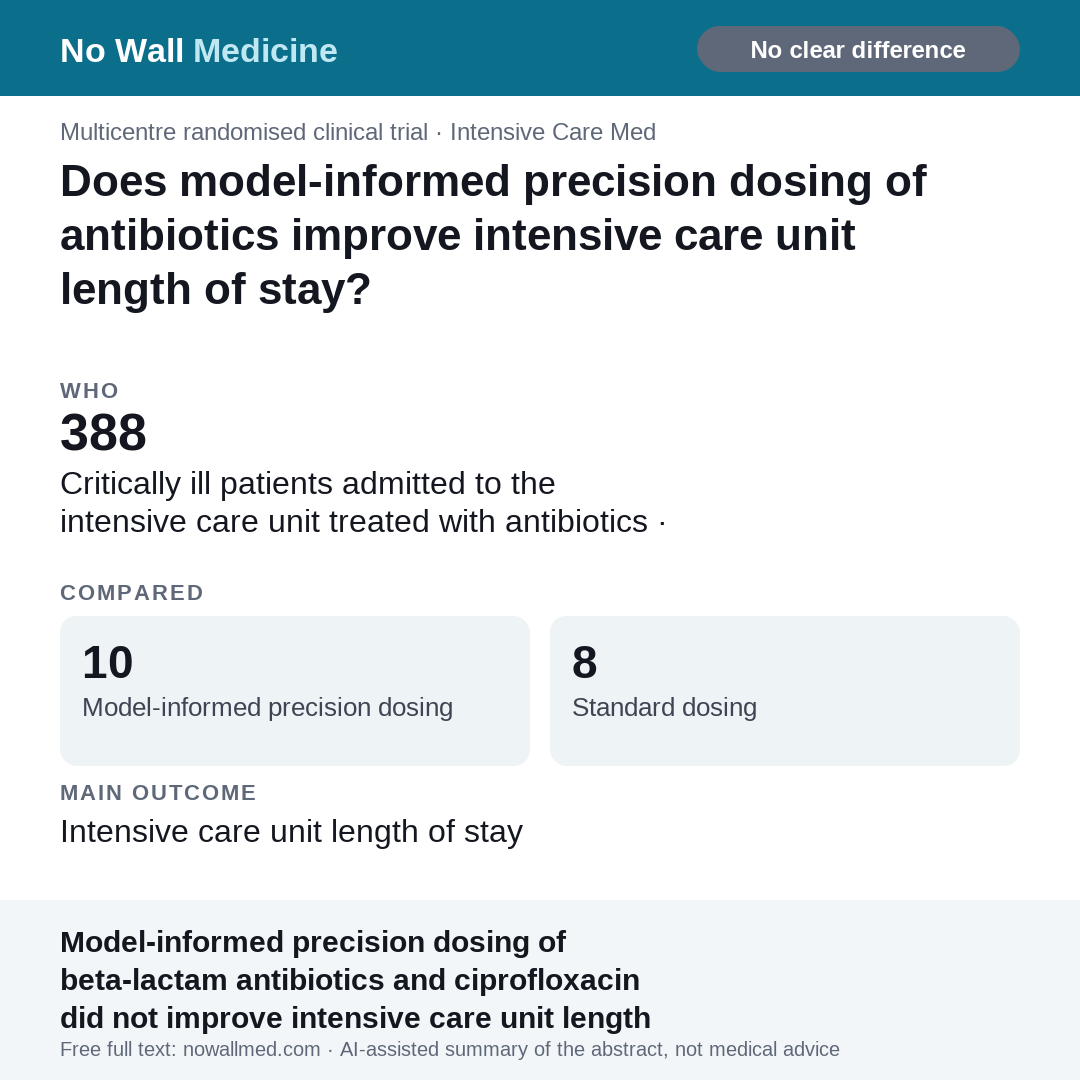
Clinical question: Does model-informed precision dosing of antibiotics improve intensive care unit length of stay?
Why it matters: It was unknown if using mathematical models to guide antibiotic dosing improves clinical outcomes for patients in the intensive care unit.
Key points
- Researchers studied 388 intensive care unit patients, comparing model-informed precision dosing—which uses drug level monitoring and mathematical models to adjust doses—to standard dosing.
- The primary outcome of intensive care unit length of stay showed no significant difference between the model-informed dosing group (10 days) and the standard dosing group (8 days).
- There were no significant differences in target attainment at day 1 (55.6% vs 60.9%) or day 3 (59.5% vs 60.4%), nor in mortality or other secondary outcomes.
Headline and key points written with AI from the paper’s abstract, with every number checked against it. Read the paper before relying on them.
Was this summary helpful?
Subject terms
Cite this article
Ewoldt TMJ, Abdulla A, Rietdijk WJR, Muller AE, de Winter BCM, Hunfeld NGM. Model-informed precision dosing of beta-lactam antibiotics and ciprofloxacin in critically ill patients: a multicentre randomised clinical trial. Intensive Care Med. 2022. doi:10.1007/s00134-022-06921-9
Spotted a mistake? Suggest a correction
Top studies every Monday
The week’s key trials and guidelines in your specialties, plus any topics you follow. By email, free.
Get the weekly digest