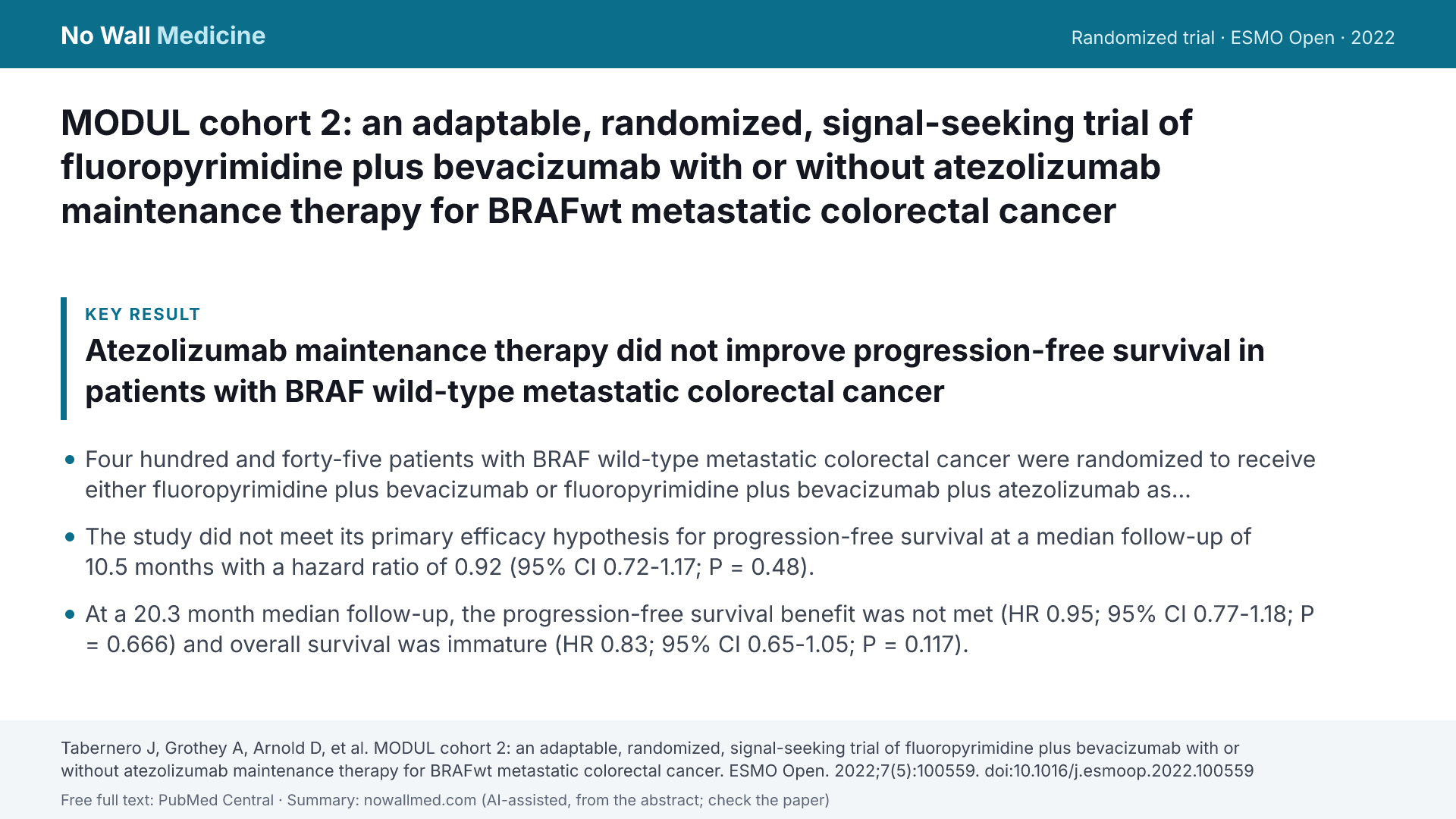
Atezolizumab maintenance therapy did not improve progression-free survival in patients with BRAF wild-type metastatic colorectal cancer
MODUL cohort 2: an adaptable, randomized, signal-seeking trial of fluoropyrimidine plus bevacizumab with or without atezolizumab maintenance therapy for BRAFwt metastatic colorectal cancer
Why it matters: It was unknown if adding atezolizumab to standard maintenance therapy would improve outcomes for patients with BRAF wild-type metastatic colorectal cancer.
Key points
- Four hundred and forty-five patients with BRAF wild-type metastatic colorectal cancer were randomized to receive either fluoropyrimidine plus bevacizumab or fluoropyrimidine plus bevacizumab plus atezolizumab as maintenance therapy.
- The study did not meet its primary efficacy hypothesis for progression-free survival at a median follow-up of 10.5 months with a hazard ratio of 0.92 (95% CI 0.72-1.17; P = 0.48).
- At a 20.3 month median follow-up, the progression-free survival benefit was not met (HR 0.95; 95% CI 0.77-1.18; P = 0.666) and overall survival was immature (HR 0.83; 95% CI 0.65-1.05; P = 0.117).
Headline and key points written with AI from the paper’s abstract, with every number checked against it. Read the paper before relying on them.
Was this summary helpful?
Subject terms
Cite this article
Tabernero J, Grothey A, Arnold D, et al. MODUL cohort 2: an adaptable, randomized, signal-seeking trial of fluoropyrimidine plus bevacizumab with or without atezolizumab maintenance therapy for BRAFwt metastatic colorectal cancer. ESMO Open. 2022. doi:10.1016/j.esmoop.2022.100559
Spotted a mistake? Suggest a correction