MODUL cohort 2: an adaptable, randomized, signal-seeking trial of fluoropyrimidine plus bevacizumab with or without atezolizumab maintenance therapy for BRAFwt metastatic colorectal cancer
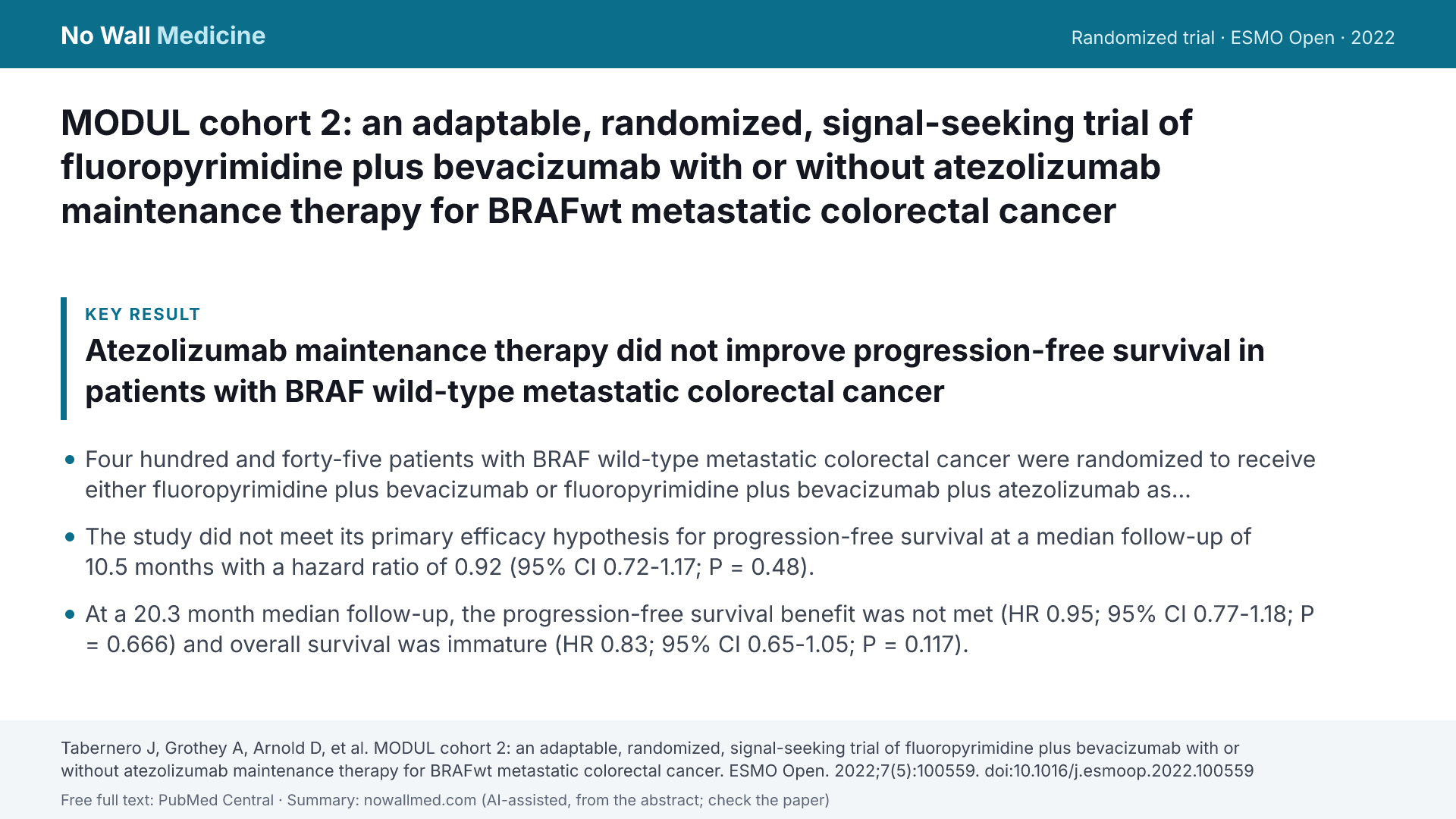
Key result: Atezolizumab maintenance therapy did not improve progression-free survival in patients with BRAF wild-type metastatic colorectal cancer
Key points
- Four hundred and forty-five patients with BRAF wild-type metastatic colorectal cancer were randomized to receive either fluoropyrimidine plus bevacizumab or fluoropyrimidine plus bevacizumab plus atezolizumab as maintenance therapy.
- The study did not meet its primary efficacy hypothesis for progression-free survival at a median follow-up of 10.5 months with a hazard ratio of 0.92 (95% CI 0.72-1.17; P = 0.48).
- At a 20.3 month median follow-up, the progression-free survival benefit was not met (HR 0.95; 95% CI 0.77-1.18; P = 0.666) and overall survival was immature (HR 0.83; 95% CI 0.65-1.05; P = 0.117).
Discussion prompts
- Would these patients look like yours? Who was left out?
- Is the main outcome one that matters to patients?
- Is the difference large enough to change what you do?
Cite: Tabernero J, Grothey A, Arnold D, et al. MODUL cohort 2: an adaptable, randomized, signal-seeking trial of fluoropyrimidine plus bevacizumab with or without atezolizumab maintenance therapy for BRAFwt metastatic colorectal cancer. ESMO Open. 2022;7(5):100559. doi:10.1016/j.esmoop.2022.100559
Free full text: PubMed Central · Summary and visual abstract: nowallmed.com/a/modul-cohort-2-an-adaptable-randomized-signal-seeking-trial-of-1cniy4/ (AI-assisted from the abstract; check the paper before relying on it).