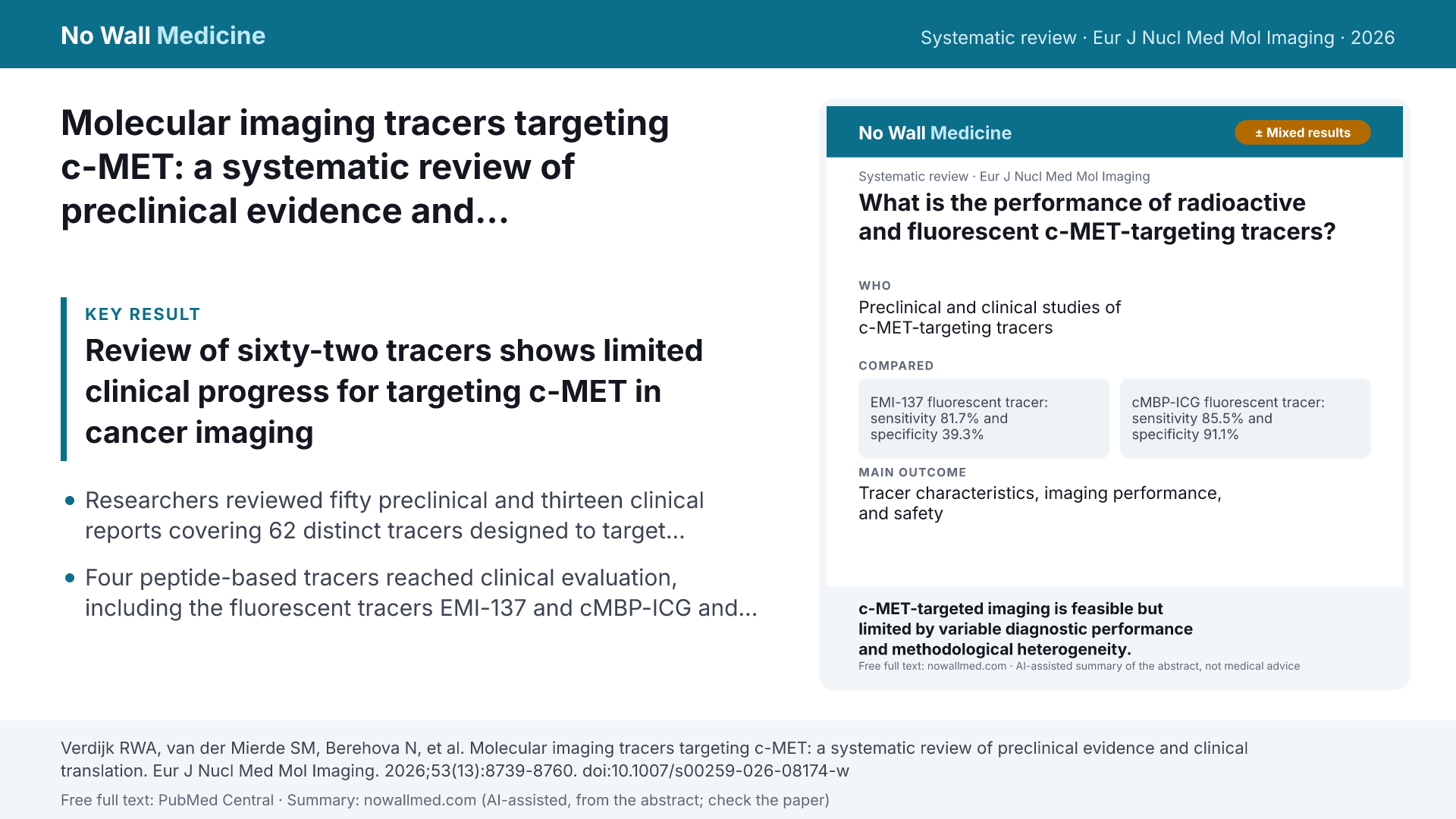
Review of sixty-two tracers shows limited clinical progress for targeting c-MET in cancer imaging
Molecular imaging tracers targeting c-MET: a systematic review of preclinical evidence and clinical translation
Systematic reviewMixed results
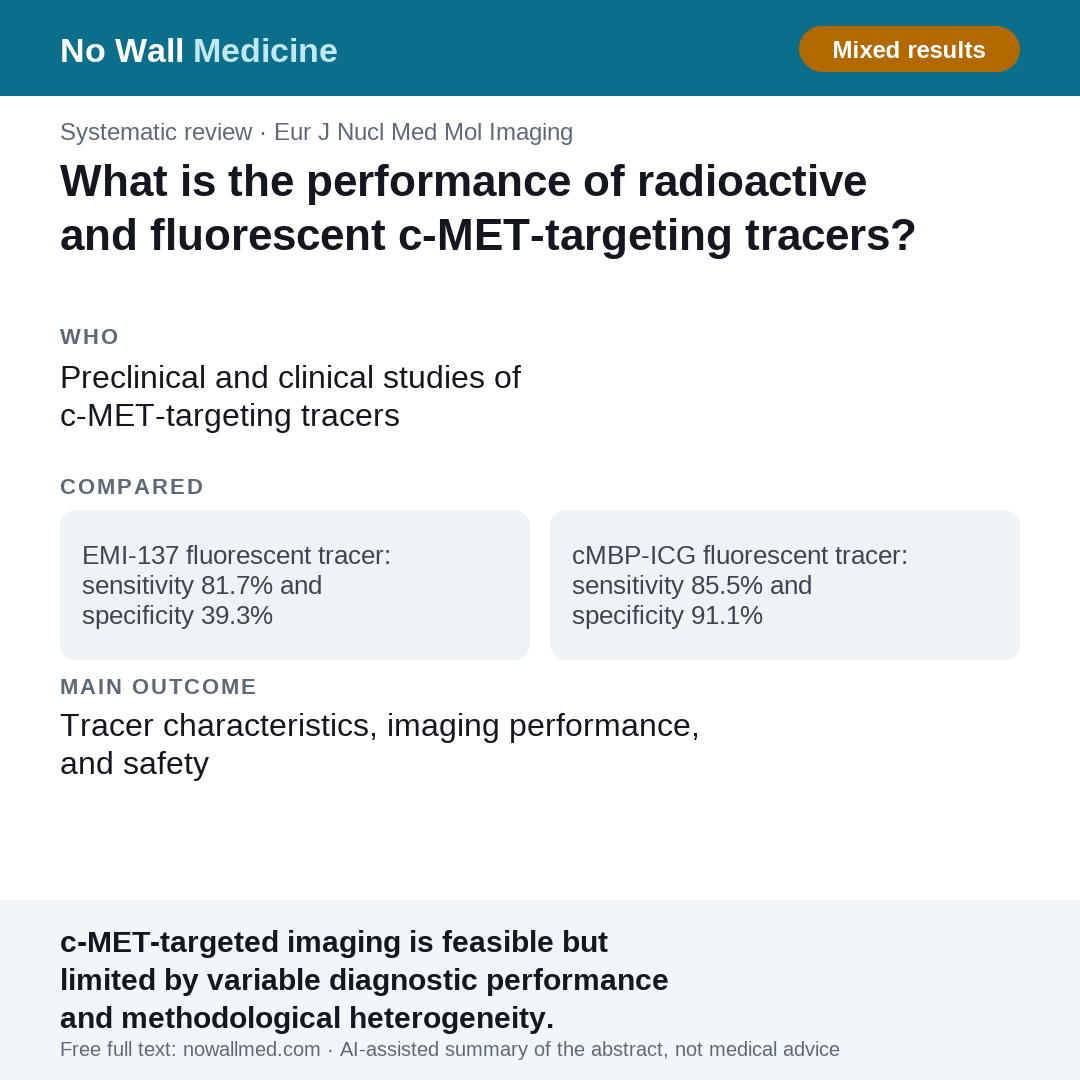
What is the performance of radioactive and fluorescent c-MET-targeting tracers?
Who
Preclinical and clinical studies of c-MET-targeting tracers
Compared
EMI-137 fluorescent tracer: sensitivity 81.7% and specificity 39.3%
cMBP-ICG fluorescent tracer: sensitivity 85.5% and specificity 91.1%
Main outcome
Tracer characteristics, imaging performance, and safety
Bottom line: c-MET-targeted imaging is feasible but limited by variable diagnostic performance and methodological heterogeneity.
Limitation: Methodological heterogeneity, small sample sizes, limited biological validation, and variable diagnostic performance.
Eur J Nucl Med Mol Imaging · 2026-09-24Download image
Clinical question: What is the performance of radioactive and fluorescent c-MET-targeting tracers?
Why it matters: The mesenchymal-epithelial transition factor is overexpressed in many cancers, but there is limited clinical evidence regarding the performance of tracers targeting this protein.
Key points
- Researchers reviewed fifty preclinical and thirteen clinical reports covering 62 distinct tracers designed to target the mesenchymal-epithelial transition factor protein.
- Four peptide-based tracers reached clinical evaluation, including the fluorescent tracers EMI-137 and cMBP-ICG and the positron emission tomography tracers ⁶⁸Ga-EMP-100 and ⁶⁸Ga-MetP.
- The fluorescent tracer cMBP-ICG showed a weighted average sensitivity of 85.5% and specificity of 91.1% in oral cavity cancer studies.
Limitation the authors note: The authors state that clinical evidence is limited by methodological heterogeneity, small sample sizes, limited biological validation, and variable diagnostic performance.
Headline and key points written with AI from the paper’s abstract, with every number checked against it. Read the paper before relying on them.
Was this summary helpful?
Subject terms
Cite this article
Verdijk RWA, van der Mierde SM, Berehova N, et al. Molecular imaging tracers targeting c-MET: a systematic review of preclinical evidence and clinical translation. Eur J Nucl Med Mol Imaging. 2026. doi:10.1007/s00259-026-08174-w
Spotted a mistake? Suggest a correction