Randomized trialJournal of Clinical Oncology · Sep 3, 2026
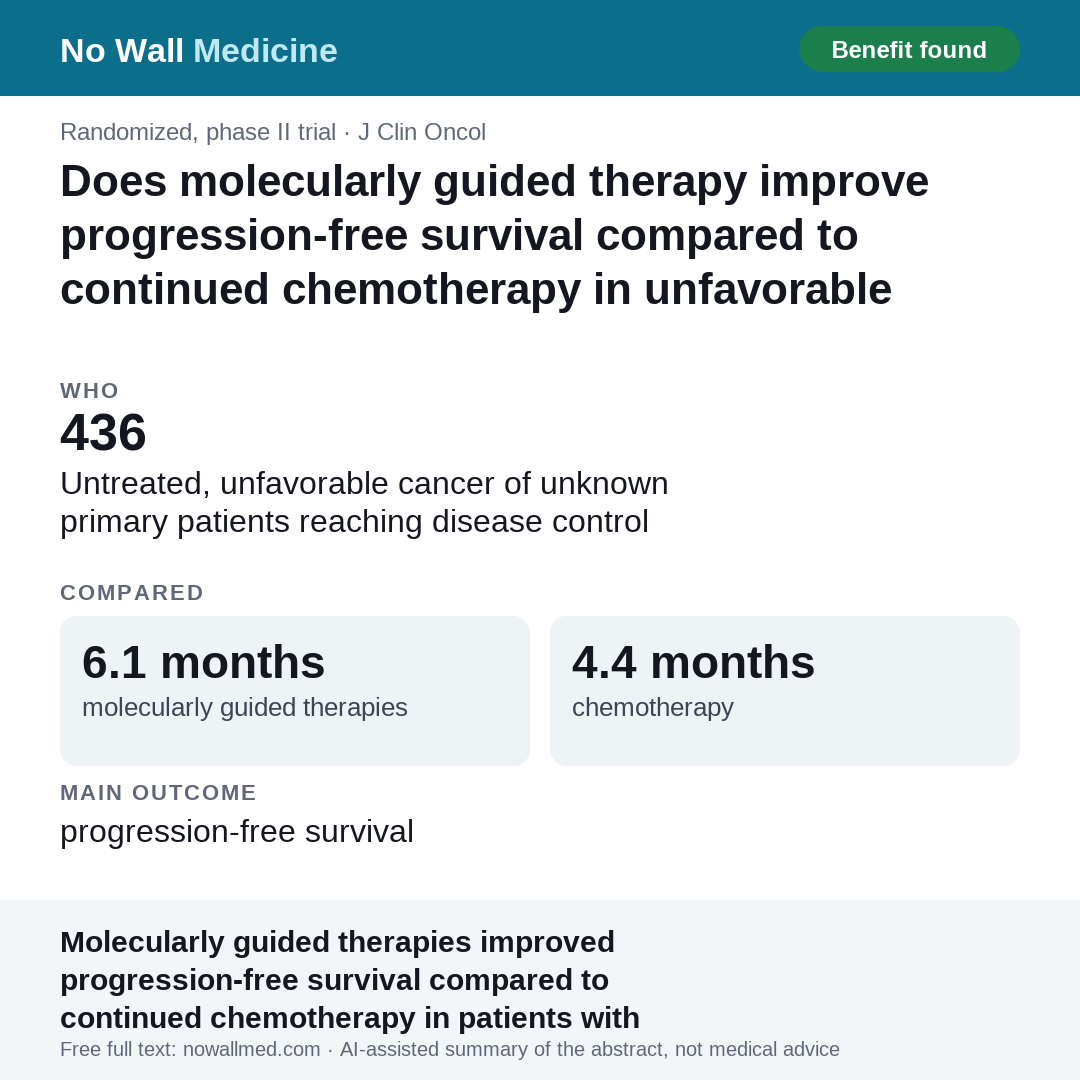
Molecularly guided therapy improved progression-free survival compared to continued chemotherapy in patients with cancer of unknown primary
Molecularly Guided Therapy Versus Continued Chemotherapy in Unfavorable Cancer of Unknown Primary: Updated Efficacy and Safety From the Randomized, Phase II CUPISCO Study
Krämer A, Bochtler T, Pauli C, Shiu KK, Cook N, Janoski de Menezes J, et al
Does molecularly guided therapy improve progression-free survival compared to continued chemotherapy in unfavorable cancer of unknown primary?
Who
436
Untreated, unfavorable cancer of unknown primary patients reaching disease control after induction chemotherapy
Compared
6.1 monthsmolecularly guided therapies (95% CI, 4.7 to 6.5)
4.4 monthschemotherapy (95% CI, 4.2 to 6.4)
Main outcome
progression-free survival
Result: hazard ratio 0.75 (95% CI 0.59 to 0.95)
Bottom line: Molecularly guided therapies improved progression-free survival compared to continued chemotherapy in patients with unfavorable cancer of unknown primary.
Clinical question: Does molecularly guided therapy improve progression-free survival compared to continued chemotherapy in unfavorable cancer of unknown primary?
Why it matters: Doctors need to know if using genetic profiling to guide treatment is more effective than standard chemotherapy for patients with cancer of unknown primary.
Key points
Researchers studied 436 patients with previously untreated, unfavorable cancer of unknown primary, comparing molecularly guided therapies to three additional cycles of chemotherapy.
The median progression-free survival, or time until the disease worsened, was 6.1 months with molecularly guided therapies compared to 4.4 months with chemotherapy.
Median overall survival was 15.2 months for the molecularly guided group and 12.8 months for the chemotherapy group, though this difference was not statistically significant.
Headline and key points written with AI from the paper’s abstract, with every number checked against it. Read the paper before relying on them.
Prostate and pelvic nodal stereotactic body radiotherapy (SBRT) versus prostate-only SBRT for high-risk, localised prostate cancer (PACE-NODES): early adverse event results from an international, open-label, phase 3, randomised controlled trial