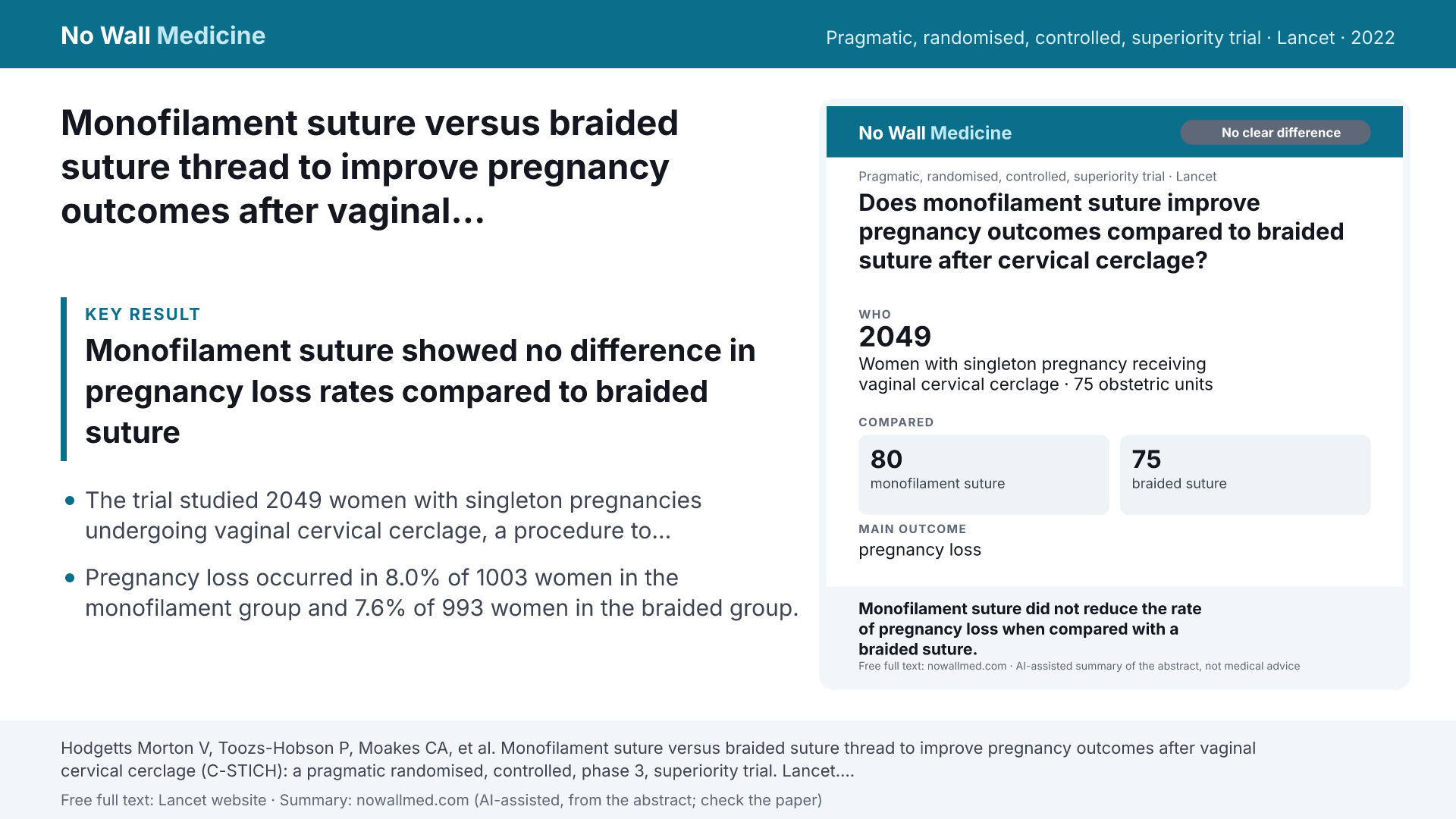
Monofilament suture showed no difference in pregnancy loss rates compared to braided suture
Monofilament suture versus braided suture thread to improve pregnancy outcomes after vaginal cervical cerclage (C-STICH): a pragmatic randomised, controlled, phase 3, superiority trial
Pragmatic, randomised, controlled, superiority trialNo clear difference
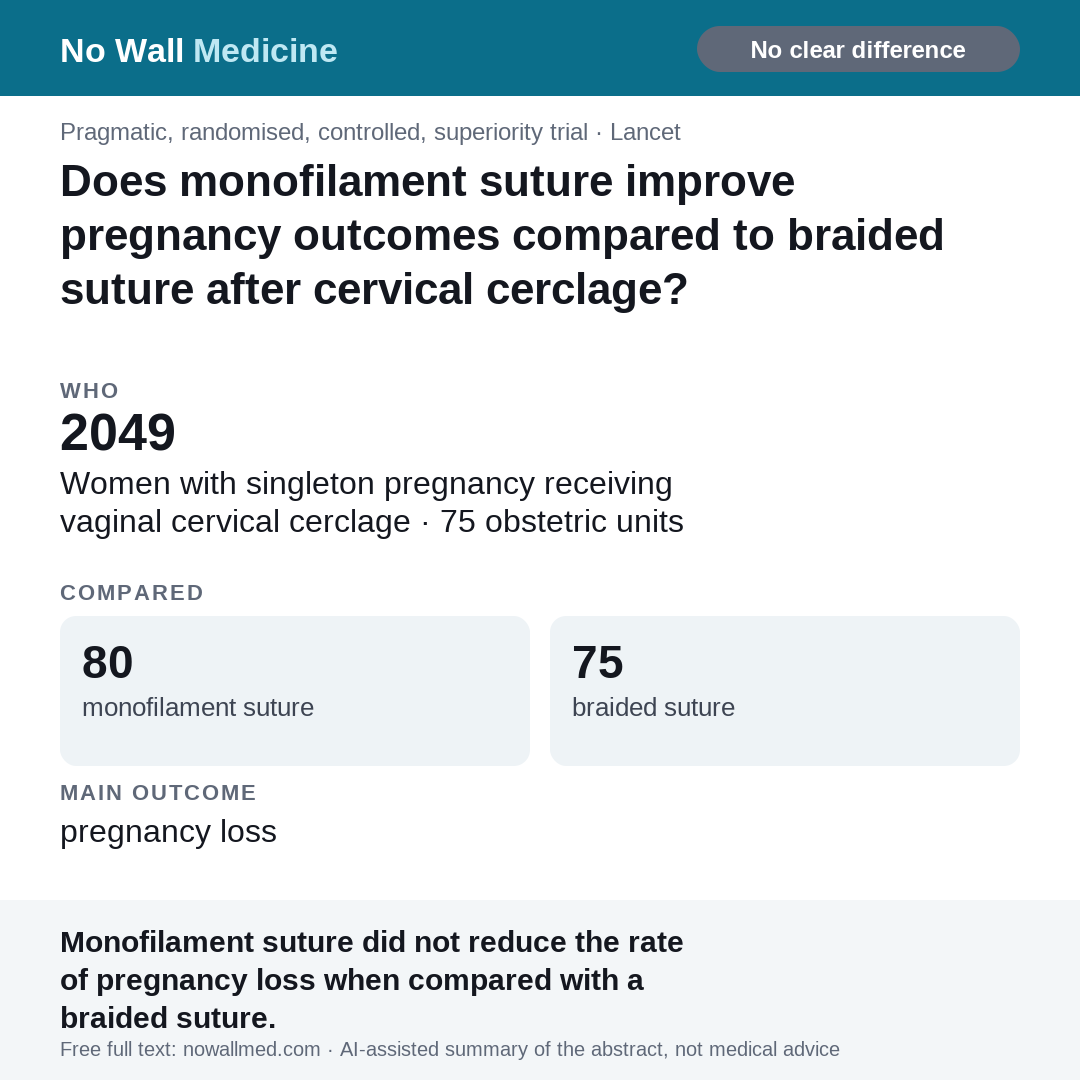
Does monofilament suture improve pregnancy outcomes compared to braided suture after cervical cerclage?
Who
2049
Women with singleton pregnancy receiving vaginal cervical cerclage · 75 obstetric units in the UK
Compared
80monofilament suture (8·0%)
75braided suture (7·6%)
Main outcome
pregnancy loss
Result: adjusted risk ratio 1·05 (95% CI 0·79 to 1·40)
Bottom line: Monofilament suture did not reduce the rate of pregnancy loss when compared with a braided suture.
Funded by: National Institute of Health Research Health Technology Assessment Programme
Lancet · 2022-10-23Download image
Clinical question: Does monofilament suture improve pregnancy outcomes compared to braided suture after cervical cerclage?
Why it matters: It was unknown whether using a monofilament suture instead of a braided suture thread would change the rates of pregnancy loss after cervical cerclage.
Key points
- The trial studied 2049 women with singleton pregnancies undergoing vaginal cervical cerclage, a procedure to support the cervix, comparing monofilament and braided suture threads.
- Pregnancy loss occurred in 8.0% of 1003 women in the monofilament group and 7.6% of 993 women in the braided group.
- The adjusted risk ratio for pregnancy loss was 1.05 with a 95% confidence interval of 0.79 to 1.40.
Headline and key points written with AI from the paper’s abstract, with every number checked against it. Read the paper before relying on them.
Was this summary helpful?
Abstract
Background
Miscarriage in the second trimester and preterm birth are significant global problems. Vaginal cervical cerclage is performed to prevent pregnancy loss and preterm birth. We aimed to determine the effectiveness of a monofilament suture thread compared with braided suture thread on pregnancy loss rates in women undergoing a cervical cerclage. Methods
C-STICH was a pragmatic, randomised, controlled, superiority trial done at 75 obstetric units in the UK. Women with a singleton pregnancy who received a vaginal cervical cerclage due to a history of pregnancy loss or premature birth, or if indicated by ultrasound, were centrally randomised (1:1) using minimisation to receive a monofilament suture or braided suture thread for their cervical cerclage. Women and outcome assessors were masked to allocation as far as possible. The primary outcome was pregnancy loss, defined as miscarriage, stillbirth, or neonatal death in the first week of life, analysed in the intention-to-treat population (ie, all women who were randomly assigned). Safety was also assessed in the intention-to-treat population. The trial was registered with ISRCTN, ISRCTN15373349. Findings
Between Aug 21, 2015, and Jan 28, 2021, 2049 women were randomly assigned to receive a monofilament suture (n=1025) or braided suture (n=1024). The primary outcome was ascertained in 1003 women in the monofilament suture group and 993 women in the braided suture group. Pregnancy loss occurred in 80 (8·0%) of 1003 women in the monofilament suture group and 75 (7·6%) of 993 women in the braided suture group (adjusted risk ratio 1·05 [95% CI 0·79 to 1·40]; adjusted risk difference 0·002 [95% CI -0·02 to 0·03]). Interpretation
Monofilament suture did not reduce rate of pregnancy loss when compared with a braided suture. Clinicians should use the results of this trial to facilitate discussions around the choice of suture thread to optimise outcomes. Funding
National Institute of Health Research Health Technology Assessment Programme.
Abstract reproduced under the article’s CC BY licence.
Subject terms
Cite this article
Hodgetts Morton V, Toozs-Hobson P, Moakes CA, Middleton L, Daniels J, Simpson NAB. Monofilament suture versus braided suture thread to improve pregnancy outcomes after vaginal cervical cerclage (C-STICH): a pragmatic randomised, controlled, phase 3, superiority trial. Lancet. 2022. doi:10.1016/S0140-6736(22)01808-6
Spotted a mistake? Suggest a correction