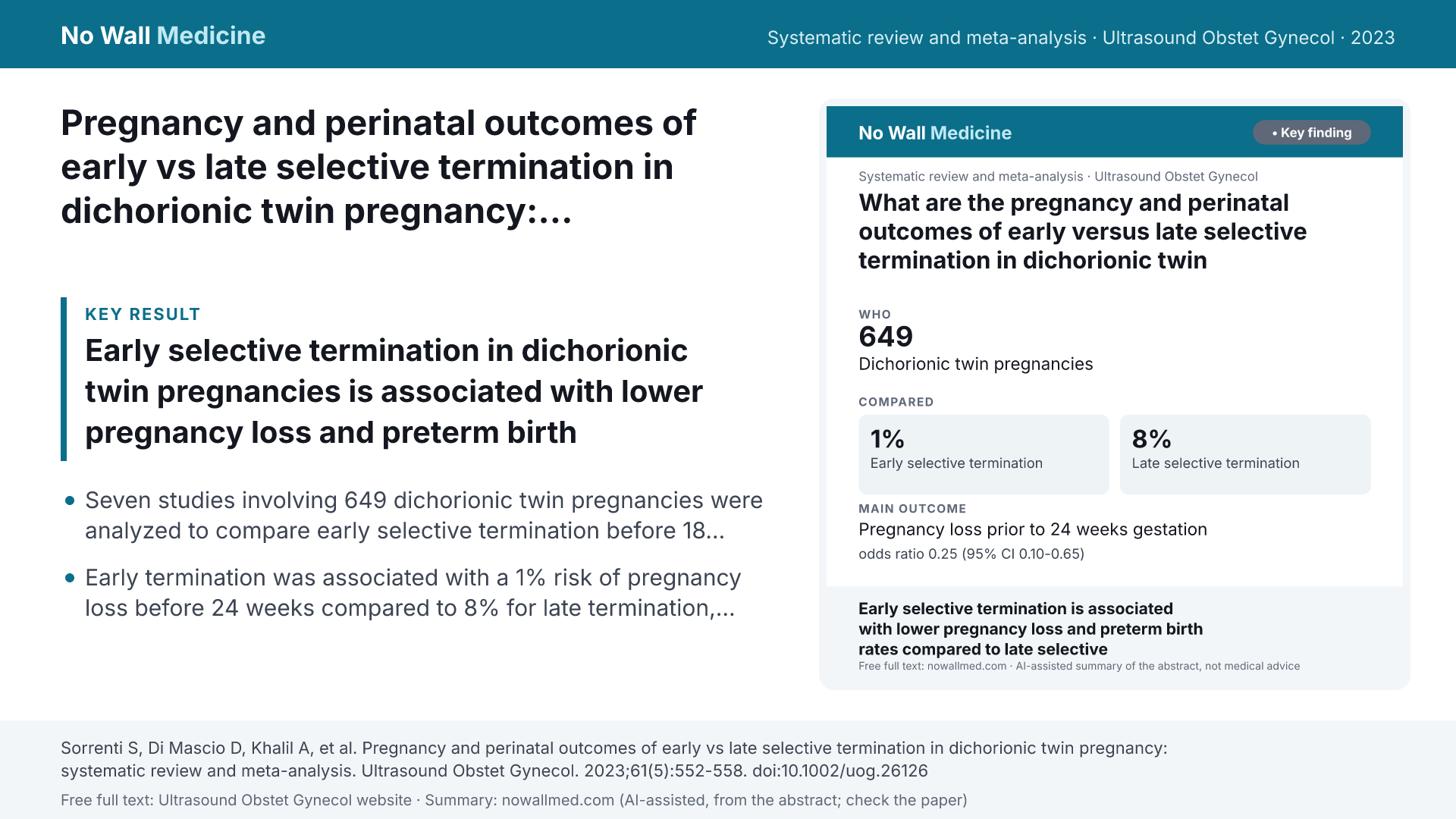
Early selective termination in dichorionic twin pregnancies is associated with lower pregnancy loss and preterm birth
Pregnancy and perinatal outcomes of early vs late selective termination in dichorionic twin pregnancy: systematic review and meta-analysis
Systematic review and meta-analysisKey finding
What are the pregnancy and perinatal outcomes of early versus late selective termination in dichorionic twin pregnancies?
Who
649
Dichorionic twin pregnancies
Compared
1%Early selective termination
8%Late selective termination
Main outcome
Pregnancy loss prior to 24 weeks gestation
Result: odds ratio 0.25 (95% CI 0.10-0.65)
Bottom line: Early selective termination is associated with lower pregnancy loss and preterm birth rates compared to late selective termination.
Ultrasound Obstet Gynecol · 2023-04-12 · Save PNG
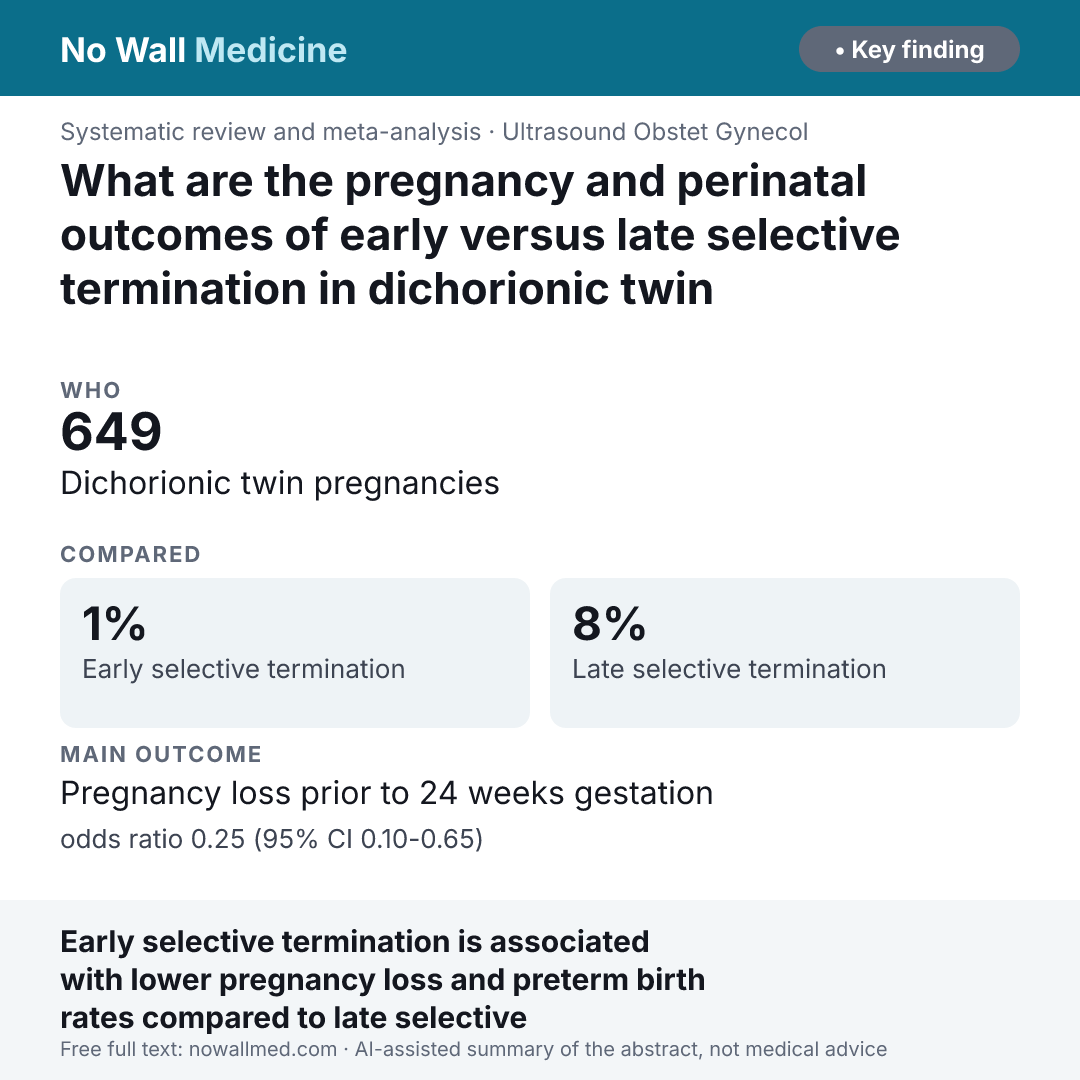
Clinical question: What are the pregnancy and perinatal outcomes of early versus late selective termination in dichorionic twin pregnancies?
Why it matters: The timing of selective termination, where one twin is removed to manage complications, in dichorionic twin pregnancies is not clearly established for pregnancy and neonatal outcomes.
Key points
- Seven studies involving 649 dichorionic twin pregnancies were analyzed to compare early selective termination before 18 weeks to late termination at or after 18 weeks.
- Early termination was associated with a 1% risk of pregnancy loss before 24 weeks compared to 8% for late termination, and lower preterm birth rates before 37, 34, and 32 weeks.
- The early termination group had a higher mean birth weight by 392.2 g and a longer mean gestational age at delivery by 2.47 weeks.
Headline and key points written with AI from the paper’s abstract, with every number checked against it. Read the paper before relying on them.
Was this summary helpful?
Subject terms
Headline, design, result, key points, caveat and citation as plain text.
Cite this article
Sorrenti S, Di Mascio D, Khalil A, et al. Pregnancy and perinatal outcomes of early vs late selective termination in dichorionic twin pregnancy: systematic review and meta-analysis. Ultrasound Obstet Gynecol. 2023;61(5):552-558. doi:10.1002/uog.26126
Spotted a mistake? Suggest a correction