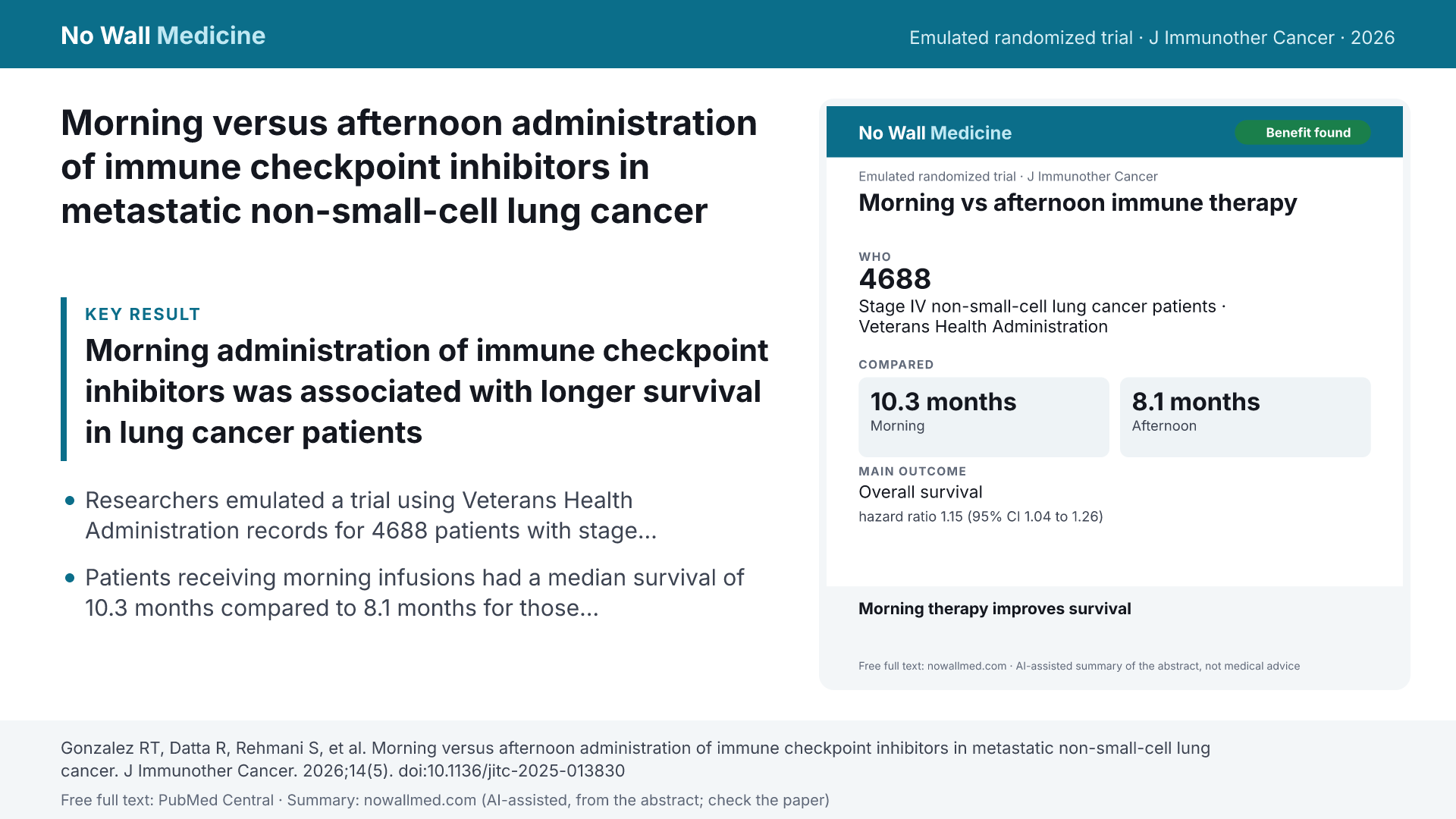
Morning administration of immune checkpoint inhibitors was associated with longer survival in lung cancer patients
Morning versus afternoon administration of immune checkpoint inhibitors in metastatic non-small-cell lung cancer
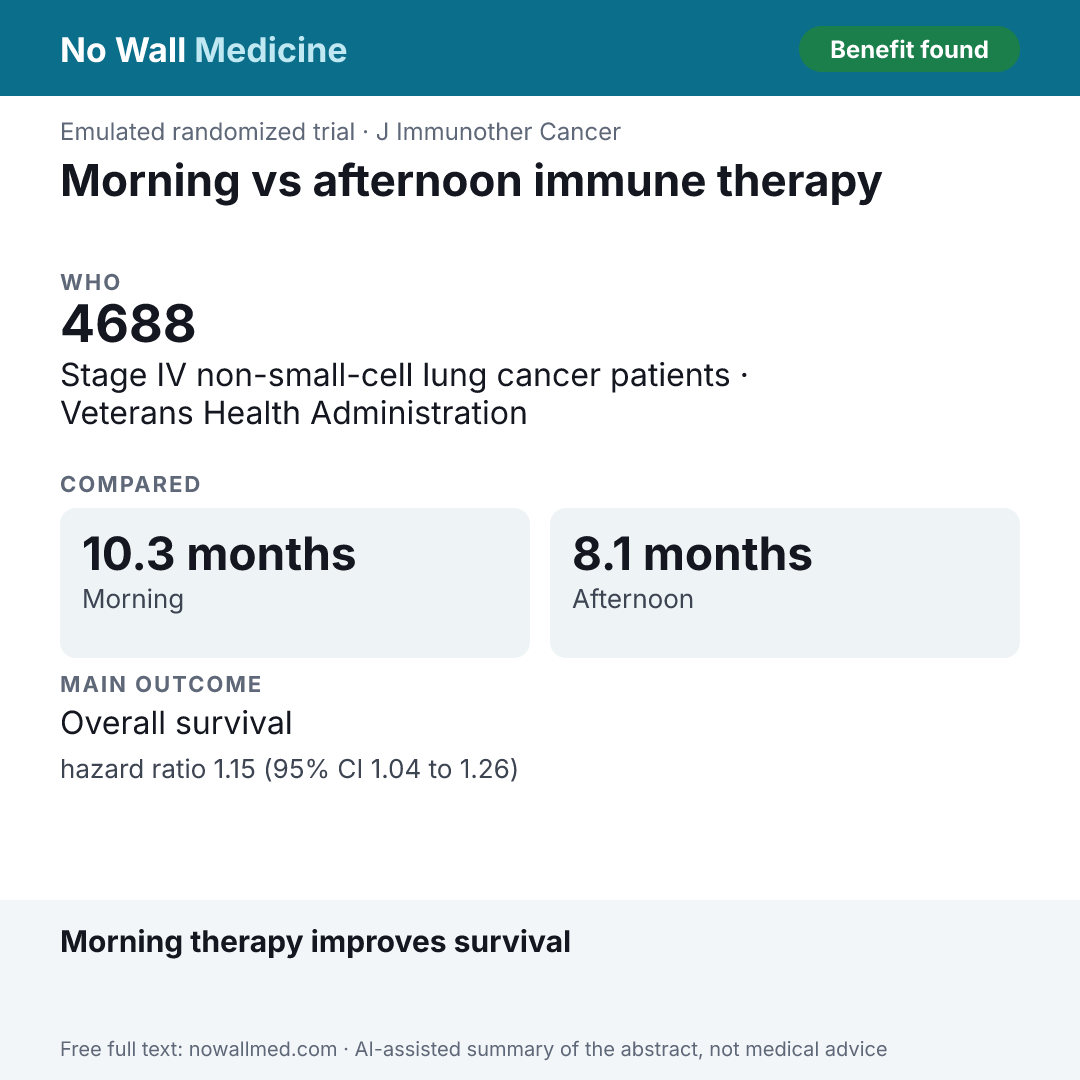
Emulated randomized trialBenefit found
Morning vs afternoon immune therapy
Who
4688
Stage IV non-small-cell lung cancer patients · Veterans Health Administration
Compared
10.3 monthsMorning
8.1 monthsAfternoon
Main outcome
Overall survival
Result: hazard ratio 1.15 (95% CI 1.04 to 1.26)
Bottom line: Morning therapy improves survival
Limitation: not prospective
J Immunother Cancer · 2026-05-14 · Save PNG
Key points
- Researchers emulated a trial using Veterans Health Administration records for 4688 patients with stage IV non-small-cell lung cancer.
- Patients receiving morning infusions had a median survival of 10.3 months compared to 8.1 months for those receiving afternoon infusions.
- Afternoon dosing was associated with worse overall survival with a hazard ratio of 1.15 (95% confidence interval 1.04 to 1.26, p=0.004).
Headline and key points written with AI from the paper’s abstract, with every number checked against it. Read the paper before relying on them.
Was this summary helpful?
Abstract
Background
Circadian biology suggests that synchronizing immune checkpoint inhibitor (ICI) dosing with morning peaks in immune activation could improve clinical outcomes, but well-powered studies using appropriate causal inference methodology are sparse. Methods
We emulated a pragmatic randomized controlled trial of AM versus PM ICI infusions using Veterans Health Administration records from 2010 to 2024. In the emulated trial, stage IV non-small-cell lung cancer patients planned to undergo first-line or second-line ICI would have been randomized to receive the first three infusions in the AM (<12:00 PM) or PM (≥12:00 PM). The primary outcome was overall survival (OS). Marginal structural models with inverse probability of censoring weights estimated the per-protocol effect, accounting for baseline and longitudinal confounding. A historical chemotherapy cohort served as a negative control. Results
4688 patients were eligible for the emulated trial; of these, 1171 received their first three infusions in the AM and 794 in the PM. Median follow-up was 4.7 years. Median survival was 10.3 months (AM) vs 8.1 months (PM). PM dosing was associated with worse OS (HR for PM versus AM 1.15, 95% CI 1.04 to 1.26, p=0.004). In 7951 chemotherapy controls (median follow-up 8.9 years), no time-of-day effect was detected (HR for PM vs AM 1.05, 95% CI 0.98 to 1.12, p=0.15). Results were robust in sensitivity analyses. Conclusions
Morning ICI infusions confer a modest but clinically meaningful survival benefit that is absent in chemotherapy controls, supporting a causal chronotherapeutic effect. Scheduling ICIs before noon represents a low-cost, immediately actionable strategy warranting prospective confirmation.
Abstract reproduced under the article’s CC BY NC licence.
Subject terms
Headline, design, result, key points, caveat and citation as plain text.
Cite this article
Gonzalez RT, Datta R, Rehmani S, et al. Morning versus afternoon administration of immune checkpoint inhibitors in metastatic non-small-cell lung cancer. J Immunother Cancer. 2026;14(5). doi:10.1136/jitc-2025-013830
Spotted a mistake? Suggest a correction