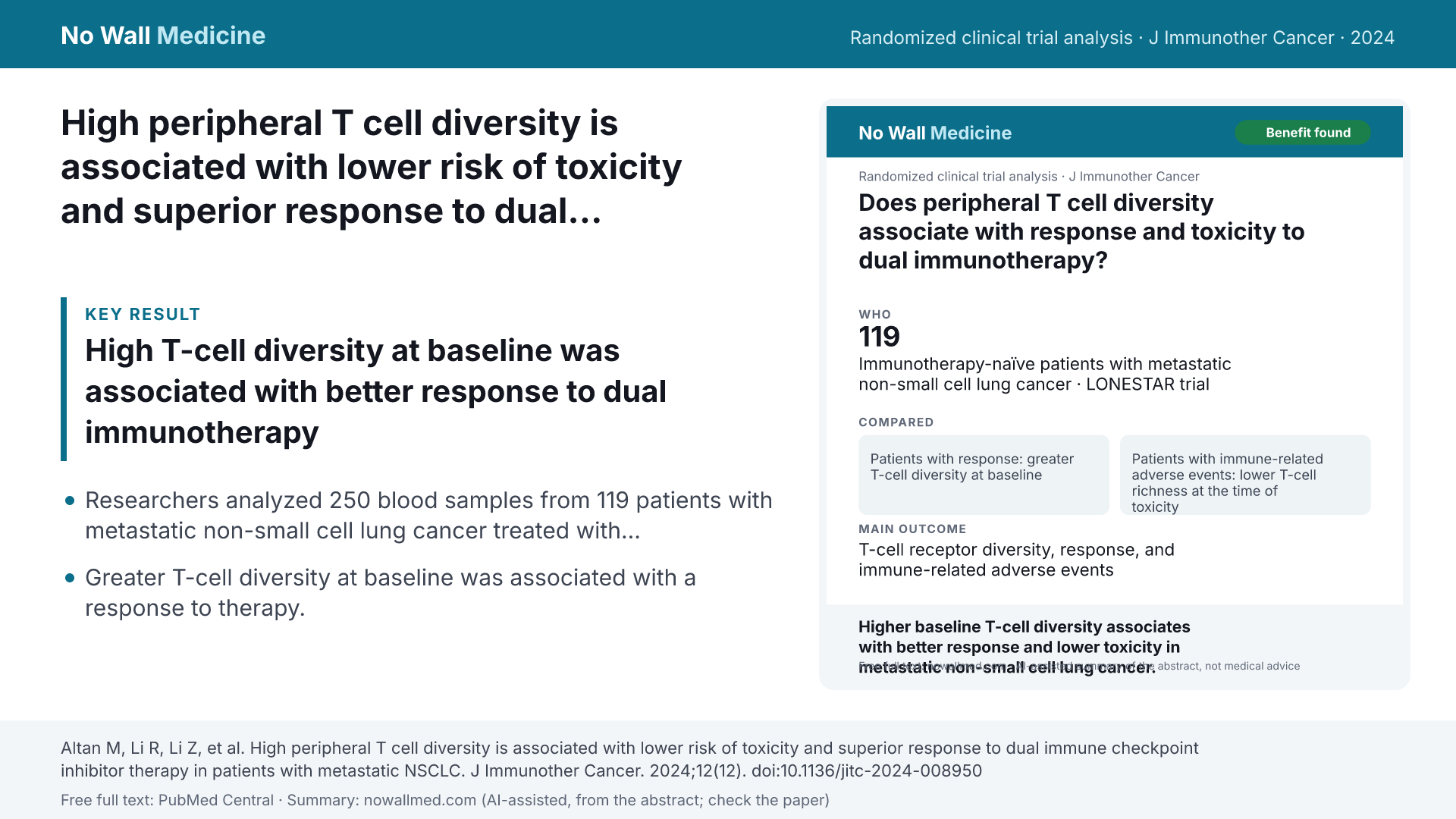
High T-cell diversity at baseline was associated with better response to dual immunotherapy
High peripheral T cell diversity is associated with lower risk of toxicity and superior response to dual immune checkpoint inhibitor therapy in patients with metastatic NSCLC
Randomized clinical trial analysisBenefit found
Does peripheral T cell diversity associate with response and toxicity to dual immunotherapy?
Who
119
Immunotherapy-naïve patients with metastatic non-small cell lung cancer · LONESTAR trial
Compared
Patients with response: greater T-cell diversity at baseline
Patients with immune-related adverse events: lower T-cell richness at the time of toxicity
Main outcome
T-cell receptor diversity, response, and immune-related adverse events
Bottom line: Higher baseline T-cell diversity associates with better response and lower toxicity in metastatic non-small cell lung cancer.
J Immunother Cancer · 2024-12-25Download image
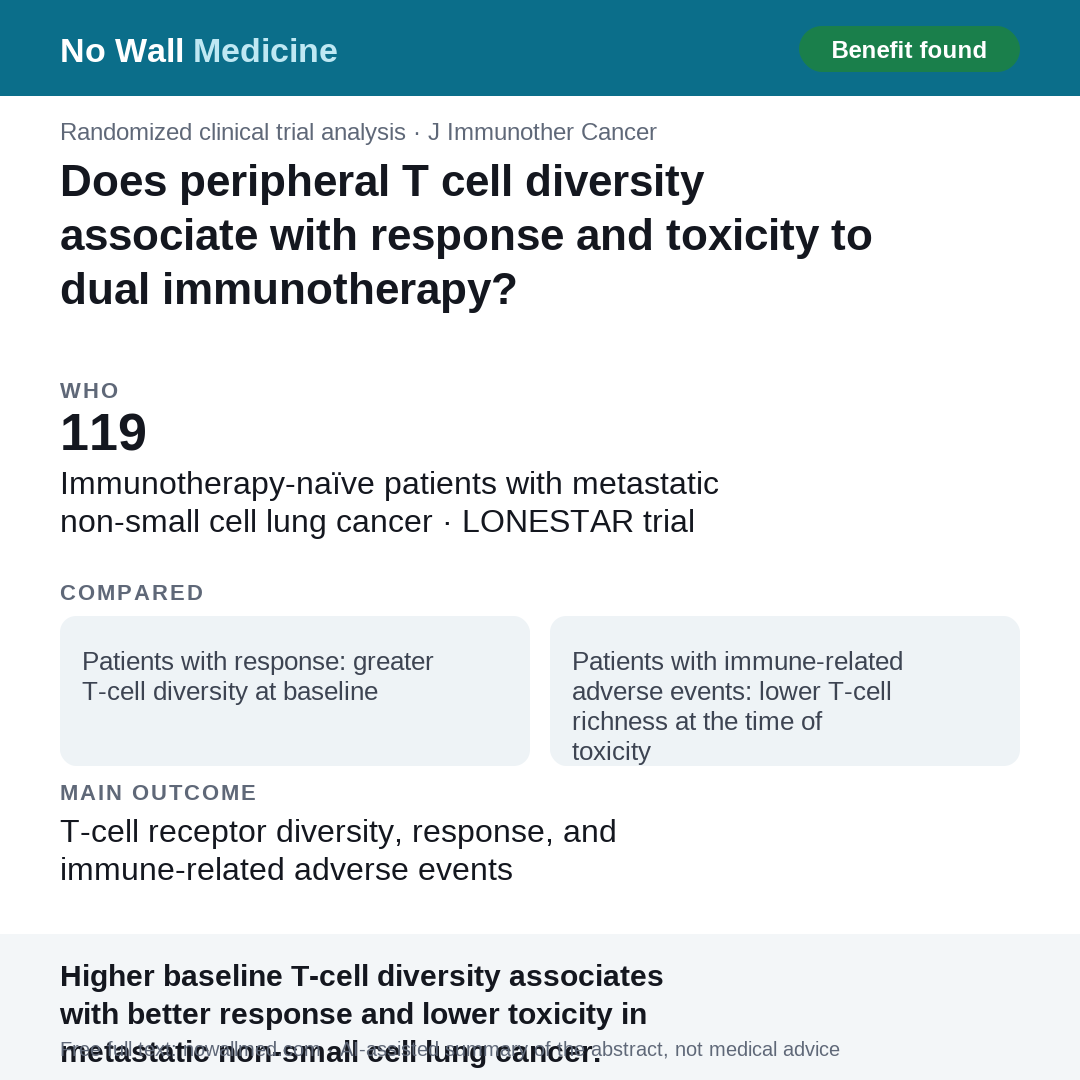
Clinical question: Does peripheral T cell diversity associate with response and toxicity to dual immunotherapy?
Why it matters: Predictive markers for response to immune checkpoint blockade are imperfect and immune-related adverse events remain unpredictable.
Key points
- Researchers analyzed 250 blood samples from 119 patients with metastatic non-small cell lung cancer treated with ipilimumab and nivolumab.
- Greater T-cell diversity at baseline was associated with a response to therapy.
- Lower T-cell richness at the time of toxicity was associated with patients experiencing immune-related adverse events of grade 2 or higher.
Headline and key points written with AI from the paper’s abstract, with every number checked against it. Read the paper before relying on them.
Was this summary helpful?
Abstract
Introduction
Despite significant successes, immune checkpoint blockade fails to achieve clinical responses in a significant proportion of patients, predictive markers for responses are imperfect and immune-related adverse events (irAEs) are unpredictable. We used T-cell receptor (TCR) sequencing to systematically analyze prospectively collected patient blood samples from a randomized clinical trial of dual immune checkpoint inhibitor therapy to evaluate changes in the T-cell repertoire and their association with response and irAEs. Methods
Patients with immunotherapy-naïve metastatic non-small cell lung cancer (NSCLC) were treated with ipilimumab and nivolumab according to trial protocol (LONESTAR, NCT03391869). Blood samples were systematically obtained at baseline (n=107), after 12 weeks of ipilimumab and nivolumab (n=91), and at the time of grade ≥2 irAEs (n=77). For analysis of T-cell repertoire, we performed immunoSEQ to assess the complementary determining region 3β region of the TCR involved in antigen binding. Results
A total of 250 samples from 119 patients were analyzed. Patients who had a response to therapy exhibited greater T-cell diversity at baseline. Interestingly, patients with irAEs demonstrated lower T-cell richness at the time of toxicity compared with those without irAEs. Conclusion
Our study highlights the potential impact of peripheral blood T-cell repertoire on clinical response and toxicities from the combination of ipilimumab and nivolumab in patients with metastatic NSCLC. These findings suggest that analysis of peripheral blood T-cell repertoire may help to guide patient selection for treatment with ipilimumab and nivolumab. Trial registration number
NCT03391869.
Abstract reproduced under the article’s CC BY NC licence.
Subject terms
Cite this article
Altan M, Li R, Li Z, Chen R, Sheshadri A, Tran HT. High peripheral T cell diversity is associated with lower risk of toxicity and superior response to dual immune checkpoint inhibitor therapy in patients with metastatic NSCLC. J Immunother Cancer. 2024. doi:10.1136/jitc-2024-008950
Spotted a mistake? Suggest a correction