Oral morphine did not change worst breathlessness scores in people with long-term lung or heart conditions
Morphine for chronic breathlessness (MABEL) in the UK: a multi-site, parallel-group, dose titration, double-blind, randomised, placebo-controlled trial
Phase 3, parallel-group, double-blind, placebo-controlled trialNo clear difference
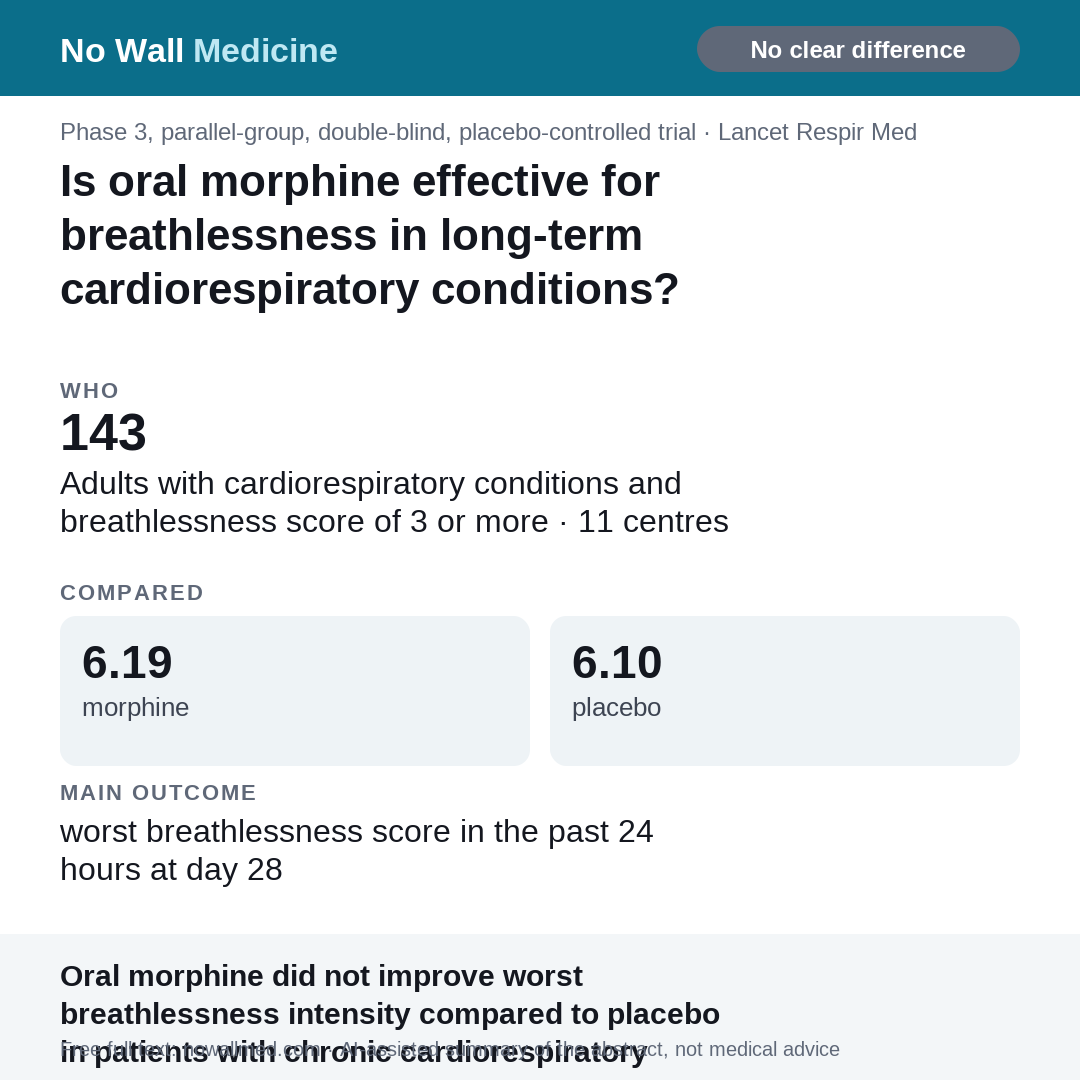
Is oral morphine effective for breathlessness in long-term cardiorespiratory conditions?
Who
143
Adults with cardiorespiratory conditions and breathlessness score of 3 or more · 11 centres
Compared
6.19morphine (95% CI 5.57 to 6.81)
6.10placebo (95% CI 5.44 to 6.76)
Main outcome
worst breathlessness score in the past 24 hours at day 28
Result: adjusted mean difference 0.09 (95% CI -0.57 to 0.75)
Bottom line: Oral morphine did not improve worst breathlessness intensity compared to placebo in patients with chronic cardiorespiratory breathlessness.
Funded by: NIHR Health Technology Assessment programme
Lancet Respir Med · 2025-09-28Download image
Clinical question: Is oral morphine effective for breathlessness in long-term cardiorespiratory conditions?
Why it matters: The effectiveness of opioids for breathlessness seen in laboratory settings has not been replicated in clinical trials for long-term conditions.
Key points
- Researchers conducted a randomized trial with 143 adults who received either 5-10 mg of long-acting morphine twice daily or a placebo for 56 days.
- At day 28, the worst breathlessness score was 6.19 in the morphine group compared to 6.10 in the placebo group, showing no significant difference.
- The morphine group reported more adverse events (251 vs 162) and more serious adverse events (15 vs 3) than the placebo group.
Headline and key points written with AI from the paper’s abstract, with every number checked against it. Read the paper before relying on them.
Abstract
Background
The effectiveness of opioids for breathlessness seen in laboratory-based studies has not been replicated in clinical trials. We aimed to assess the effectiveness of oral morphine for breathlessness in long-term conditions. Methods
This phase 3, parallel-group, double-blind, placebo-controlled trial across 11 centres randomly assigned consenting adults (1:1, stratified by site and causal disease) with a modified Medical Research Council breathlessness score of 3 or more due to cardiorespiratory conditions to receive 5-10 mg twice daily oral long-acting morphine or placebo (as well as a blinded laxative) for 56 days. The primary outcome was worst breathlessness score in the past 24 h at day 28, measured using a numerical rating scale (NRS; 0=not breathless at all; 10=worst imaginable breathlessness). Secondary outcomes included physical activity levels, worst cough NRS, quality of life, and morphine-related toxicities. Patients who received at least one dose of study drug were eligible for inclusion in efficacy and safety analyses. The trial was registered with ISRCTN (ISRCTN87329095) and the EU Clinical Trials Register (EudraCT 2019-002479-33). Findings
Between March 18, 2021, and Oct 26, 2023, 143 participants were randomly assigned to receive either morphine (73 participants) or placebo (67 participants) and were included in the analyses; three participants did not receive the allocated treatment. Participants had a mean age of 70·5 (SD 9·4) years, were mostly male (93 [66%]), and were mostly White (132 [94%]). By day 28, 64 (88%) participants in the morphine group versus 66 (99%) in the placebo group had 90% adherence or greater. We found no evidence of difference in worst breathlessness at day 28 (morphine 6·19 [95% CI 5·57 to 6·81] vs placebo 6·10 [5·44 to 6·76]; adjusted mean difference 0·09 [95% CI -0·57 to 0·75], p=0·78) or any secondary measure, except for improved cough seen at day 56 (adjusted mean difference -1·41 [-2·18 to -0·64]). Increased moderate to vigorous physical activity was seen at day 28 (adjusted mean difference 9·51 min/day [0·54-18·48]) but this was not significant after multiple-measures correction. The morphine group had more adverse events (251 vs 162), serious adverse events (15 vs three, of which three in the morphine group and zero in the placebo group were deemed to be related to the study), and study drug withdrawals (13 vs two). There were no treatment-related deaths. Interpretation
We found no evidence that morphine improves worst breathlessness intensity. Further research is needed to understand whether there is any role for morphine in chronic breathlessness, but our findings do not support its use in this setting. Funding
NIHR Health Technology Assessment programme (HTA Project 17/34/01).
Abstract reproduced under the article’s CC BY licence.
Topics
Cite this article
Johnson MJ, Williams B, Keerie C, Tuck S, Hart S, Bajwah S. Morphine for chronic breathlessness (MABEL) in the UK: a multi-site, parallel-group, dose titration, double-blind, randomised, placebo-controlled trial. Lancet Respir Med. 2025. doi:10.1016/S2213-2600(25)00205-X
Spotted a mistake? Suggest a correction
Top studies every Monday
The week’s key trials and guidelines in your specialties, plus any topics you follow. By email, free.
Get the weekly digest