Forward and backward aortic pulse wave components were associated with higher cardiovascular risk
Mortality and Cardiovascular End Points In Relation to the Aortic Pulse Wave Components: An Individual-Participant Meta-Analysis
Individual-participant meta-analysisBenefit found
Are aortic pulse wave components associated with cardiovascular mortality and nonfatal events?
Who
2206
Participants aged 20 years or older from three cohorts · Argentina, Belgium, and Finland
Compared
1 SD increment in Pfor: 27% (95% CI, 1.07-1.49) higher risk
1 SD increment in Tfor: 25% (95% CI, 1.07-1.45) higher risk
1 SD increment in Tfor/Tref: 32% (95% CI, 1.12-1.56) higher risk
Main outcome
Cardiovascular mortality and nonfatal cardiovascular and cerebrovascular events
Bottom line: Higher forward pressure, time to peak, and the Tfor/Tref ratio are associated with increased cardiovascular risk.
Hypertension · 2024-02-23Download image
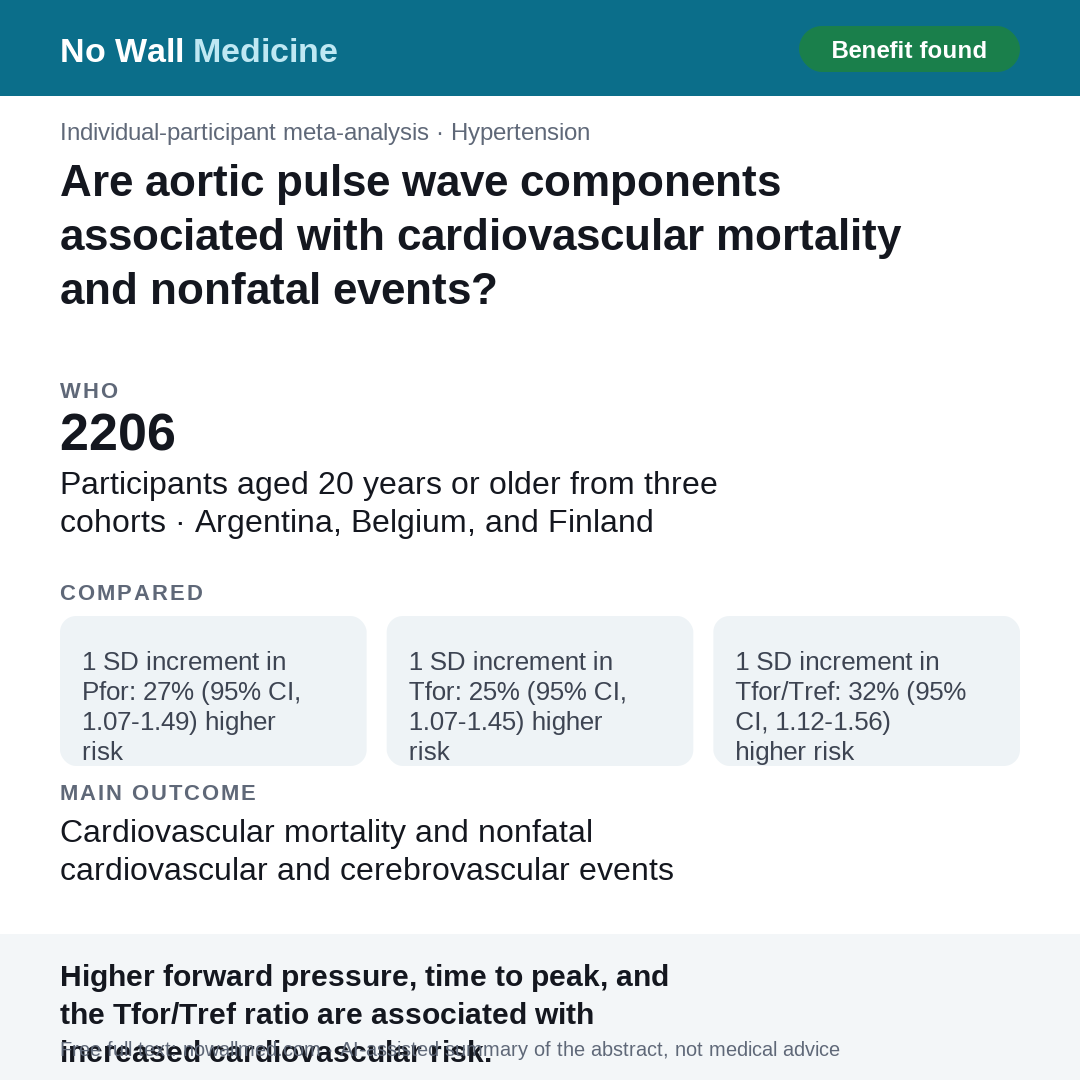
Clinical question: Are aortic pulse wave components associated with cardiovascular mortality and nonfatal events?
Why it matters: It was unknown how the individual pressures and timing of forward and backward aortic pulse waves relate to cardiovascular mortality and nonfatal cardiovascular or cerebrovascular events.
Key points
- Researchers analyzed 2206 participants with a median follow-up of 4.4 years to examine how different components of the aortic pulse wave relate to cardiovascular events.
- Every 1 standard deviation increase in forward wave pressure, time to forward wave peak, and the ratio of time to forward and backward peaks was associated with 27%, 25%, and 32% higher risk, respectively.
- Adding the time to forward wave peak and the ratio of time to forward and backward peaks to existing risk models improved prediction of cardiovascular outcomes.
Headline and key points written with AI from the paper’s abstract, with every number checked against it. Read the paper before relying on them.
Was this summary helpful?
Subject terms
Cite this article
Norton GR, An DW, Aparicio LS, Yu YL, Wei FF, Niiranen TJ. Mortality and Cardiovascular End Points In Relation to the Aortic Pulse Wave Components: An Individual-Participant Meta-Analysis. Hypertension. 2024. doi:10.1161/HYPERTENSIONAHA.123.22036
Spotted a mistake? Suggest a correction
Top studies every Monday
The week’s key trials and guidelines in your specialties, plus any topics you follow. By email, free.
Get the weekly digest