Most artificial intelligence models for intensive care remain in testing phases rather than clinical practice
Moving from bytes to bedside: a systematic review on the use of artificial intelligence in the intensive care unit
Systematic reviewUnclear result
What is the current maturity and risk of bias of artificial intelligence in intensive care?
Who
494
Studies using artificial intelligence to analyze intensive care unit data
Compared
Retrospective studies: 476 studies (96.4%)
8Prospective observational studies (1.6%)
10Clinical trials (2%)
Main outcome
Maturity, research methods, and risk of bias of artificial intelligence models
Bottom line: Most artificial intelligence models in intensive care are retrospective and lack evaluation in routine clinical practice.
Limitation: No studies reported outcome evaluation of artificial intelligence models integrated in routine clinical practice.
Intensive Care Med · 2021-06-05Download image
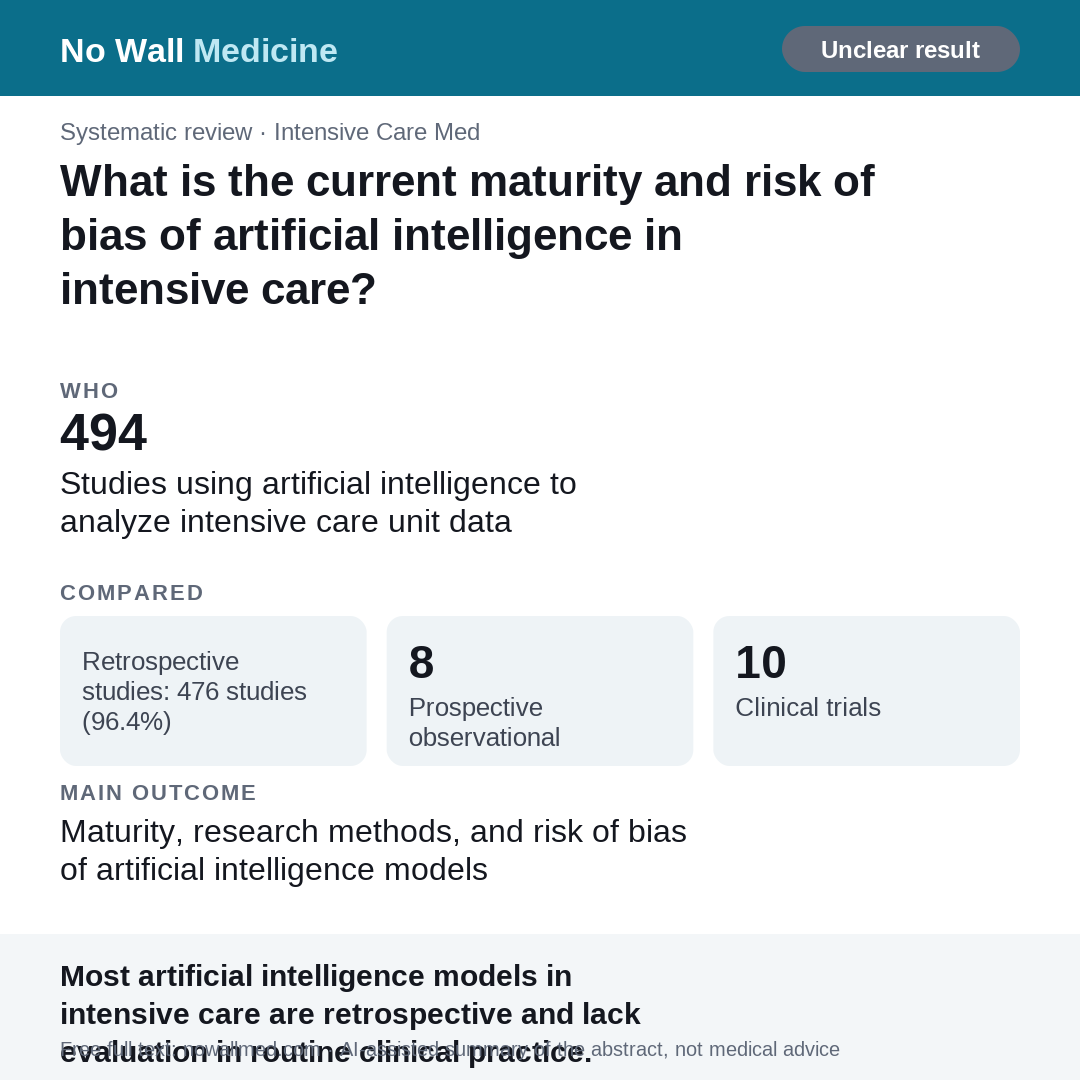
Clinical question: What is the current maturity and risk of bias of artificial intelligence in intensive care?
Why it matters: It is unknown how artificial intelligence models perform when integrated into routine clinical practice within the intensive care unit.
Key points
- Researchers reviewed 494 studies from a pool of 6455 identified through various medical databases.
- The majority of studies were retrospective at 96.4%, while only 2% were clinical trials.
- No studies were identified that reported on the outcome evaluation of an artificial intelligence model integrated into routine clinical practice.
Limitation the authors note: The vast majority of studies were retrospective and 80.9% of those were classified as having a high risk of bias.
Headline and key points written with AI from the paper’s abstract, with every number checked against it. Read the paper before relying on them.
Was this summary helpful?
Subject terms
Cite this article
van de Sande D, van Genderen ME, Huiskens J, Gommers D, van Bommel J. Moving from bytes to bedside: a systematic review on the use of artificial intelligence in the intensive care unit. Intensive Care Med. 2021. doi:10.1007/s00134-021-06446-7
Spotted a mistake? Suggest a correction
Top studies every Monday
The week’s key trials and guidelines in your specialties, plus any topics you follow. By email, free.
Get the weekly digest