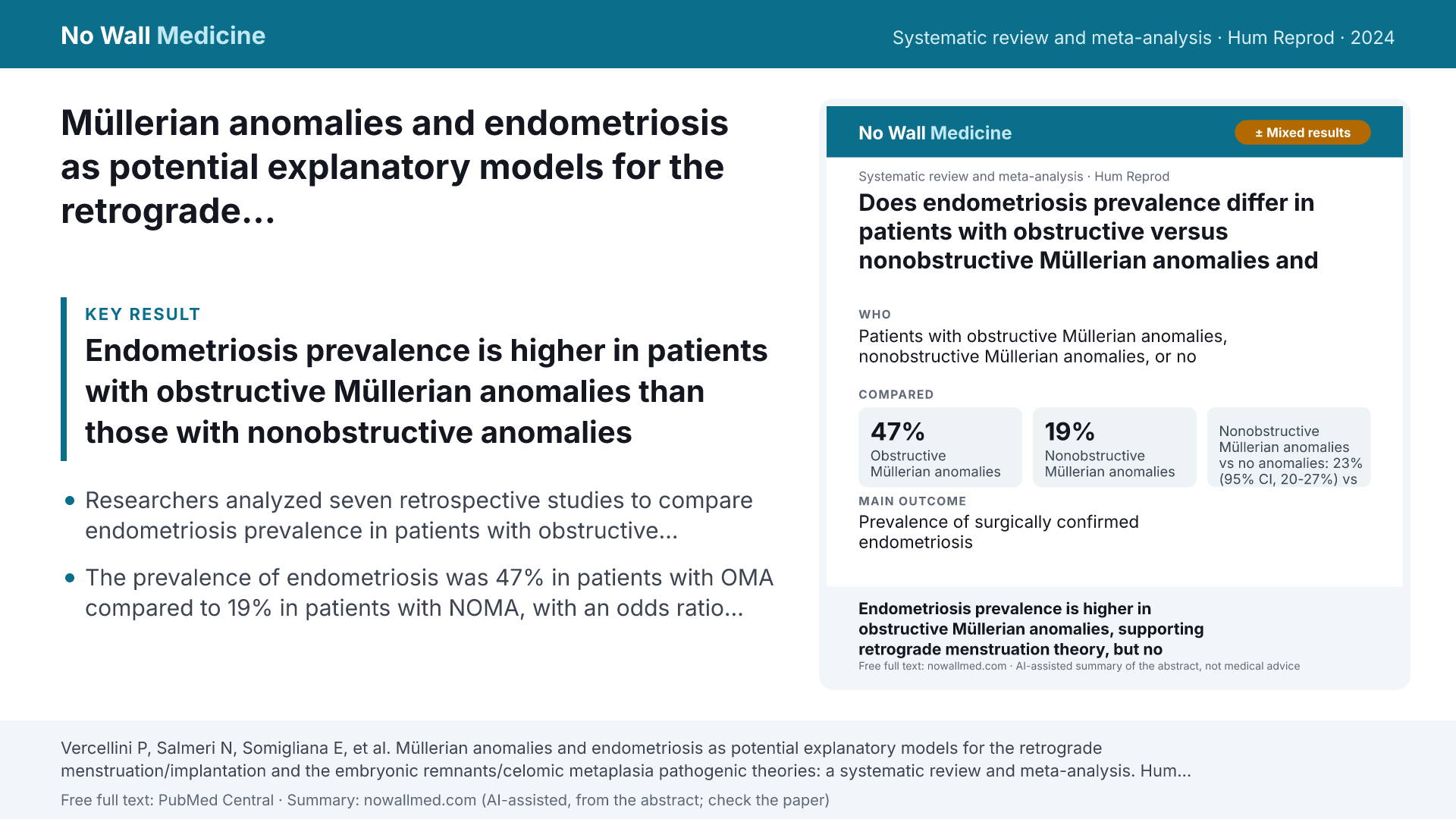
Endometriosis prevalence is higher in patients with obstructive Müllerian anomalies than those with nonobstructive anomalies
Müllerian anomalies and endometriosis as potential explanatory models for the retrograde menstruation/implantation and the embryonic remnants/celomic metaplasia pathogenic theories: a systematic review and meta-analysis
Systematic review and meta-analysisMixed results
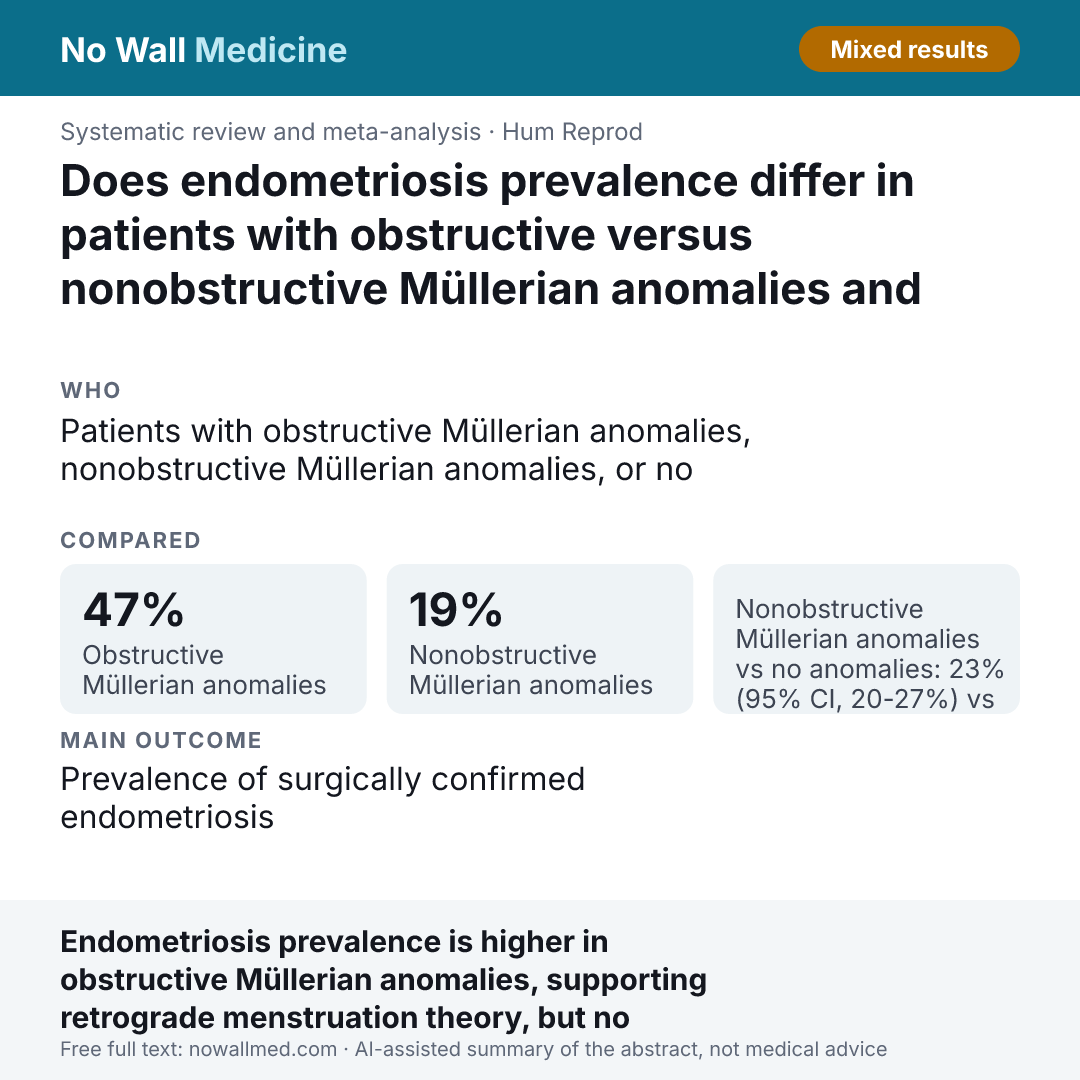
Does endometriosis prevalence differ in patients with obstructive versus nonobstructive Müllerian anomalies and without anomalies?
Who
Patients with obstructive Müllerian anomalies, nonobstructive Müllerian anomalies, or no anomalies
Compared
47%Obstructive Müllerian anomalies (95% CI, 36-58%)
19%Nonobstructive Müllerian anomalies (95% CI, 15-24%)
Nonobstructive Müllerian anomalies vs no anomalies: 23% (95% CI, 20-27%) vs 21% (95% CI, 20-22%)
Main outcome
Prevalence of surgically confirmed endometriosis
Result: OR 4.72 (95% CI, 2.54-8.77) for OMA vs NOMA; OR 0.95 (95% CI, 0.57-1.58) for NOMA vs no anomalies
Bottom line: Endometriosis prevalence is higher in obstructive Müllerian anomalies, supporting retrograde menstruation theory, but no difference was found between nonobstructive and no anomalies.
Limitation: Low certainty of evidence and potential confounding by indication or NOMA subtypes affecting menstrual efflux.
Hum Reprod · 2024-05-11 · Save PNG
Clinical question: Does endometriosis prevalence differ in patients with obstructive versus nonobstructive Müllerian anomalies and without anomalies?
Why it matters: The exact cause of endometriosis is not definitively known, and researchers are testing whether it is caused by retrograde menstruation or embryonic remnants.
Key points
- Researchers analyzed seven retrospective studies to compare endometriosis prevalence in patients with obstructive Müllerian anomalies (OMA), nonobstructive Müllerian anomalies (NOMA), and those without Müllerian anomalies.
- The prevalence of endometriosis was 47% in patients with OMA compared to 19% in patients with NOMA, with an odds ratio of 4.72.
- Endometriosis prevalence was 23% in patients with NOMA and 21% in patients without Müllerian anomalies, with an odds ratio of 0.95.
Limitation the authors note: The authors state that the certainty of evidence was low and that confounding by indication or specific NOMA subtypes could explain the results.
Headline and key points written with AI from the paper’s abstract, with every number checked against it. Read the paper before relying on them.
Was this summary helpful?
Subject terms
Headline, design, result, key points, caveat and citation as plain text.
Cite this article
Vercellini P, Salmeri N, Somigliana E, et al. Müllerian anomalies and endometriosis as potential explanatory models for the retrograde menstruation/implantation and the embryonic remnants/celomic metaplasia pathogenic theories: a systematic review and meta-analysis. Hum Reprod. 2024;39(7):1460-1470. doi:10.1093/humrep/deae086
Spotted a mistake? Suggest a correction