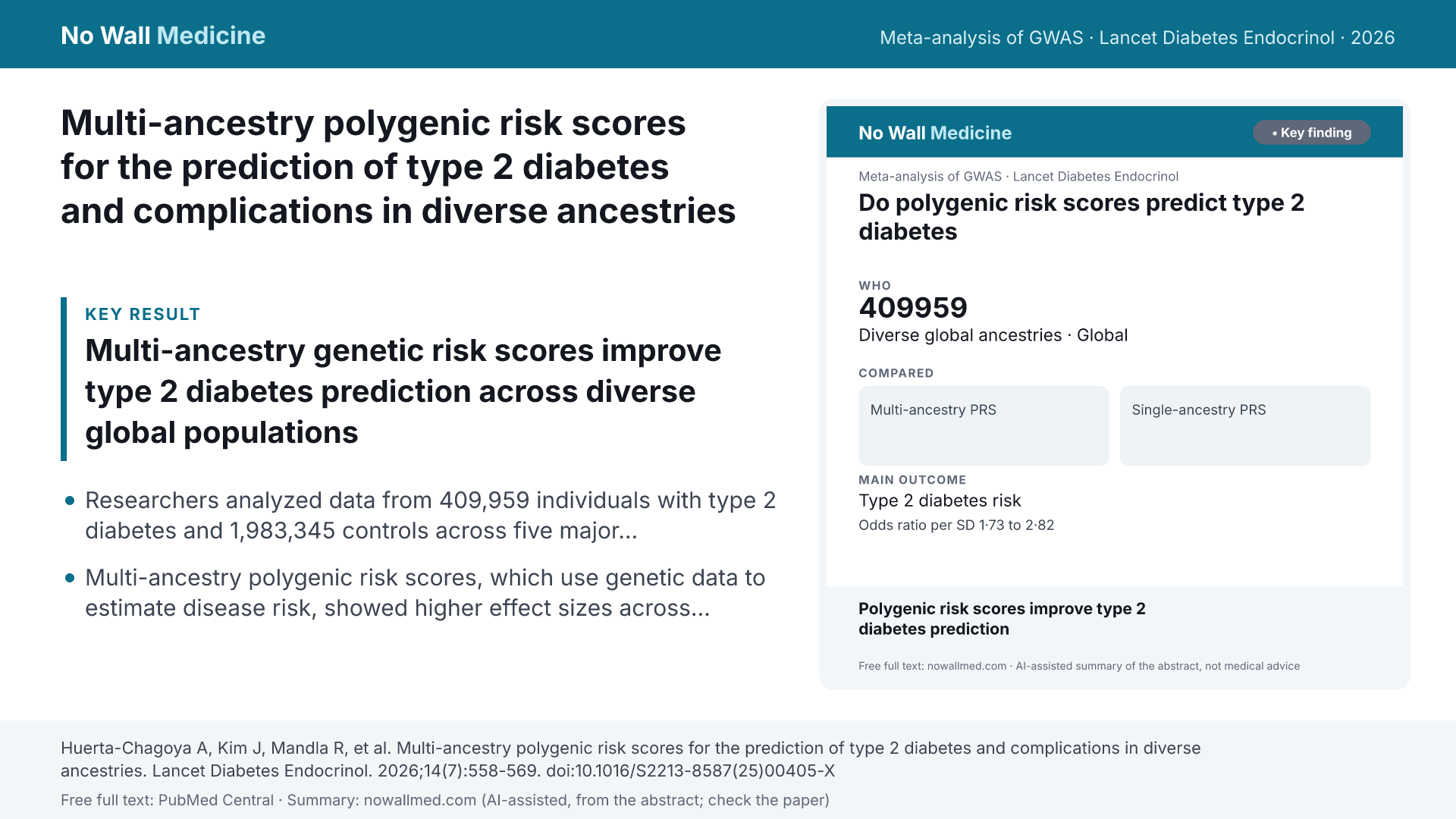
Multi-ancestry genetic risk scores improve type 2 diabetes prediction across diverse global populations
Multi-ancestry polygenic risk scores for the prediction of type 2 diabetes and complications in diverse ancestries
Meta-analysis of GWASKey finding
Do polygenic risk scores predict type 2 diabetes
Who
409959
Diverse global ancestries · Global
Compared
Multi-ancestry PRS
Single-ancestry PRS
Main outcome
Type 2 diabetes risk
Result: Odds ratio per SD 1·73 to 2·82
Bottom line: Polygenic risk scores improve type 2 diabetes prediction
Limitation: Poor performance in non-European populations
Funded by: National Human Genome Research Institute
Lancet Diabetes Endocrinol · 2026-04-27 · Save PNG

Why it matters: Polygenic risk scores often perform poorly in populations of non-European ancestry, which limits their clinical utility for global populations.
Key points
- Researchers analyzed data from 409,959 individuals with type 2 diabetes and 1,983,345 controls across five major global ancestries.
- Multi-ancestry polygenic risk scores, which use genetic data to estimate disease risk, showed higher effect sizes across all ancestries compared to single-ancestry scores.
- High-risk individuals in the 97.5th percentile had a 3-7 times increased risk of type 2 diabetes compared to those in the middle range.
Headline and key points written with AI from the paper’s abstract, with every number checked against it. Read the paper before relying on them.
Was this summary helpful?
Abstract
Background
Polygenic risk scores (PRSs) improve prediction of the development of type 2 diabetes over the use of clinical risk factors alone; however, they perform poorly in populations of non-European ancestry, limiting their global clinical utility. We aimed to deliver comprehensive and rigorously tested multi-ancestry PRSs for prediction in type 2 diabetes. Methods
We conducted meta-analyses using data from type 2 diabetes genome-wide association studies (GWAS) across cohorts from five major global ancestries: European, African or African American, Admixed American, South Asian, and East Asian. We used summary statistics from the GWAS to construct single-ancestry PRSs (using the continuous-shrinkage PRS-CS method) and multi-ancestry PRSs (using the PRS-CSx method), and constructed ancestry-specific linkage disequilibrium panels to model pairwise correlations between single-nucleotide polymorphisms in GWAS during PRS construction. Models were validated for association with type 2 diabetes in at least four independent cohorts per ancestry. The effect sizes of PRSs were estimated as the odds ratio (OR) per SD of the PRS, and ORs for individuals at the 90th, 95th, and 97·5th PRS percentiles were compared with the IQR as a reference. We also tested our PRS models for prediction of diabetes incidence with or without additional clinical factors, as well as microvascular complications and comorbidities. Findings
Our analysis used data from 409 959 individuals with type 2 diabetes and 1 983 345 controls: respectively, 359 819 and 1 825 729 indivduals were included in the GWAS dataset, with 10 992 and 31 792 individuals in the training dataset and 39 148 and 125 824 individuals in the validation dataset. The best predictive performance for the single-ancestry PRSs was in European (incremental AUC 0·07-0·14) and East Asian (0·02-0·16) ancestries, whereas prediction was poorer for African or African American (0·02-0·03), Admixed American (0·02-0·04), and South Asian (0·02-0·04) ancestries, correlating with sample sizes in the GWAS. Compared with single-ancestry PRSs, our multi-ancestry PRSs showed higher effect sizes and smaller 95% CIs across all ancestries: OR per SD 1·73 (95% CI 1·67-1·80) in African or African American, 2·82 (2·67-2·97) in Admixed American, 2·45 (2·36-2·54) in East Asian, 2·36 (2·32-2·41) in European, and 2·23 (2·05-2·42) in South Asian ancestries. Individuals in the 97·5th PRS percentile had a 3-7 times increased risk of type 2 diabetes compared with those in the IQR (OR 3·43 [95% CI 2·80-4·21] in African or African American, 7·47 [5·64-9·89] in Admixed American, 6·62 [5·58-7·85] in East Asian, 6·25 [5·72-6·82] in European, and 4·50 [2·70-7·53] in South Asian ancestries). These PRSs were also associated with earlier onset of type 2 diabetes, higher risk of developing microvascular complications, and provide additional predictive value beyond clinical factors. In individuals with type 2 diabetes, the association between multi-ancestry PRSs and risk of microvascular complications and comorbidity was studied in populations of African, Admixed American, and European ancestries and was significant in all three ancestry groups for diabetic retinopathy (ORs per SD 1·28-1·57), diabetic nephropathy (1·25-1·58), proliferative diabetic retinopathy (1·39-2·08), and end-stage diabetic nephropathy (1·44-1·87); PRS was associated with coronary artery disease in the Admixed American ancestry group only (1·16 [95% CI 1·08-1·25]). Interpretation
These validated, publicly available PRSs can improve risk stratification for type 2 diabetes onset and complications across diverse ancestries, supporting their further evaluation in clinical settings. Funding
The National Human Genome Research Institute of the US National Institutes of Health.
Abstract reproduced under the article’s CC BY NC ND licence.
Subject terms
Headline, design, result, key points, caveat and citation as plain text.
Cite this article
Huerta-Chagoya A, Kim J, Mandla R, et al. Multi-ancestry polygenic risk scores for the prediction of type 2 diabetes and complications in diverse ancestries. Lancet Diabetes Endocrinol. 2026;14(7):558-569. doi:10.1016/S2213-8587(25)00405-X
Spotted a mistake? Suggest a correction