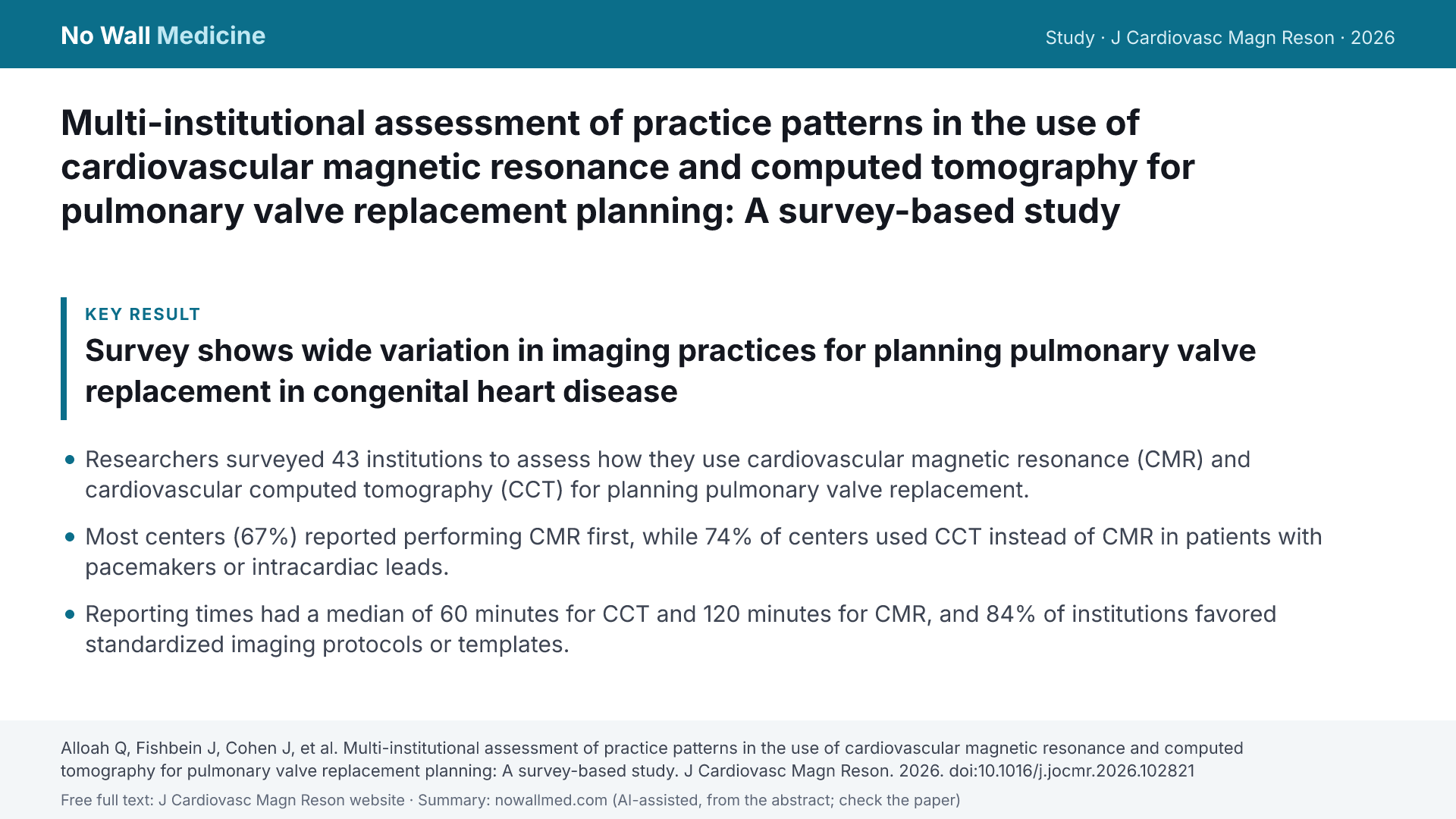
Survey shows wide variation in imaging practices for planning pulmonary valve replacement in congenital heart disease
Multi-institutional assessment of practice patterns in the use of cardiovascular magnetic resonance and computed tomography for pulmonary valve replacement planning: A survey-based study
Why it matters: Clinical practice patterns for using magnetic resonance and computed tomography in pulmonary valve replacement planning remain unclear despite existing consensus recommendations.
Key points
- Researchers surveyed 43 institutions to assess how they use cardiovascular magnetic resonance (CMR) and cardiovascular computed tomography (CCT) for planning pulmonary valve replacement.
- Most centers (67%) reported performing CMR first, while 74% of centers used CCT instead of CMR in patients with pacemakers or intracardiac leads.
- Reporting times had a median of 60 minutes for CCT and 120 minutes for CMR, and 84% of institutions favored standardized imaging protocols or templates.
Study type: Observational study: it can show a link, but not prove that one thing causes another.
Headline and key points written with AI from the paper’s abstract, with every number checked against it. Read the paper before relying on them.
Was this summary helpful?
Cite this article
Alloah Q, Fishbein J, Cohen J, Christopher A, Beroukhim RS, Lee S. Multi-institutional assessment of practice patterns in the use of cardiovascular magnetic resonance and computed tomography for pulmonary valve replacement planning: A survey-based study. J Cardiovasc Magn Reson. 2026. doi:10.1016/j.jocmr.2026.102821
Spotted a mistake? Suggest a correction