Empagliflozin decreased kidney filtration rate and blood flow compared to sitagliptin in a pilot trial
Multi-Parametric Magnetic Resonance Imaging to Assess Empagliflozin Effect on the Kidneys in People With Type 2 Diabetes Mellitus: A Pilot Clinical Trial
Prospective randomized open-label crossover clinical trialBenefit found
Does empagliflozin affect kidney function and renal metrics measured by multiparametric magnetic resonance imaging?
Who
12
Adults with type 2 diabetes and albuminuria
Compared
Empagliflozin: mean decrease in MRI-GFR (3.03 mL/min/1.73 m2)
Sitagliptin
Main outcome
Glomerular filtration rate and renal vascular resistance
Bottom line: Empagliflozin decreased glomerular filtration rate and medullary hypoxia compared to sitagliptin in people with type 2 diabetes.
Diabetes Obes Metab · 2026-06-04Download image
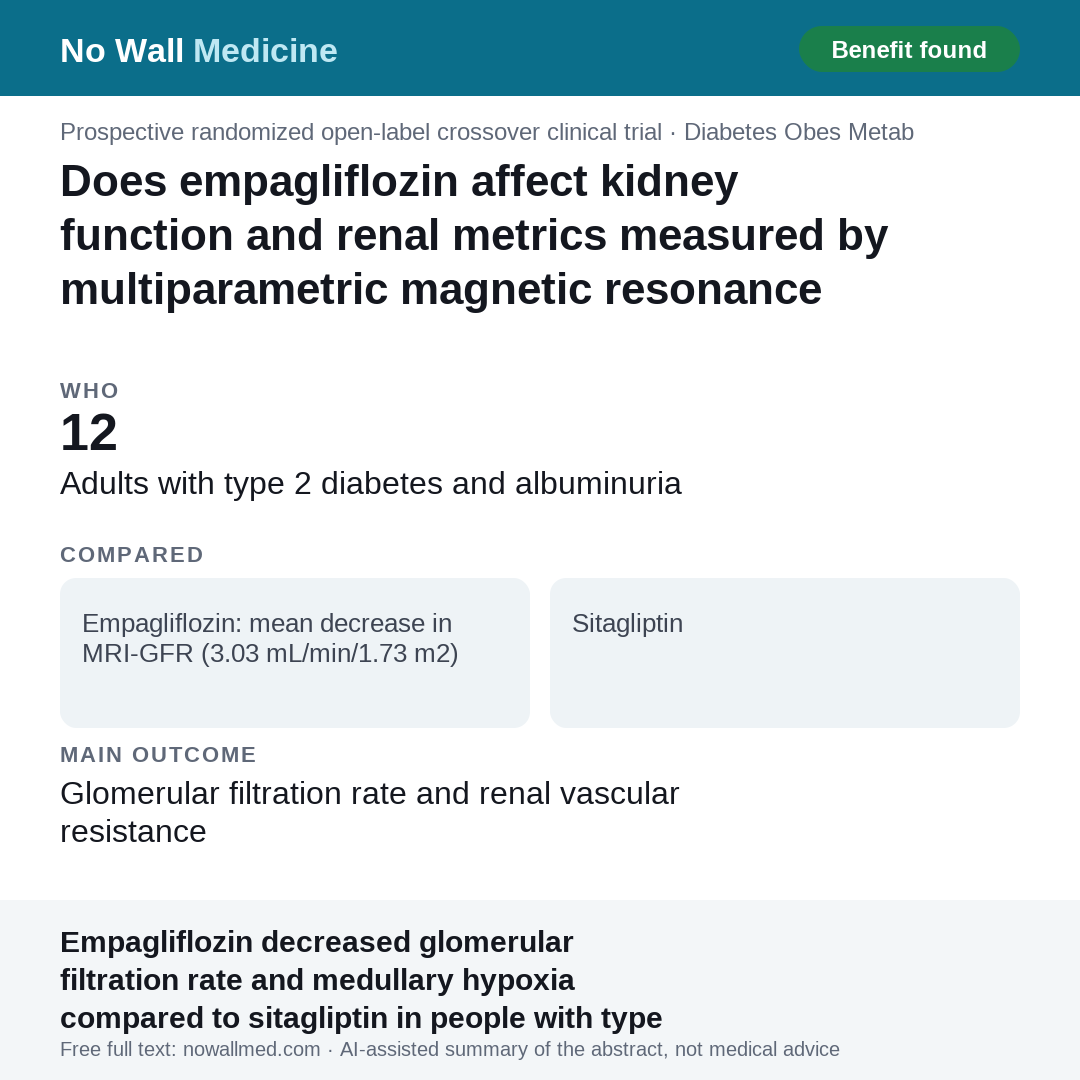
Clinical question: Does empagliflozin affect kidney function and renal metrics measured by multiparametric magnetic resonance imaging?
Why it matters: Researchers wanted to use advanced imaging to see if empagliflozin affects kidney blood flow and oxygenation beyond what traditional laboratory tests can show.
Key points
- Twelve adults with type 2 diabetes and kidney disease were studied using multiparametric magnetic resonance imaging (a detailed kidney scan) to compare empagliflozin and sitagliptin.
- Empagliflozin caused significant mean decreases in magnetic resonance imaging-derived glomerular filtration rate (3.03 mL/min/1.73 m2) and renal blood flow (41.24 mL/min) compared to sitagliptin.
- The study found no statistically significant changes to renal vascular resistance, kidney microstructure, estimated glomerular filtration rate, or albuminuria with empagliflozin.
Headline and key points written with AI from the paper’s abstract, with every number checked against it. Read the paper before relying on them.
Topics
Cite this article
Lim RP, Qassin S, McKenna L, Hornsey E, Italiano D, Churilov L. Multi-Parametric Magnetic Resonance Imaging to Assess Empagliflozin Effect on the Kidneys in People With Type 2 Diabetes Mellitus: A Pilot Clinical Trial. Diabetes Obes Metab. 2026. doi:10.1111/dom.70950
Spotted a mistake? Suggest a correction