Immediate urinary catheter removal is non-inferior to 24-hour removal after minimally invasive colon surgery
Multicentre, prospective, randomized controlled non-inferiority trial of bladder catheter management in short-duration, minimally invasive colon surgery (The Vesicalcath I-Study)
Multicentre, prospective, randomized controlled non-inferiority trialBenefit found
Is immediate catheter removal non-inferior to 24-hour removal after minimally invasive colon surgery?
Who
415
Patients undergoing elective minimally invasive colon and upper rectal surgery · Six Spanish public hospitals
Compared
1.8%24-hour removal group
5.1%Immediate removal group
Main outcome
Incidence of acute urinary retention
Result: absolute difference 3.48% (one-sided 95% confidence interval upper bound: 7.18%)
Bottom line: Immediate urinary catheter removal is a safe and non-inferior alternative to the standard 24-hour protocol.
Limitation: Higher acute urinary retention rates were observed in left-sided resections with immediate removal.
Int J Surg · 2025-07-17Download image
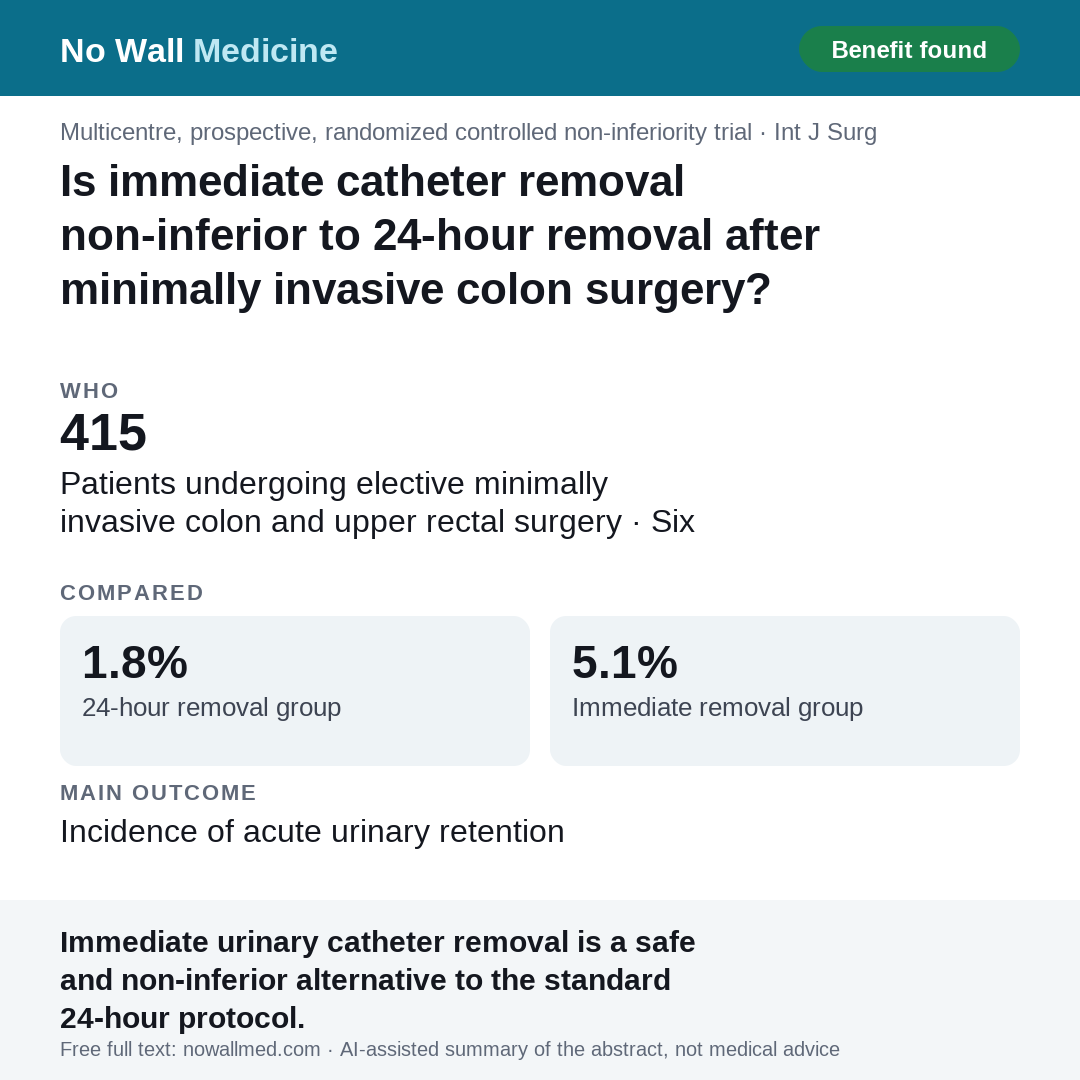
Clinical question: Is immediate catheter removal non-inferior to 24-hour removal after minimally invasive colon surgery?
Why it matters: The optimal duration for retaining a urinary catheter after surgery is controversial due to risks of urinary tract infections and acute urinary retention.
Key points
- Researchers conducted a multicentre randomized trial involving 415 patients undergoing laparoscopic or robotic colon and upper rectal surgery.
- The incidence of acute urinary retention, or the inability to pass urine, was 3.4% overall, with 1.8% in the 24-hour group and 5.1% in the immediate removal group.
- The absolute difference of 3.48% met the pre-specified non-inferiority margin of 8%, and the urinary tract infection rate was 0.5%.
Limitation the authors note: Higher rates of acute urinary retention were observed in patients undergoing left-sided resections with immediate removal.
Headline and key points written with AI from the paper’s abstract, with every number checked against it. Read the paper before relying on them.
Topics
Cite this article
Serra-Aracil X, Hidalgo J, Perucho NL, Montesinos CS, Diaz CG, Figueras RV. Multicentre, prospective, randomized controlled non-inferiority trial of bladder catheter management in short-duration, minimally invasive colon surgery (The Vesicalcath I-Study). Int J Surg. 2025. doi:10.1097/JS9.0000000000002962
Spotted a mistake? Suggest a correction