Self-assembling haemostatic gel did not reduce delayed bleeding after endoscopic mucosal resection
Multicentre randomised controlled trial of a self-assembling haemostatic gel to prevent delayed bleeding following endoscopic mucosal resection (PURPLE Trial)
Prospective randomised trialNo clear difference
Does prophylactic haemostatic gel application reduce delayed bleeding after endoscopic mucosal resection?
Who
232
Patients undergoing hot-snare endoscopic mucosal resection of flat lesions · 15 German centres
Compared
11.7%haemostatic gel application (14 cases)
6.3%no prophylaxis (7 cases)
Main outcome
delayed bleeding within 30 days
Result: p=0.227
Bottom line: Haemostatic gel application following endoscopic mucosal resection does not reduce the rate of delayed bleeding.
Gut · 2025-06-06Download image
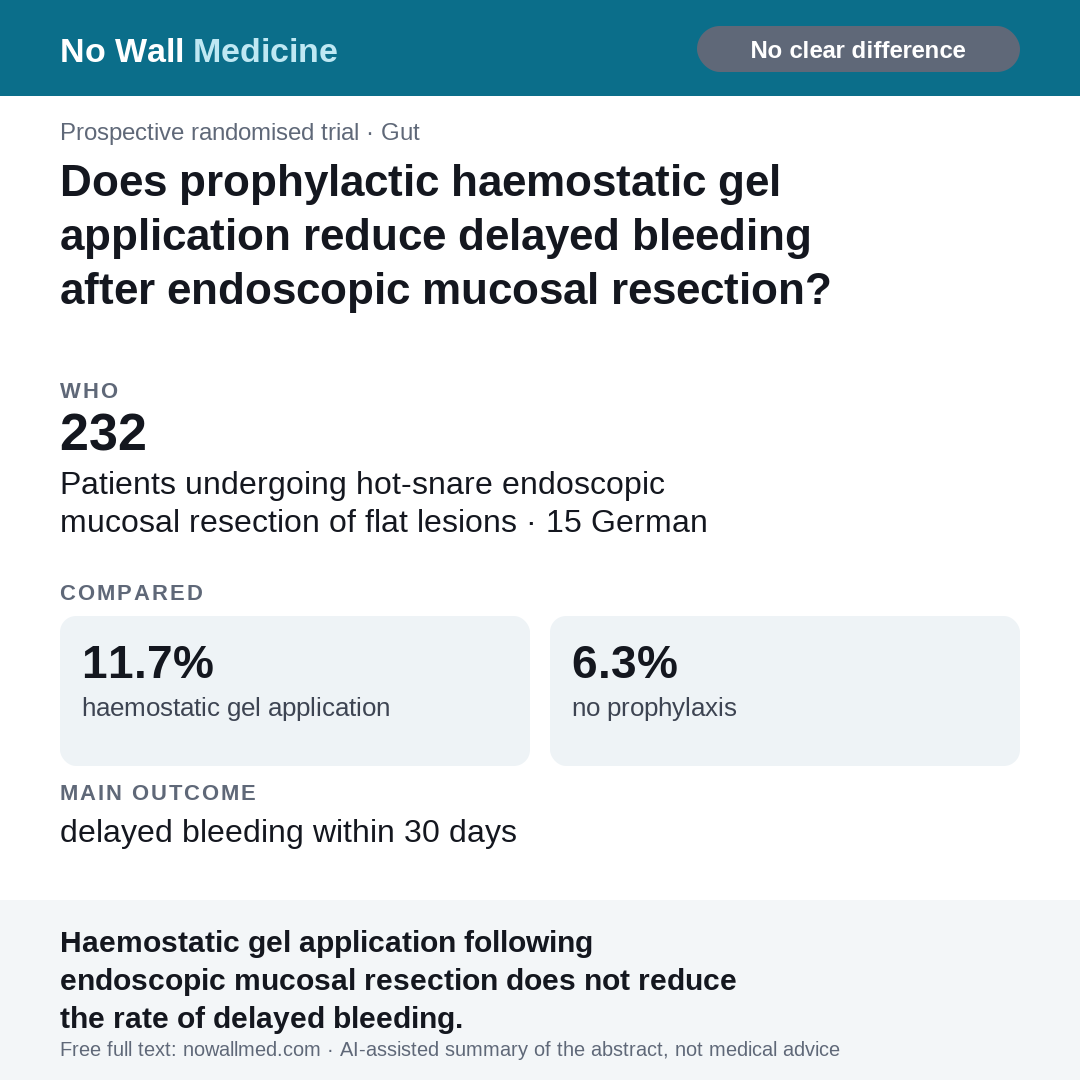
Clinical question: Does prophylactic haemostatic gel application reduce delayed bleeding after endoscopic mucosal resection?
Why it matters: Clinicians need to know if applying a haemostatic gel to the resection field can prevent clinically significant delayed bleeding after endoscopic mucosal resection.
Key points
- Researchers conducted a randomized trial of 232 patients undergoing endoscopic mucosal resection, which is a procedure to remove flat lesions from the duodenum or colorectum.
- Delayed bleeding within 30 days occurred in 11.7% of patients receiving the haemostatic gel compared to 6.3% in the control group, which was not a statistically significant difference.
- The trial was stopped early due to futility after an interim analysis was performed.
Headline and key points written with AI from the paper’s abstract, with every number checked against it. Read the paper before relying on them.
Abstract
Background
Prophylactic application of a haemostatic gel to the resection field may be an easy way to prevent delayed bleeding, a frequent complication after endoscopic mucosal resection (EMR). Objective
We aimed to evaluate if the prophylactic application of a haemostatic gel to the resection field directly after EMR can reduce the rate of clinically significant delayed bleeding events. Design
We conducted a prospective randomised trial of patients undergoing hot-snare EMR of flat lesions in the duodenum (≥10 mm) and colorectum (≥20 mm) at 15 German centres. Prophylactic clip closure was not allowed, but selective clipping or coagulation could be used prior to randomisation to treat intraprocedural bleeding or for prophylactic closure of visible vessels. Patients were randomised to haemostatic gel application or no prophylaxis. The primary endpoint was delayed bleeding within 30 days. Results
The trial was stopped early due to futility after an interim analysis. The primary endpoint was analysed in 232 patients (208 colorectal, 26 duodenal). Both groups were comparable in age, sex, comorbidities and lesion characteristics. Preventive measures, such as selective clipping or coagulation, were applied prior to randomisation in 51.9% of cases, with no difference between groups. Delayed bleeding occurred in 14 cases (11.7%; 95% CI 7.1% to 18.6%) after Purastat and in 7 cases (6.3%; 95% CI 3.1% to 12.3%) in the control group (p=0.227), with no difference between colorectal and duodenal subgroups. Conclusion
The application of a haemostatic gel following EMR of large flat lesions in the duodenum and colorectum does not reduce the rate of delayed bleeding.
Abstract reproduced under the article’s CC BY NC licence.
Topics
Cite this article
Drews J, Zachäus M, Kleemann T, Schirra J, Cahyadi O, Möschler O. Multicentre randomised controlled trial of a self-assembling haemostatic gel to prevent delayed bleeding following endoscopic mucosal resection (PURPLE Trial). Gut. 2025. doi:10.1136/gutjnl-2024-334229
Spotted a mistake? Suggest a correction
Top studies every Monday
The week’s key trials and guidelines in your specialties, plus any topics you follow. By email, free.
Get the weekly digest