Multicomponent intervention reduces mobility disability in frail older adults with low physical performance
Multicomponent intervention to prevent mobility disability in frail older adults: randomised controlled trial (SPRINTT project)
Evaluator blinded, randomised controlled trialBenefit found
Does a multicomponent intervention prevent mobility disability in frail older adults?
Who
1519
Community dwelling men and women aged 70 years or older with physical frailty and sarcopenia · 16 clinical sites across 11 European countries
Compared
Multicomponent intervention: 283/605 (46.8%)
Education on healthy ageing: 316/600 (52.7%)
Main outcome
Mobility disability (inability to independently walk 400 m in <15 minutes)
Result: hazard ratio 0.78 (95% confidence interval 0.67 to 0.92)
Bottom line: A multicomponent intervention reduced mobility disability incidence in older adults with physical frailty and sarcopenia and short physical performance battery scores of 3-7.
BMJ · 2022-05-11Download image
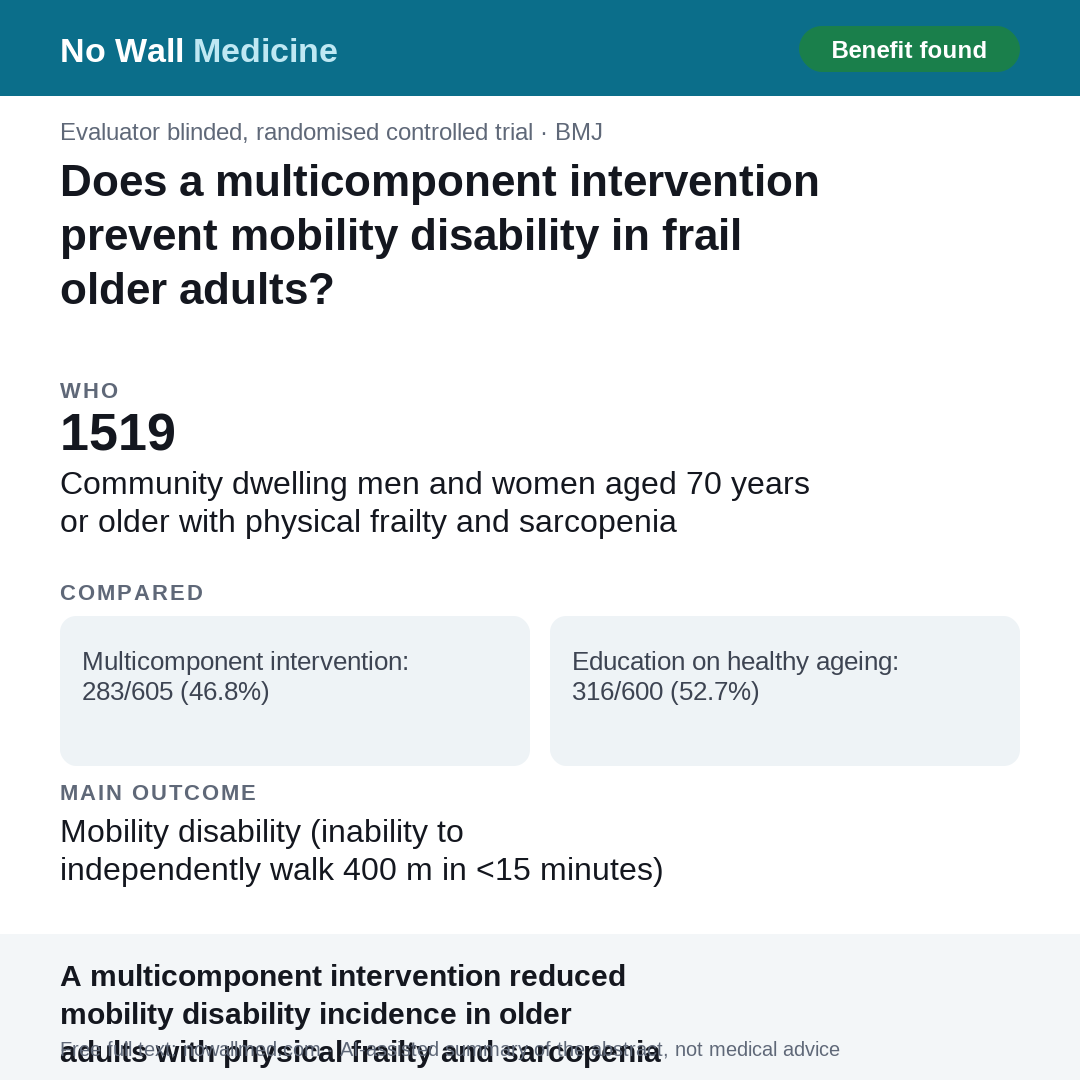
Clinical question: Does a multicomponent intervention prevent mobility disability in frail older adults?
Why it matters: It was unknown if combining physical activity with technological support and nutritional counseling could prevent mobility disability in older adults with physical frailty and sarcopenia.
Key points
- Researchers studied 1519 community-dwelling men and women aged 70 or older with physical frailty and sarcopenia, which is the loss of muscle mass and strength.
- In participants with short physical performance battery scores of 3 to 7, mobility disability occurred in 46.8% of the intervention group compared to 52.7% of the control group.
- The intervention group showed higher physical performance scores at 24 and 36 months, with women in the intervention group losing less muscle mass than controls.
Headline and key points written with AI from the paper’s abstract, with every number checked against it. Read the paper before relying on them.
Was this summary helpful?
Abstract
Objective
To determine whether a multicomponent intervention based on physical activity with technological support and nutritional counselling prevents mobility disability in older adults with physical frailty and sarcopenia. Design
Evaluator blinded, randomised controlled trial. Setting
16 clinical sites across 11 European countries, January 2016 to 31 October 2019. Participants
1519 community dwelling men and women aged 70 years or older with physical frailty and sarcopenia, operationalised as the co-occurrence of low functional status, defined as a short physical performance battery (SPPB) score of 3 to 9, low appendicular lean mass, and ability to independently walk 400 m. 760 participants were randomised to a multicomponent intervention and 759 received education on healthy ageing (controls). Interventions
The multicomponent intervention comprised moderate intensity physical activity twice weekly at a centre and up to four times weekly at home. Actimetry data were used to tailor the intervention. Participants also received personalised nutritional counselling. Control participants received education on healthy ageing once a month. Interventions and follow-up lasted for up to 36 months. Main outcome measures
The primary outcome was mobility disability (inability to independently walk 400 m in <15 minutes). Persistent mobility disability (inability to walk 400 m on two consecutive occasions) and changes from baseline to 24 and 36 months in physical performance, muscle strength, and appendicular lean mass were analysed as pre-planned secondary outcomes. Primary comparisons were conducted in participants with baseline SPPB scores of 3-7 (n=1205). Those with SPPB scores of 8 or 9 (n=314) were analysed separately for exploratory purposes. Results
Mean age of the 1519 participants (1088 women) was 78.9 (standard deviation 5.8) years. The average follow-up was 26.4 (SD 9.5) months. Among participants with SPPB scores of 3-7, mobility disability occurred in 283/605 (46.8%) assigned to the multicomponent intervention and 316/600 (52.7%) controls (hazard ratio 0.78, 95% confidence interval 0.67 to 0.92; P=0.005). Persistent mobility disability occurred in 127/605 (21.0%) participants assigned to the multicomponent intervention and 150/600 (25.0%) controls (0.79, 0.62 to 1.01; P=0.06). The between group difference in SPPB score was 0.8 points (95% confidence interval 0.5 to 1.1 points; P<0.001) and 1.0 point (95% confidence interval 0.5 to 1.6 points; P<0.001) in favour of the multicomponent intervention at 24 and 36 months, respectively. The decline in handgrip strength at 24 months was smaller in women assigned to the multicomponent intervention than to control (0.9 kg, 95% confidence interval 0.1 to 1.6 kg; P=0.028). Women in the multicomponent intervention arm lost 0.24 kg and 0.49 kg less appendicular lean mass than controls at 24 months (95% confidence interval 0.10 to 0.39 kg; P<0.001) and 36 months (0.26 to 0.73 kg; P<0.001), respectively. Serious adverse events occurred in 237/605 (39.2%) participants assigned to the multicomponent intervention and 216/600 (36.0%) controls (risk ratio 1.09, 95% confidence interval 0.94 to 1.26). In participants with SPPB scores of 8 or 9, mobility disability occurred in 46/155 (29.7%) in the multicomponent intervention and 38/159 (23.9%) controls (hazard ratio 1.25, 95% confidence interval 0.79 to 1.95; P=0.34). Conclusions
A multicomponent intervention was associated with a reduction in the incidence of mobility disability in older adults with physical frailty and sarcopenia and SPPB scores of 3-7. Physical frailty and sarcopenia may be targeted to preserve mobility in vulnerable older people. Trial registration
ClinicalTrials.gov NCT02582138.
Abstract reproduced under the article’s CC BY NC licence.
Subject terms
Cite this article
Bernabei R, Landi F, Calvani R, Cesari M, Del Signore S, Anker SD. Multicomponent intervention to prevent mobility disability in frail older adults: randomised controlled trial (SPRINTT project). BMJ. 2022. doi:10.1136/bmj-2021-068788
Spotted a mistake? Suggest a correction
Top studies every Monday
The week’s key trials and guidelines in your specialties, plus any topics you follow. By email, free.
Get the weekly digest