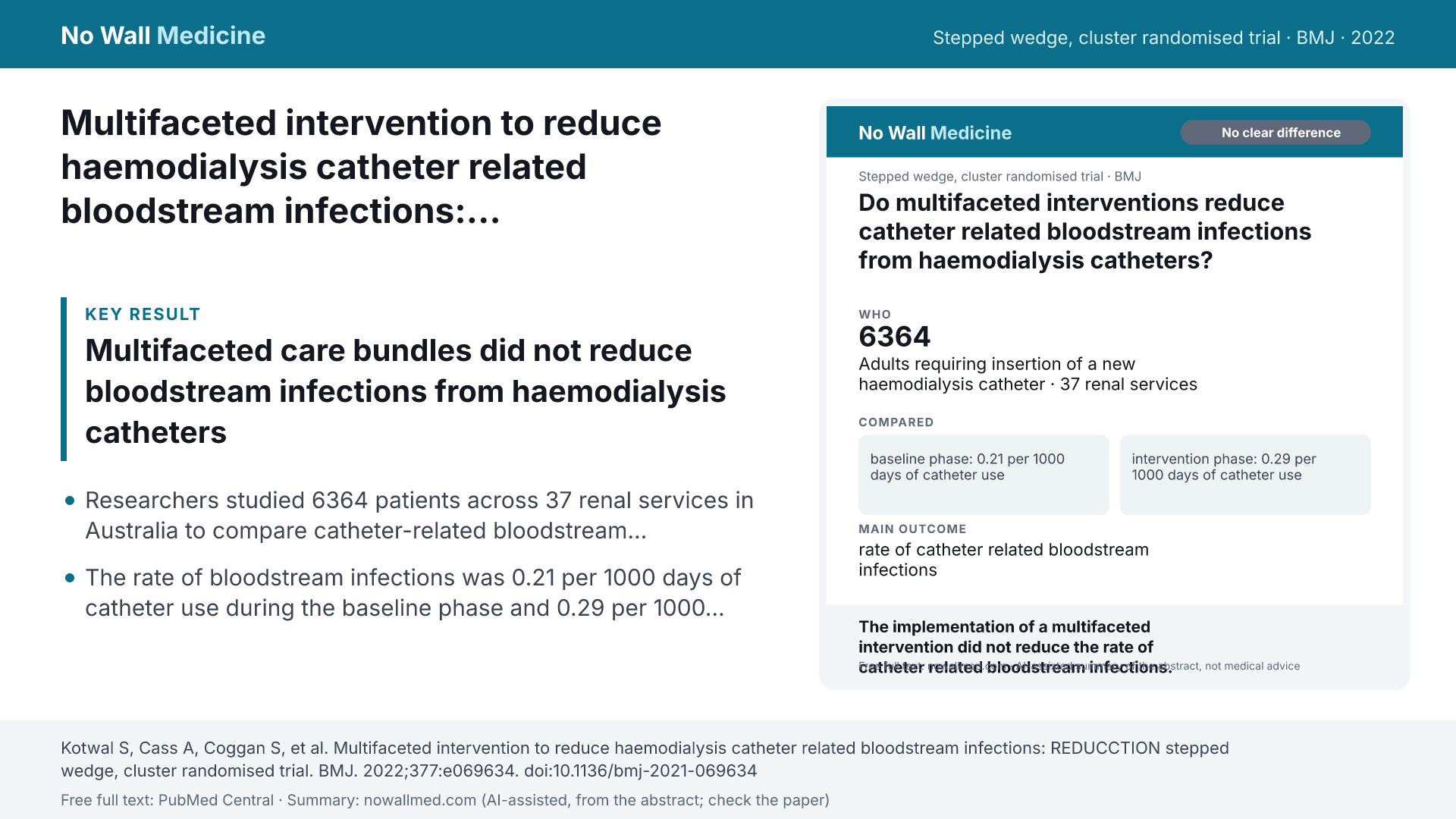
Multifaceted care bundles did not reduce bloodstream infections from haemodialysis catheters
Multifaceted intervention to reduce haemodialysis catheter related bloodstream infections: REDUCCTION stepped wedge, cluster randomised trial
Stepped wedge, cluster randomised trialNo clear difference
Do multifaceted interventions reduce catheter related bloodstream infections from haemodialysis catheters?
Who
6364
Adults requiring insertion of a new haemodialysis catheter · 37 renal services across Australia
Compared
baseline phase: 0.21 per 1000 days of catheter use
intervention phase: 0.29 per 1000 days of catheter use
Main outcome
rate of catheter related bloodstream infections
Result: incidence rate ratio 1.37 (95% confidence interval 0.85 to 2.21)
Bottom line: The implementation of a multifaceted intervention did not reduce the rate of catheter related bloodstream infections.
BMJ · 2022-04-12Download image
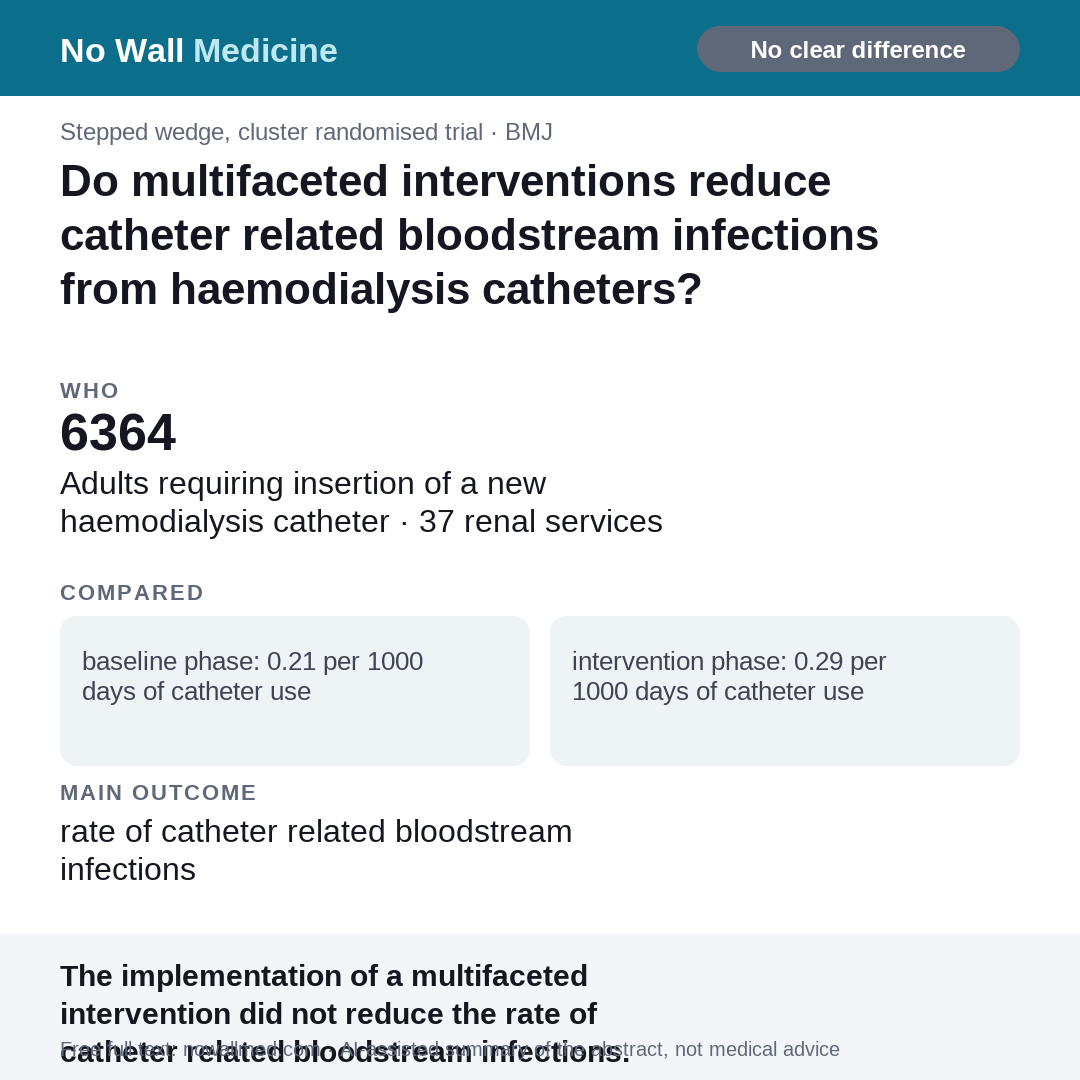
Clinical question: Do multifaceted interventions reduce catheter related bloodstream infections from haemodialysis catheters?
Why it matters: It is unknown if service-wide bundles of care for catheter insertion, maintenance, and removal are effective at reducing bloodstream infections in clinical practice.
Key points
- Researchers studied 6364 patients across 37 renal services in Australia to compare catheter-related bloodstream infections during a baseline phase and an intervention phase.
- The rate of bloodstream infections was 0.21 per 1000 days of catheter use during the baseline phase and 0.29 per 1000 days during the intervention phase.
- The intervention resulted in an incidence rate ratio of 1.37 (95% confidence interval 0.85 to 2.21; P=0.20), which was not statistically significant.
Headline and key points written with AI from the paper’s abstract, with every number checked against it. Read the paper before relying on them.
Was this summary helpful?
Abstract
Objective
To identify whether multifaceted interventions, or care bundles, reduce catheter related bloodstream infections (CRBSIs) from central venous catheters used for haemodialysis. Design
Stepped wedge, cluster randomised design. Setting
37 renal services across Australia. Participants
All adults (age ≥18 years) under the care of a renal service who required insertion of a new haemodialysis catheter. Interventions
After a baseline observational phase, a service-wide, multifaceted intervention bundle that included elements of catheter care (insertion, maintenance, and removal) was implemented at one of three randomly assigned time points (12 at the first time point, 12 at the second, and 13 at the third) between 20 December 2016 and 31 March 2020. Main outcomes measure
The primary endpoint was the rate of CRBSI in the baseline phase compared with intervention phase at the renal service level using the intention-to-treat principle. Results
1.14 million haemodialysis catheter days of use were monitored across 6364 patients. Patient characteristics were similar across baseline and intervention phases. 315 CRBSIs occurred (158 in the baseline phase and 157 in the intervention phase), with a rate of 0.21 per 1000 days of catheter use in the baseline phase and 0.29 per 1000 days in the intervention phase, giving an incidence rate ratio of 1.37 (95% confidence interval 0.85 to 2.21; P=0.20). This translates to one in 10 patients who undergo dialysis for a year with a catheter experiencing an episode of CRBSI. Conclusions
Among patients who require a haemodialysis catheter, the implementation of a multifaceted intervention did not reduce the rate of CRBSI. Multifaceted interventions to prevent CRBSI might not be effective in clinical practice settings. Trial registration
Australia New Zealand Clinical Trials Registry ACTRN12616000830493.
Abstract reproduced under the article’s CC BY licence.
Subject terms
Cite this article
Kotwal S, Cass A, Coggan S, et al. Multifaceted intervention to reduce haemodialysis catheter related bloodstream infections: REDUCCTION stepped wedge, cluster randomised trial. BMJ. 2022. doi:10.1136/bmj-2021-069634
Spotted a mistake? Suggest a correction