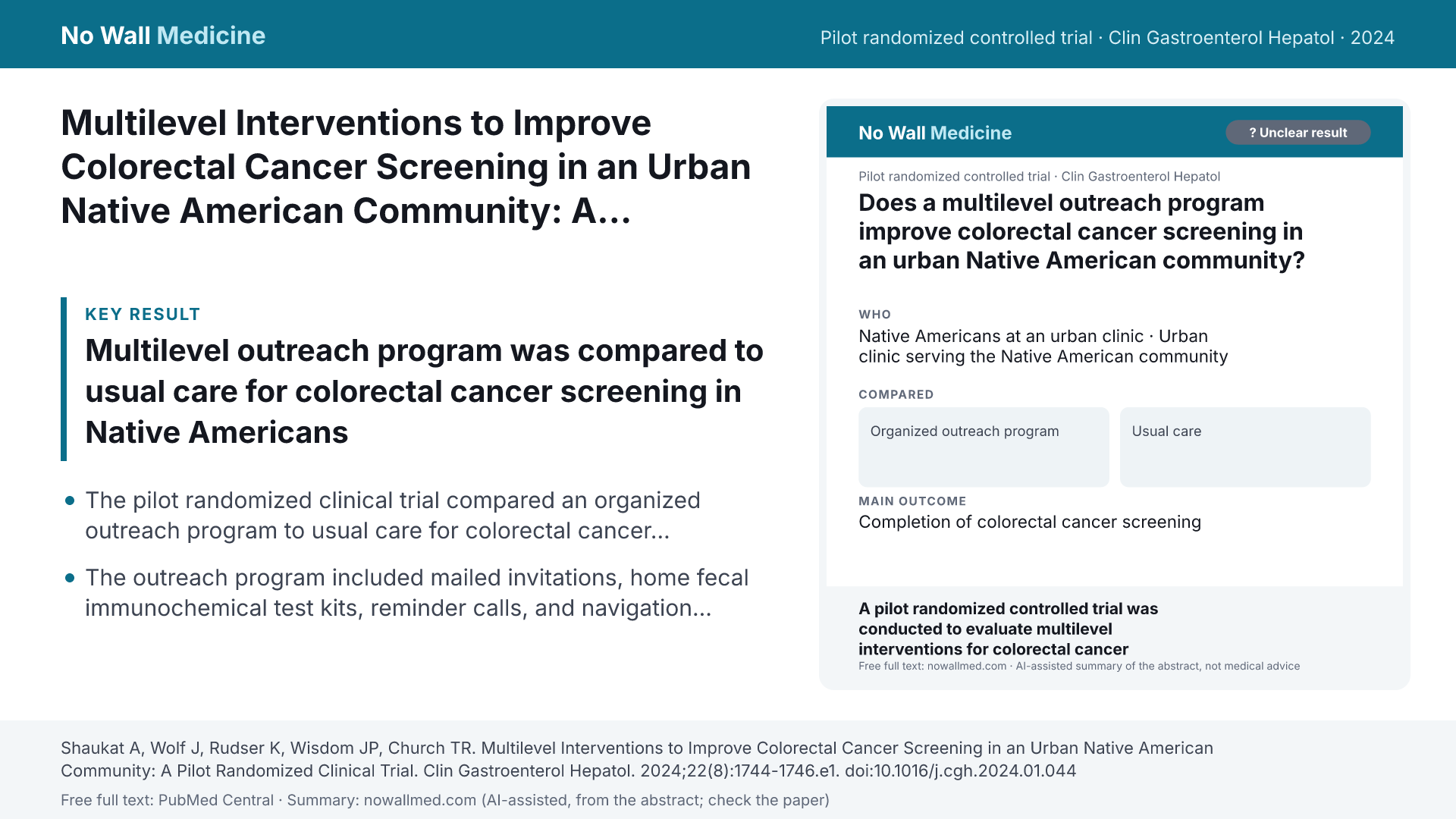
Multilevel outreach program was compared to usual care for colorectal cancer screening in Native Americans
Multilevel Interventions to Improve Colorectal Cancer Screening in an Urban Native American Community: A Pilot Randomized Clinical Trial
Pilot randomized controlled trialUnclear result
Does a multilevel outreach program improve colorectal cancer screening in an urban Native American community?
Who
Native Americans at an urban clinic · Urban clinic serving the Native American community
Compared
Organized outreach program
Usual care
Main outcome
Completion of colorectal cancer screening
Bottom line: A pilot randomized controlled trial was conducted to evaluate multilevel interventions for colorectal cancer screening in Native Americans.
Clin Gastroenterol Hepatol · 2024-02-15Download image
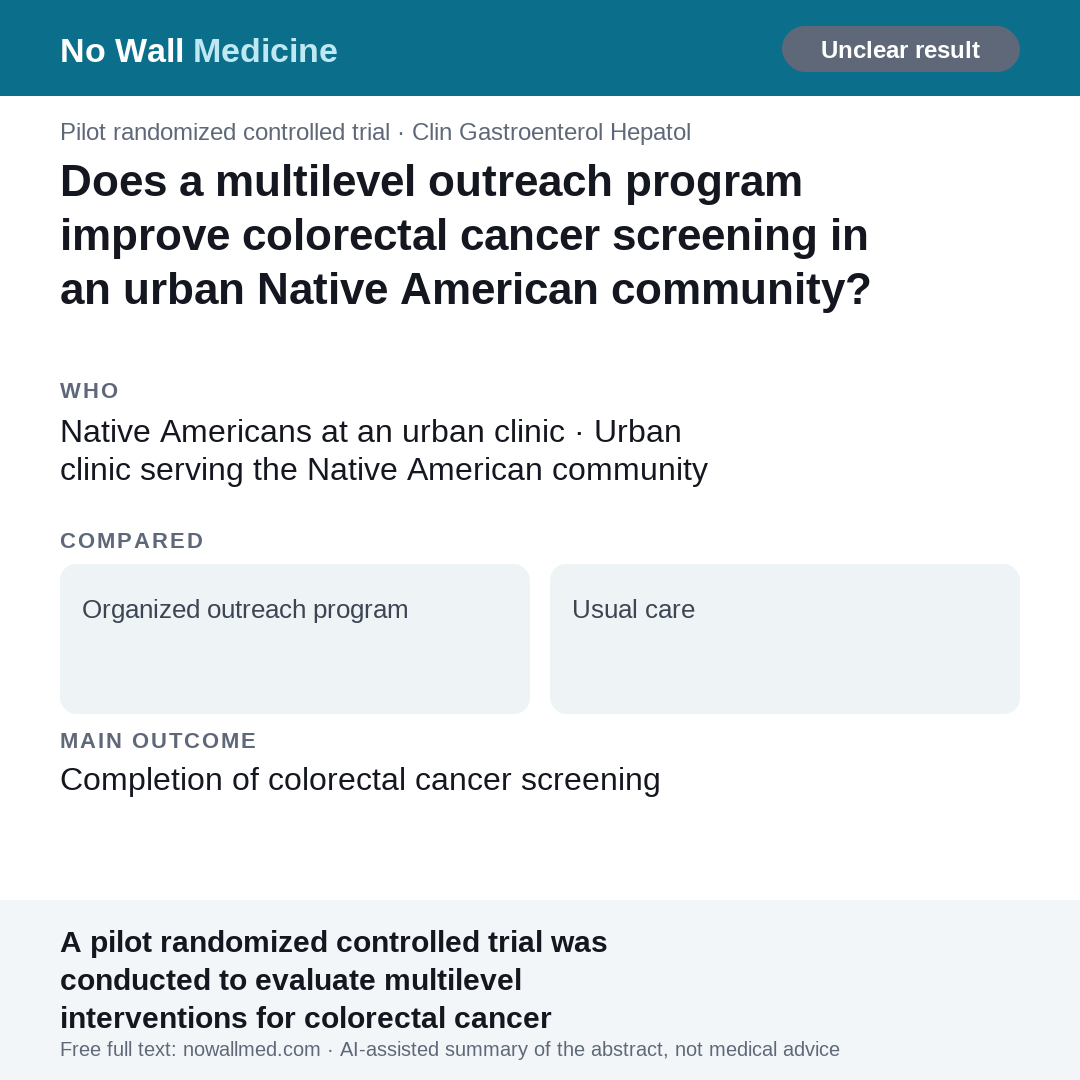
Clinical question: Does a multilevel outreach program improve colorectal cancer screening in an urban Native American community?
Why it matters: Native Americans have the highest burden of colorectal cancer and the lowest screening rates in the United States, with disparities increasing during the pandemic.
Key points
- The pilot randomized clinical trial compared an organized outreach program to usual care for colorectal cancer screening in an urban clinic serving the Native American community.
- The outreach program included mailed invitations, home fecal immunochemical test kits, reminder calls, and navigation to diagnostic colonoscopy.
Headline and key points written with AI from the paper’s abstract, with every number checked against it. Read the paper before relying on them.
Was this summary helpful?
Subject terms
Cite this article
Shaukat A, Wolf J, Rudser K, Wisdom JP, Church TR. Multilevel Interventions to Improve Colorectal Cancer Screening in an Urban Native American Community: A Pilot Randomized Clinical Trial. Clin Gastroenterol Hepatol. 2024. doi:10.1016/j.cgh.2024.01.044
Spotted a mistake? Suggest a correction