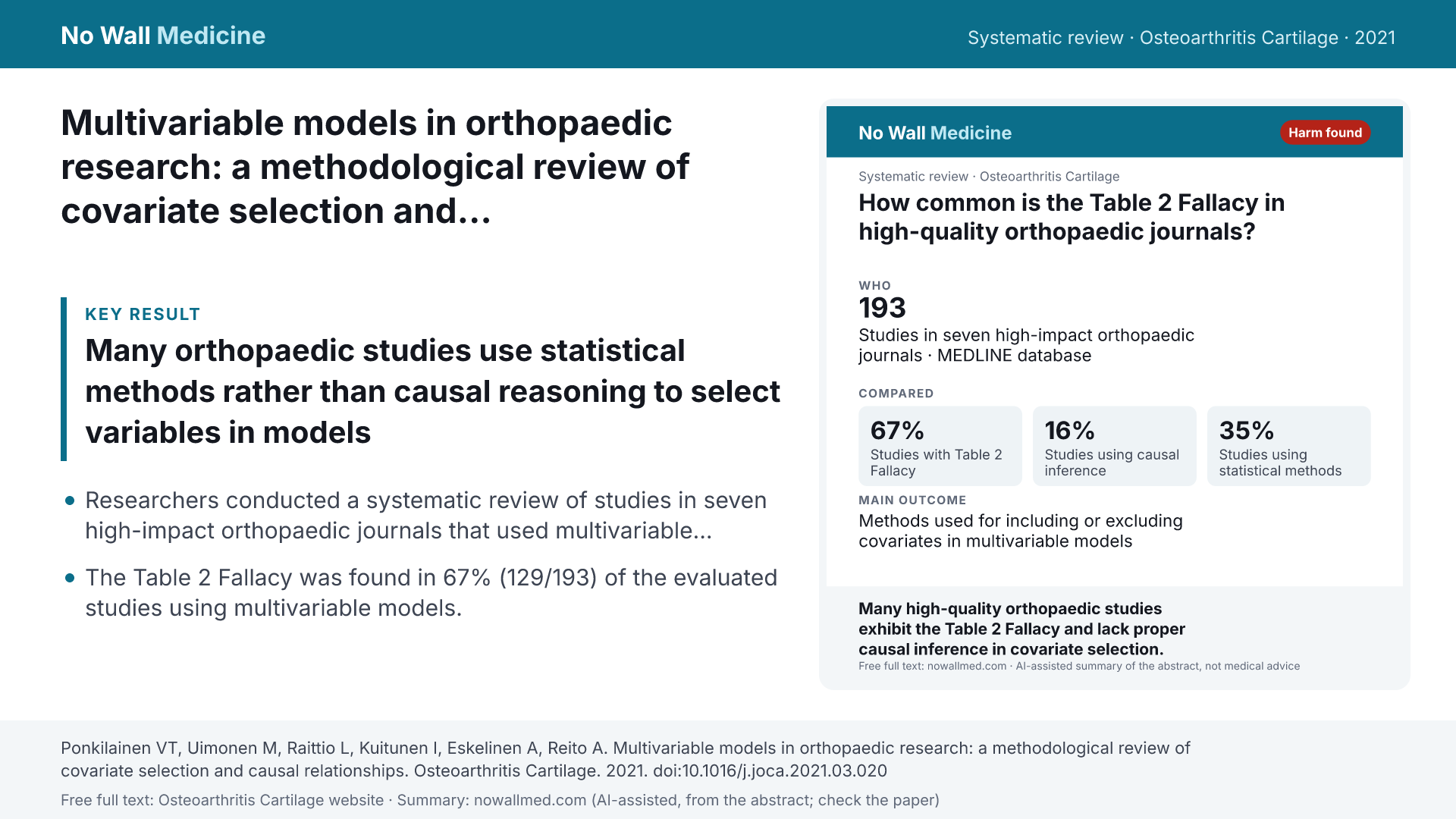
Many orthopaedic studies use statistical methods rather than causal reasoning to select variables in models
Multivariable models in orthopaedic research: a methodological review of covariate selection and causal relationships
Systematic reviewHarm found
How common is the Table 2 Fallacy in high-quality orthopaedic journals?
Who
193
Studies in seven high-impact orthopaedic journals · MEDLINE database
Compared
67%Studies with Table 2 Fallacy (129/193)
16%Studies using causal inference (31/193)
35%Studies using statistical methods (67/193)
Main outcome
Methods used for including or excluding covariates in multivariable models
Bottom line: Many high-quality orthopaedic studies exhibit the Table 2 Fallacy and lack proper causal inference in covariate selection.
Osteoarthritis Cartilage · 2021-04-29 · Save PNG
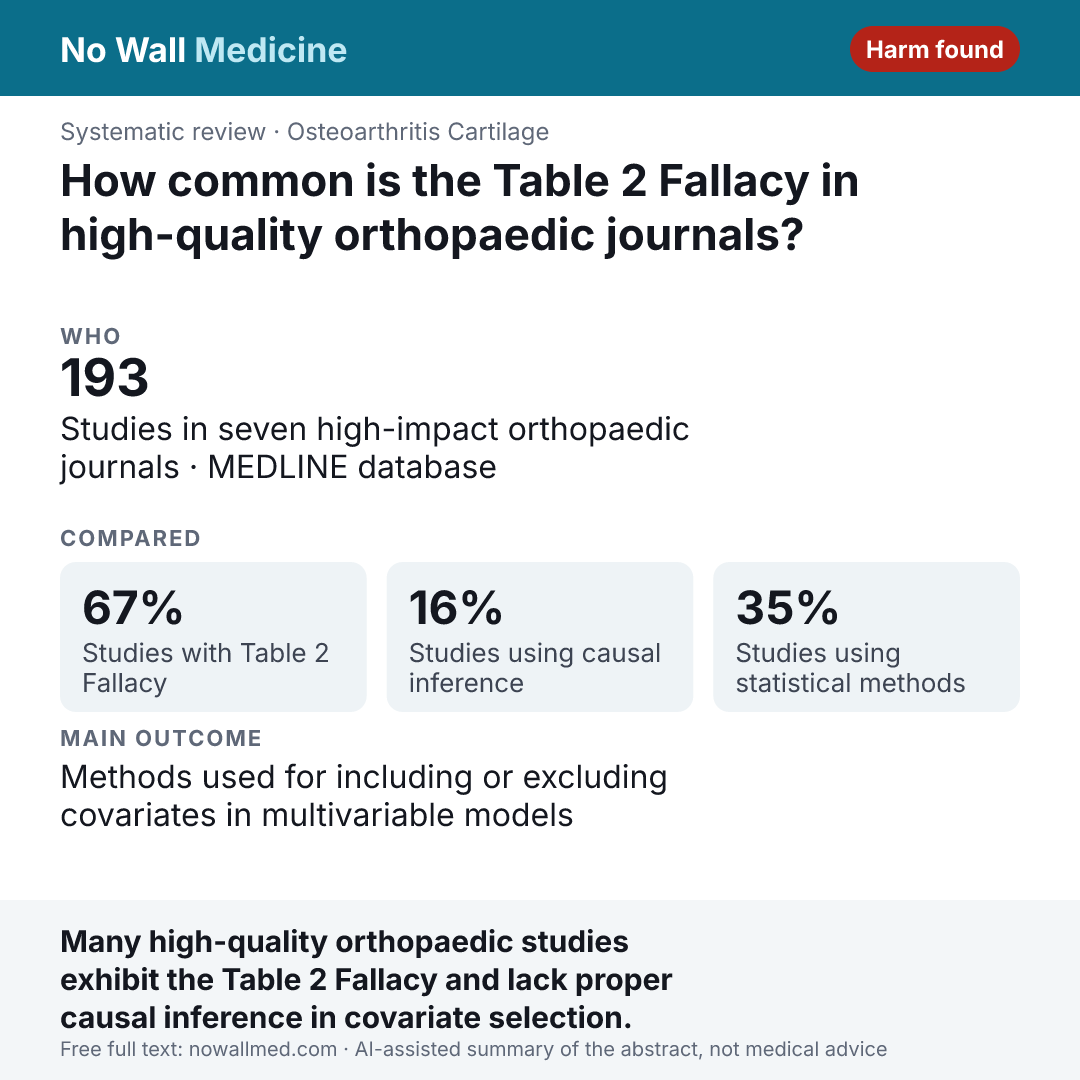
Clinical question: How common is the Table 2 Fallacy in high-quality orthopaedic journals?
Key points
- Researchers conducted a systematic review of studies in seven high-impact orthopaedic journals that used multivariable models to analyze data.
- The Table 2 Fallacy was found in 67% (129/193) of the evaluated studies using multivariable models.
- Only 16% (31/193) of studies included variables based on causal inference, and only three used causal diagrams.
Headline and key points written with AI from the paper’s abstract, with every number checked against it. Read the paper before relying on them.
Was this summary helpful?
Subject terms
Headline, design, result, key points, caveat and citation as plain text.
Cite this article
Ponkilainen VT, Uimonen M, Raittio L, Kuitunen I, Eskelinen A, Reito A. Multivariable models in orthopaedic research: a methodological review of covariate selection and causal relationships. Osteoarthritis Cartilage. 2021. doi:10.1016/j.joca.2021.03.020
Spotted a mistake? Suggest a correction