Multivariable models in orthopaedic research: a methodological review of covariate selection and causal relationships
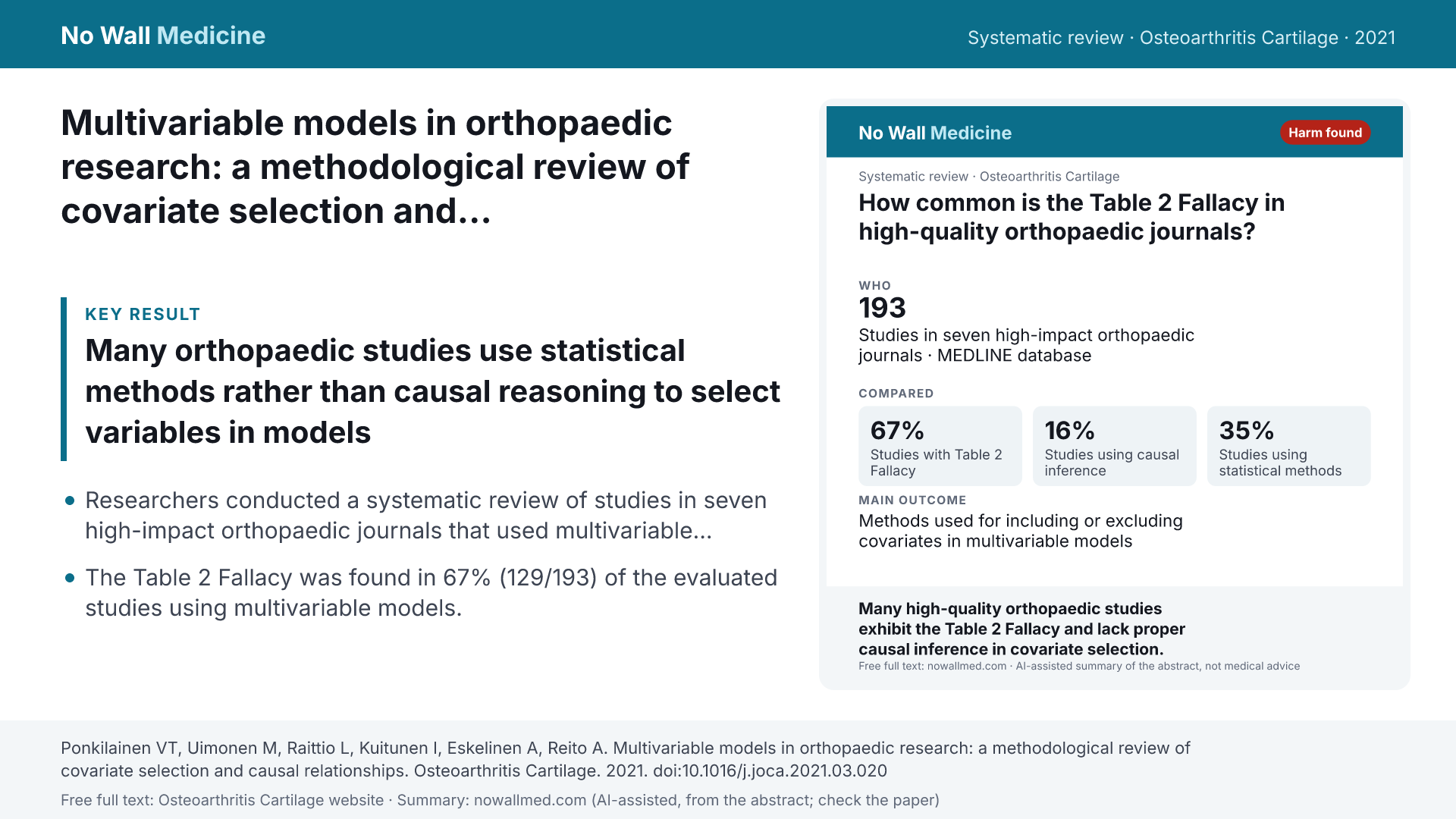
Key result: Many orthopaedic studies use statistical methods rather than causal reasoning to select variables in models
Systematic reviewHarm found
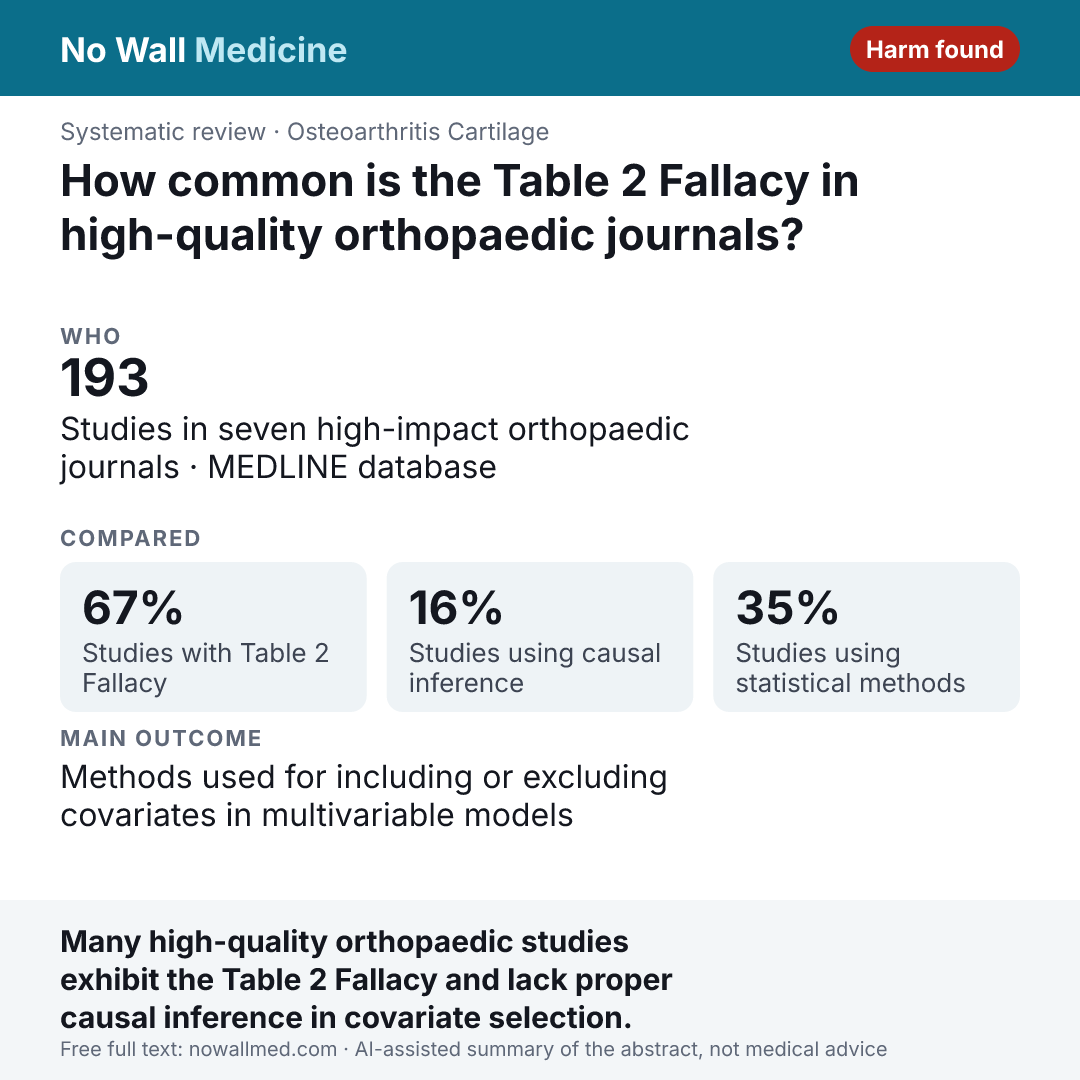
How common is the Table 2 Fallacy in high-quality orthopaedic journals?
Who
193
Studies in seven high-impact orthopaedic journals · MEDLINE database
Compared
67%Studies with Table 2 Fallacy (129/193)
16%Studies using causal inference (31/193)
35%Studies using statistical methods (67/193)
Main outcome
Methods used for including or excluding covariates in multivariable models
Bottom line: Many high-quality orthopaedic studies exhibit the Table 2 Fallacy and lack proper causal inference in covariate selection.
Osteoarthritis Cartilage · 2021-04-29 · Save PNG
Key points
- Researchers conducted a systematic review of studies in seven high-impact orthopaedic journals that used multivariable models to analyze data.
- The Table 2 Fallacy was found in 67% (129/193) of the evaluated studies using multivariable models.
- Only 16% (31/193) of studies included variables based on causal inference, and only three used causal diagrams.
Discussion prompts
- Would these patients look like yours? Who was left out?
- Is the main outcome one that matters to patients?
- Is the difference large enough to change what you do?
Cite: Ponkilainen VT, Uimonen M, Raittio L, Kuitunen I, Eskelinen A, Reito A. Multivariable models in orthopaedic research: a methodological review of covariate selection and causal relationships. Osteoarthritis Cartilage. 2021. doi:10.1016/j.joca.2021.03.020
Free full text: Osteoarthritis Cartilage website · Summary and visual abstract: nowallmed.com/a/multivariable-models-in-orthopaedic-research-a-methodological-review-10xrlci/ (AI-assisted from the abstract; check the paper before relying on it).